
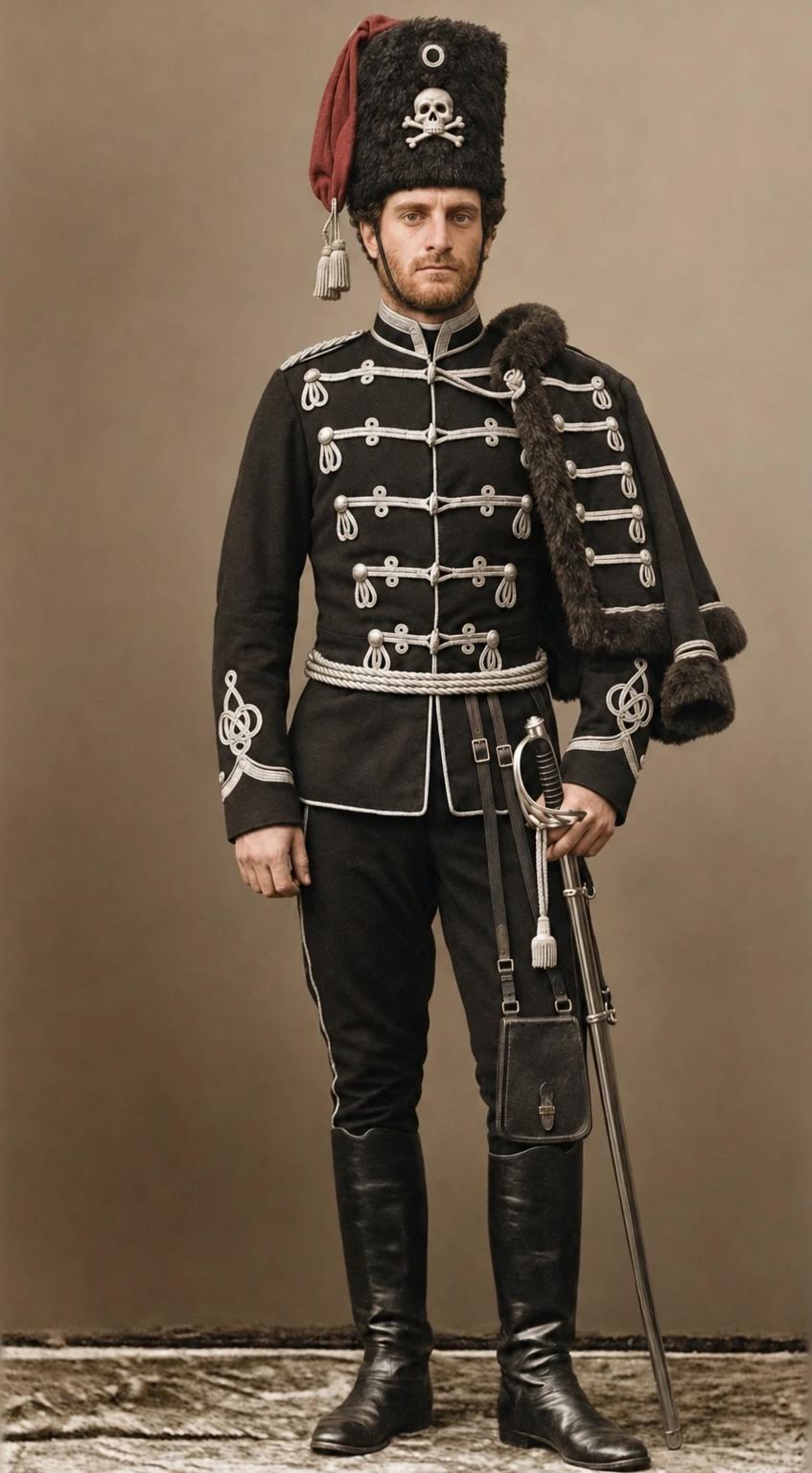
Uniform and equipment
| Uniform | Black dolman and pelisse with white braiding |
|---|---|
| Dress uniform | Black hussar kit with full pelisse, silver cords, skull-and-crossbones |
| Headgear | Black fur busby with skull-and-crossbones front plate |
| Equipment | Curved sabre, pistols, carbine |
| Insignia and standard | Large Totenkopf plate on fur busby |
Service record
| First appeared | 1741 |
|---|---|
| Peak strength | ~2,000 men |
| Recruited from | Volunteers / Aristocracy |
| Primary tactic | Shock / Pursuit |
| Signature engagement | Battle of Heilsberg (1807) |
| Motto or battle cry | Vincere aut mori (Conquer or die) |
| Obsolescence | Machine Guns / Trench Warfare |
Timeline
- 1741: Formation of Ruesch Hussars. Frederick the Great establishes the 5th Hussar Regiment (Black Hussars), the spiritual ancestors who adopted the skull insignia.
- 1808: Reorganization. Following the disasters of 1806, the unit is split into the 1st and 2nd Leib-Husaren Regiments, becoming the Life Guard hussars of Prussia.
- 1813: War of Liberation. The regiments spearhead the campaign to drive Napoleon out of Germany, earning a reputation for merciless pursuit.
- 1870: Franco-Prussian War. Participated in the great cavalry clashes at Mars-la-Tour, proving the relevance of the hussar in modern warfare.
- 1919: Disbandment. After serving on both fronts in WWI, the Imperial regiments were dissolved, though their traditions were absorbed by the Reichswehr.
Battles
Battle of Heilsberg
The regiment's defining moment of grit. Amidst a collapsing front, the Black Hussars launched repeated, desperate charges against Murat's French cavalry and artillery. Though costly, their ferocity stabilized the Prussian line and cemented their reputation as men who courted death.
Battle of Leipzig
In the 'Battle of Nations', the Leib-Husaren unleashed their fury against the crumbling French flanks. Acting as the tip of the spear for the Army of Silesia, they executed a brutal pursuit that turned a retreat into a rout, cutting down fleeing infantry for miles.
Battle of Waterloo
Arriving with Blücher's flank attack, the hussars plunged into the chaos of Plancenoit. In the fading light, their black uniforms and silver skulls were the last thing many of the Old Guard saw as the Prussians shattered Napoleon's final hope.
Commanders
Gebhard Leberecht von Blücher
Known as 'Marschall Vorwärts' for his aggressive posture, Blücher embodied the hussar spirit: reckless bravery, unyielding energy, and a hatred for retreat. He wore the uniform of the Black Hussars early in his career and carried their ferocious ethos until he crushed Napoleon at Waterloo.
August von Mackensen
Though a commander of armies in a later era, Mackensen is the iconic image of the Death's Head Hussar. Rising from the regiment to Field Marshal, he wore the distinctive black uniform and Totenkopf busby throughout WWI, symbolizing the grim, elite tradition of the Prussian cavalry.
Tactics
The Shock Charge
A disciplined, knee-to-knee gallop designed to break enemy infantry squares through sheer psychological terror and kinetic impact.
Relentless Pursuit
Once an enemy line broke, the hussars were unleashed to hunt down fleeing troops, preventing them from rallying and turning defeat into total destruction.
Kleinkrieg (Little War)
Traditional light cavalry duties including scouting, screening the main army, and raiding enemy supply lines to sow confusion.