
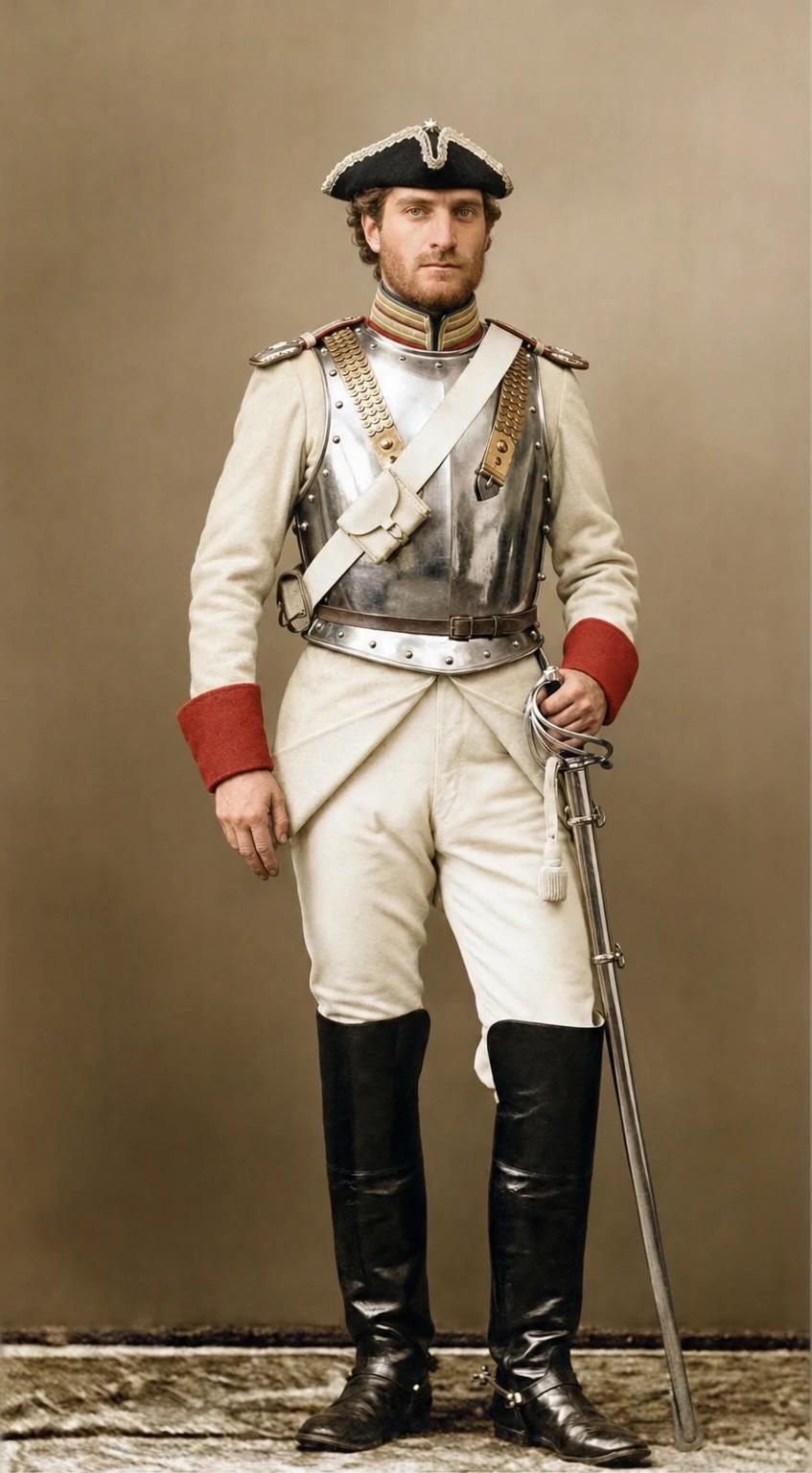
Uniform and equipment
| Uniform | White coat, red facings, steel cuirass |
|---|---|
| Dress uniform | White with silver lace, polished cuirass, supraveste |
| Headgear | Black tricorne with silver lace |
| Equipment | Pallasch, cuirass, pistols |
| Insignia and standard | Star of the Black Eagle |
Service record
| First appeared | 1740 |
|---|---|
| Peak strength | 800 men |
| Recruited from | Prussian aristocracy; elite physical selection |
| Primary tactic | Heavy cavalry shock charge |
| Signature engagement | Battle of Rossbach (1757) |
| Motto or battle cry | Pro Gloria et Patria (For Glory and Fatherland) |
| Obsolescence | Machine guns and modern firepower |
Timeline
- 1740: Formation. Established by King Frederick II (the Great) shortly after his accession, formed from the elite Regiment No. 13.
- 1745: Battle of Hohenfriedberg. Early display of shock tactics; the Prussian cavalry begins to eclipse the infantry in offensive capability.
- 1757: Legend of Rossbach. The Garde du Corps achieves immortality by routing the French army, becoming the premier heavy cavalry of Europe.
- 1806: Collapse at Jena-Auerstedt. The unit is decimated and effectively destroyed as the old Prussian military system collapses under Napoleon's advance.
- 1813: Reformation. Reconstituted for the War of Liberation, adopting new uniforms and modernized tactics.
- 1918: Disbandment. Following the fall of the German Empire and the abdication of the Kaiser, the royal bodyguard is permanently dissolved.
Battles
Battle of Rossbach
The unit's defining hour. Hidden behind the Janus Hill, the Garde du Corps launched a surprise thunderbolt against the French flank. The charge was so sudden and violent that the enemy army evaporated in under 90 minutes, cementing the legend of Prussian invincibility.
Battle of Zorndorf
A brutal, bloody grinder against the Russians. When the Prussian infantry collapsed, the Garde du Corps charged into the chaotic melee, fighting hand-to-hand in dust and smoke to prevent total annihilation. They saved the King's army at a terrible cost in men and horses.
Battle of Leipzig
During the War of Liberation, the reformed Garde du Corps proved they had recovered from the humiliation of 1806. They executed decisive charges against Napoleonic forces in the 'Battle of Nations', helping to break French hegemony over Europe.
Commanders
Friedrich Wilhelm von Seydlitz
The archetypal hussar turned heavy cavalry genius. Notorious for his daredevil riding and iron discipline, he transformed the Prussian cavalry into a precision weapon. At Rossbach, he refused the King's order to charge until the trap was set, famously stating his head belonged to the King only after the battle.
Frederick the Great
King of Prussia and the unit's Colonel-in-Chief. While a strategist of the highest order, he personally led the Garde du Corps on marches and relied on them as his final reserve of shock power. He demanded they be the 'noblest men' in the army, serving as the ultimate shield of the monarchy.
Tactics
The Knee-to-Knee Charge
Riders rode so close their knees locked with their neighbors, creating a solid wall of horse and steel that smashed through enemy formations by sheer kinetic mass.
Attack in Echelon
Squadrons attacked in a staggered diagonal formation, allowing the unit to hit the enemy flank successively while holding a reserve to exploit the breakthrough.
Cold Steel Discipline
Firing during a charge was strictly forbidden. The unit relied entirely on the shock of the sword and the horse, advancing in silence until the final trumpet call.