
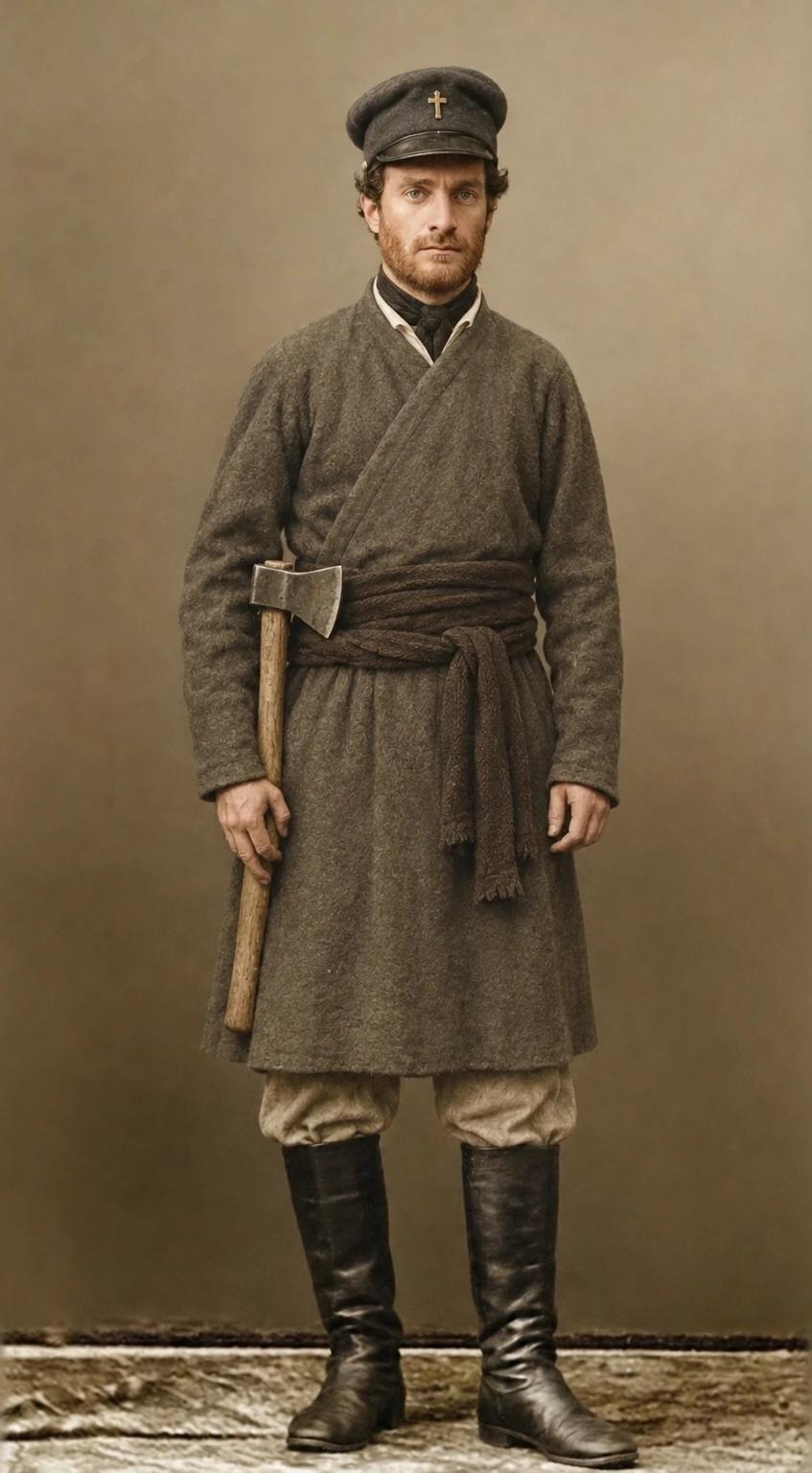
Uniform and equipment
| Uniform | Peasant caftan, cross on cap, beard |
|---|---|
| Dress uniform | N/A |
| Headgear | Peasant cap with brass cross |
| Equipment | Pike, axe, old musket |
| Insignia and standard | Brass cross on peasant cap |
Service record
| First appeared | 1812 |
|---|---|
| Peak strength | Hundreds of thousands |
| Recruited from | Serf Levy |
| Primary tactic | Mass Human Wave / Work Parties |
| Signature engagement | Battle of Borodino (1812) |
| Motto or battle cry | Za Veru i Tsarya (For Faith and Tsar) |
| Obsolescence | Demobilized after war |
Timeline
- 1806: Initial Militia Call. Tsar Alexander I issues the first call for a mass militia to counter Napoleon's rise, setting the precedent for 1812.
- 1812: The Great Manifesto. Following the French invasion, the Tsar issues a manifesto calling for the defense of the Fatherland; nobility and peasantry mobilize.
- 1812: Formation of the Moscow Opolchenie. Over 30,000 volunteers gather in Moscow, armed with pikes and blessed by the church, ready to die for the ancient capital.
- 1812: Borodino Earthworks. Militia units dig the massive Raevsky Redoubt and Bagration Flèches, working under fire to prepare the battlefield.
- 1813: Foreign Campaign. Surviving Opolchenie units cross the border, primarily used for sieges (Danzig, Modlin) to free up regular troops for maneuver warfare.
- 1814: Disbandment. With Paris taken and the war won, the militia is disbanded; peasants return to serfdom, carrying their scars and medals.
Battles
Battle of Maloyaroslavets
A chaotic urban brawl where Opolchenie units fought alongside regulars. Amidst burning ruins, the militia used axes and pikes in brutal close-quarters combat, forcing Napoleon to abandon his march toward the fertile south and retreat via the devastated Smolensk road.
Battle of Borodino
While the regulars held the center, the Opolchenie stood stoically under withering artillery fire in reserve and constructed the vital field fortifications. Thousands died without firing a shot, their bodies forming a human wall to protect the sacred soil of Mother Russia.
Battle of Polotsk
The St. Petersburg Opolchenie proved their mettle in a vicious offensive. Despite lacking training, they charged French positions with such ferocity that they were instrumental in retaking the city, securing the northern flank of the Russian retreat.
Commanders
Count Fyodor Rostopchin
The Governor-General of Moscow who orchestrated the raising of the Moscow militia. A fiery patriot, he armed the peasantry with pikes and axes from the arsenal when muskets ran short, famously inciting a scorched-earth policy that denied Napoleon his prize.
Prince Mikhail Kutuzov
The one-eyed savior of Russia who understood that the Opolchenie were the spiritual backbone of the defense. He utilized these untrained masses to bolster the line and construct the earthworks that bled the Grande Armée dry, valuing their stoic endurance over drill precision.
Tactics
Combat Engineering
The primary utility of the Opolchenie; rapidly constructing redoubts, trenches, and abatis to channel enemy attacks, often continuing to dig while under direct artillery bombardment.
Human Wave Defense
Lacking the drill to form squares, militia units relied on dense columns and sheer mass to absorb cavalry charges, using pikes to create a thicket of steel that horses refused to charge.
Forest Swarming
Utilizing their knowledge of the terrain, small bands would ambush foraging parties in the woods, using axes and silence to eliminate isolated French patrols.