
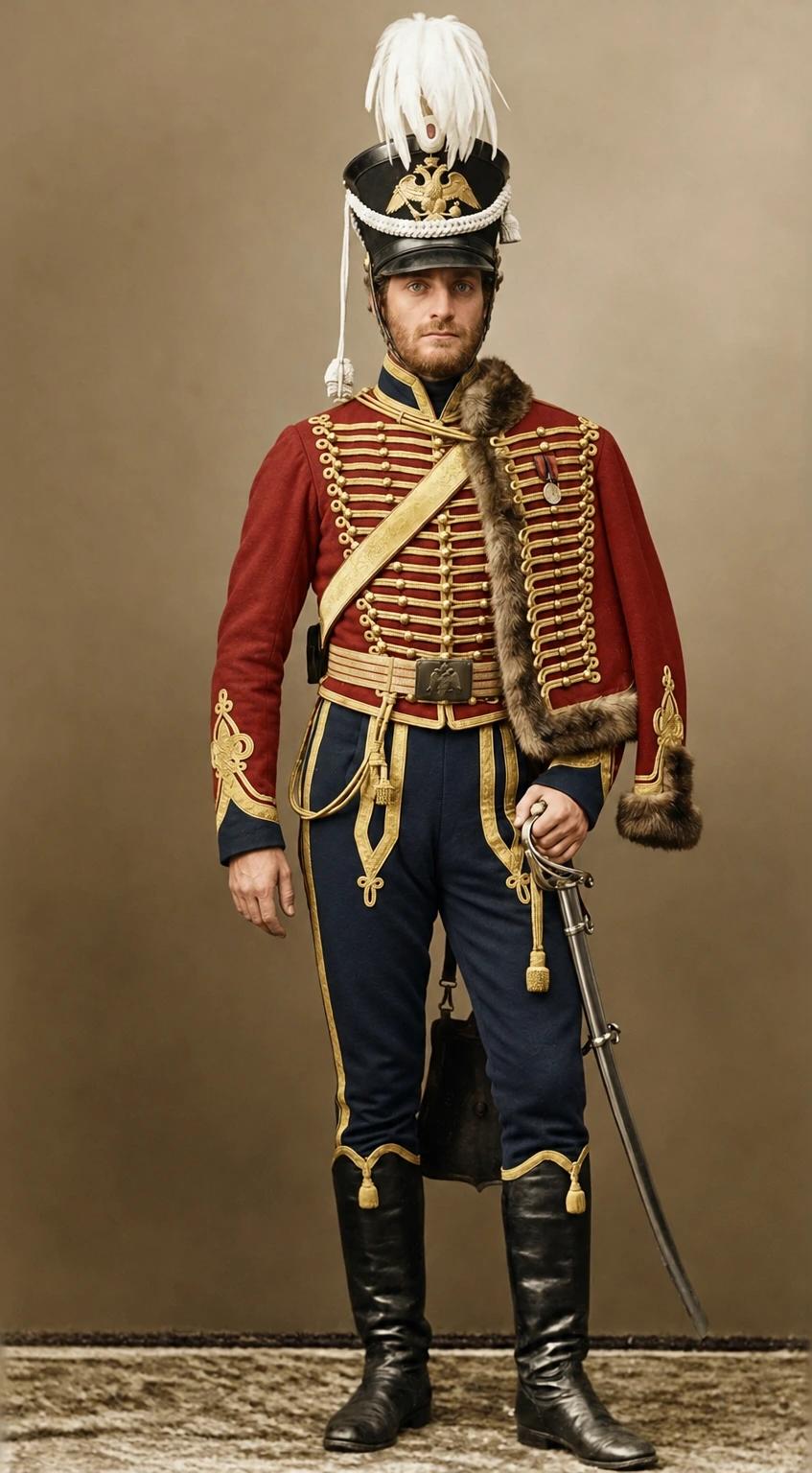
Uniform and equipment
| Uniform | Red dolman with yellow frogging (gold for officers) |
|---|---|
| Dress uniform | Full hussar kit with pelisse on shoulder, decorated sabretache |
| Headgear | Black hussar shako (kiwer) with white cords and plume |
| Equipment | Curved sabre, pistols, carbine |
| Insignia and standard | Imperial eagle plate on sabretache |
Service record
| First appeared | 1796 |
|---|---|
| Peak strength | ~1,500 men |
| Recruited from | High Nobility |
| Primary tactic | Light Cavalry Shock |
| Signature engagement | Battle of Leipzig (1813) |
| Motto or battle cry | Za Veru i Vernost (For Faith and Fidelity) |
| Obsolescence | Russian Revolution (1917) |
Timeline
- 1775: Formation. Established as the Life-Guard Hussar Squadron by Empress Catherine the Great to serve as an elite personal escort.
- 1798: Regimental Expansion. Paul I expands the squadron into the Life-Guard Hussar Regiment, granting them full Guard privileges.
- 1805: Baptism of Fire. The regiment suffers heavy losses but earns a reputation for fanatical bravery at the Battle of Austerlitz.
- 1812: Patriotic War. The unit fights a grueling defensive campaign against Napoleon, distinguishing itself at Borodino and the Berezina.
- 1813: Charge at Leipzig. The regiment executes a legendary counter-charge against French heavy cavalry, saving the Allied monarchs.
- 1831: Polish Campaign. Deployed to suppress the November Uprising, participating in the storming of Warsaw.
- 1877: Balkan Campaign. The regiment modernizes and deploys to Bulgaria to fight the Ottoman Empire.
- 1918: Disbandment. Following the Bolshevik Revolution and the collapse of the Imperial Army, the regiment is formally dissolved.
Battles
Battle of Austerlitz
In their baptism of fire, the Guard Hussars charged blindly into the fog against seasoned French cavalry. Despite suffering horrific casualties and losing their standard, their reckless bravery bought crucial time for the chaotic Russian retreat.
Battle of Borodino
Stationed on the right flank, the Hussars engaged in a brutal, swirling melee near the Kolocha River. They repeatedly counter-charged French light cavalry, preventing the envelopment of the Russian line amidst a storm of artillery fire.
Battle of Leipzig
The regiment's finest hour. Seeing the Tsar threatened by Murat's heavy cavalry, the Hussars launched a suicidal, glorious charge. They smashed into the French cuirassiers, shattering the assault and turning the tide of the 'Battle of Nations'.
Battle of Telish
During the Russo-Turkish War, the regiment proved that the age of the sword was not over. They executed a textbook pursuit of Ottoman forces, cutting down fleeing infantry and capturing vital defensive works.
Commanders
Grand Duke Nicholas Nikolaevich (The Elder)
A towering Romanov figure who commanded the regiment with aristocratic fervor. He later led the Russian armies in the Russo-Turkish War, embodying the transition from dashing hussar officer to strategic commander, though his heart remained with the charge.
Major General Ivan Shevich
The quintessential hussar commander—fearless and reckless. He led the regiment during the desperate campaigns of 1813. At Leipzig, he led a decisive counter-charge against French heavy cavalry, falling in battle moments before his men broke the enemy line.
Prince Ilarion Vasilchikov
A commander of steel nerves who led the regiment during the 1812 invasion. He masterminded the rearguard actions that saved the army during the retreat to Moscow and unleashed the regiment's fury during the subsequent pursuit of the Grande Armée.
Tactics
The Shock Charge
A rapid acceleration from a trot to a full gallop, designed to break enemy formations through sheer kinetic energy and psychological terror before steel even met flesh.
Wolf Pack Skirmishing
Using their carbines and superior mobility to harass enemy flanks and supply lines, bleeding the enemy dry before the main battle.
Pursuit à outrance
The relentless chasing down of a broken enemy, ensuring a retreat turned into a rout by cutting down disorganized fugitives.