
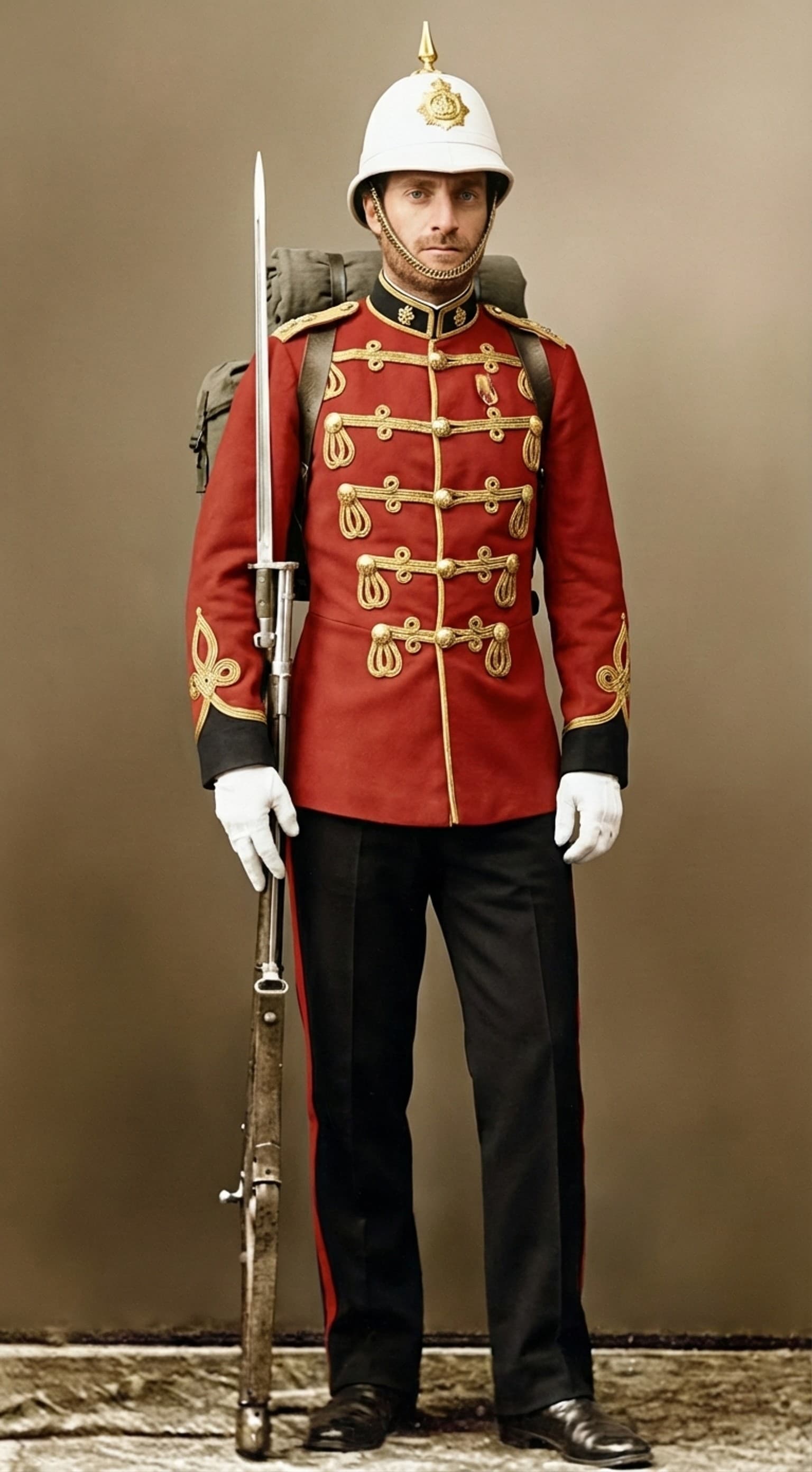
Uniform and equipment
| Uniform | White tunic, dark trousers, colored sash; officers with additional braid |
|---|---|
| Dress uniform | White tunic with gold buttons and epaulettes, bright sash in national colors |
| Headgear | High bearskin-style hat with colored plume for full dress |
| Equipment | Rifles, bayonets, officers with swords |
| Insignia and standard | Rajawalit/ Garuda or royal cypher |
Service record
| First appeared | 1850s |
|---|---|
| Peak strength | Several thousand men |
| Recruited from | Royal Conscription / Volunteers |
| Primary tactic | European Drill / Ceremonial |
| Signature engagement | Franco-Siamese War (1893) |
| Motto or battle cry | For Nation, Religion, Monarchy |
| Obsolescence | N/A (Ceremonial Role) |
Timeline
- 1859: Formation. King Chulalongkorn establishes the 'Royal Guards' from the pages of the Royal Bodyguard, initially as a personal protection force.
- 1868: Modernization. Following his coronation, Rama V mandates European drill and organization, moving away from traditional feudal levies.
- 1893: The Franco-Siamese War. The unit sees major combat action defending the capital against French naval aggression.
- 1902: Internal Security Operations. Deployment to the north to suppress the Shan Rebellion, cementing the central government's power.
- 1911: Wild Tiger Corps Integration. King Vajiravudh (Rama VI) establishes the Wild Tiger Corps, influencing the drill and ethos of the Guards.
Battles
Suppression of the Haw Wars
A grueling series of campaigns against Chinese flag bandits. The King's Guard proved their mettle outside the palace, enduring disease and guerilla ambushes to secure the northern borders of the Kingdom.
The Paknam Incident
The Guard's defining trial by fire. Siamese forces engaged French gunboats attempting to force the river passage. Despite being outgunned, the infantry and artillery displayed stoic bravery under heavy bombardment, proving their modernization was not merely ceremonial.
Shan Rebellion
When Shan rebels seized provincial towns, the Royal Army, spearheaded by modern infantry units, executed a rapid counter-offensive, crushing the uprising and restoring royal authority in the north.
Commanders
Chaophraya Surasakmontri
A field marshal of iron will, he led modern Siamese forces, including Guard elements, into the treacherous northern highlands to suppress the Haw bandits. Known for his logistical brilliance and ruthless efficiency in jungle warfare.
King Chulalongkorn (Rama V)
The visionary monarch who founded the Royal Guards. He modernized the Siamese military to European standards, using the King's Guard as the model unit to deter colonial aggression and preserve Siamese sovereignty through discipline and diplomacy.
Tactics
European Close Order Drill
Rigid formation movements designed to maximize volley fire density and maintain morale under artillery fire.
Riverine Fortification Defense
Integrating infantry rifle fire with coastal artillery batteries to create kill zones at river mouths.
Jungle Counter-Insurgency
Adapting conventional lines to rough terrain to hunt down irregular bandit forces in the northern highlands.