
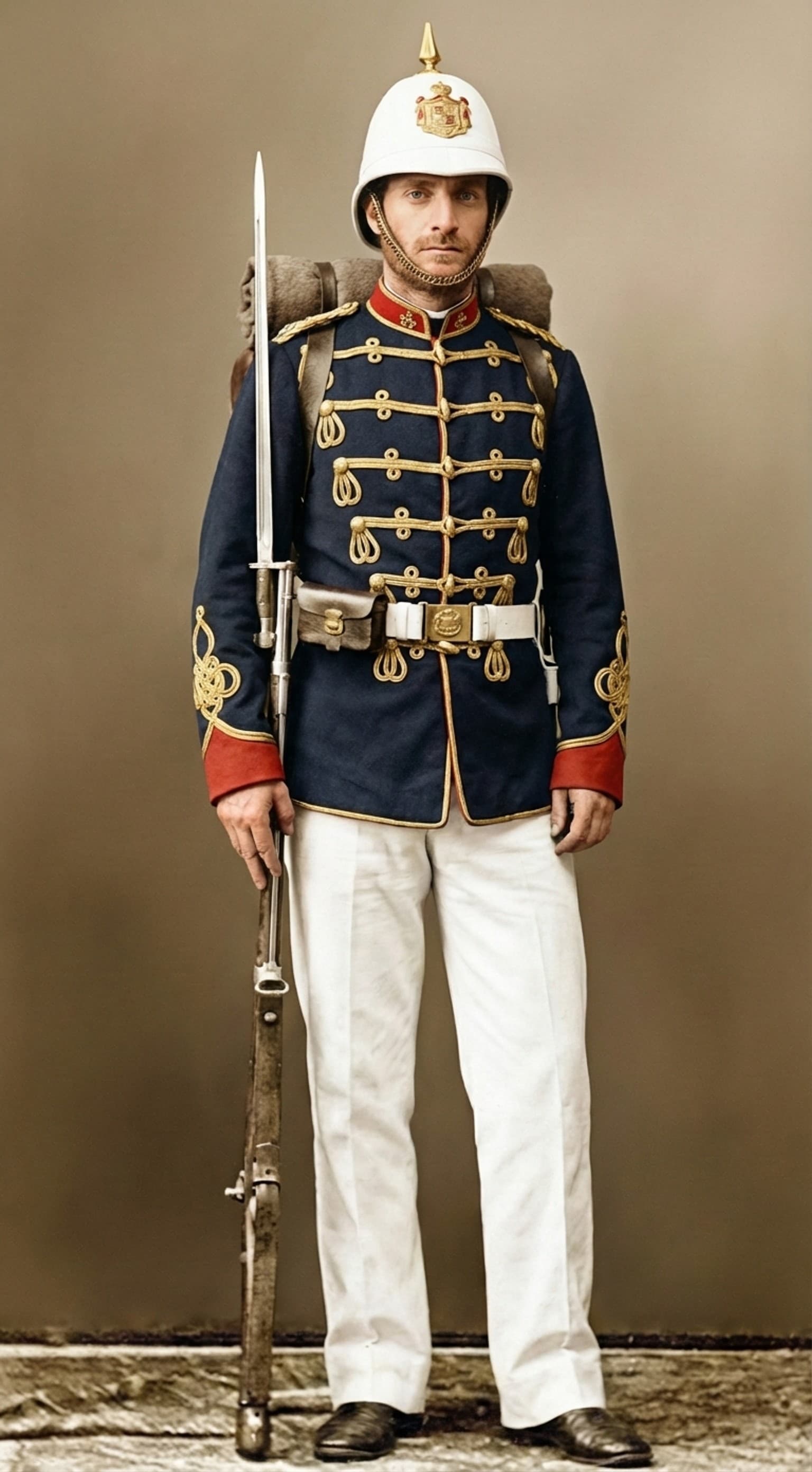
Uniform and equipment
| Uniform | Dark blue or red tunic, white trousers, black belts |
|---|---|
| Dress uniform | Bright red tunic with yellow facings echoing Hawaiian colors, white trousers |
| Headgear | Shako or later spiked helmet, sometimes adorned with feathered crest |
| Equipment | Rifle, bayonet, ceremonial sword for NCOs |
| Insignia and standard | Helmet plate with Hawaiian crown and crossed kahilis |
Service record
| First appeared | 1850s |
|---|---|
| Peak strength | ~600 men |
| Recruited from | Native Hawaiian Volunteers |
| Primary tactic | European Drill |
| Signature engagement | Wilcox Rebellion (1889) |
| Motto or battle cry | Onipa'a (Steadfast) |
| Obsolescence | Overthrow of Monarchy (1893) |
Timeline
- 1871: Construction of Iolani Barracks. Coral block fortress completed to house the Royal Guard, serving as the military heart of the Kingdom.
- 1881: Kalākaua's World Tour. The King visits Europe, returning with Prussian military advisors and new equipment to professionalize the Guard.
- 1887: The Bayonet Constitution. Political unrest forces a reduction in the military's size, leaving a lean but hardened core of loyalists.
- 1889: Defense of the Palace. The Guard successfully repels the Wilcox insurrection in a violent skirmish on the palace grounds.
- 1893: Disbandment. Following the overthrow of Queen Liliʻuokalani, the Provisional Government disarms and disbands the Royal Guard.
Battles
The Wilcox Rebellion
Insurgents led by Robert Wilcox seized the Palace grounds. The Royal Guard, utilizing superior positioning in the Opera House and barracks, laid siege to the rebels. A gritty exchange of rifle fire forced Wilcox's surrender, preserving the crown for another four years.
The Overthrow of the Hawaiian Kingdom
A political coup backed by the USS Boston's landing force. The Royal Guard fortified the palace and police station, heavily outgunned but resolved to fight. They were ultimately ordered to surrender by Queen Liliʻuokalani to prevent useless bloodshed against American heavy artillery.
Commanders
King David Kalākaua
The 'Merrie Monarch' and Commander-in-Chief who sought to modernize Hawaii's military prestige. Inspired by Prussian discipline, he revitalized the Royal Guard to project sovereignty in the face of growing imperialist pressures.
Captain Samuel Nowlein
A loyalist officer who commanded the Household Guard during the monarchy's final, desperate hours. Though prepared to engage U.S. forces in 1893, he stood down only upon the Queen's direct order to avoid a massacre of the Hawaiian people.
Tactics
European Close Order Drill
Rigid, disciplined formation movement derived from Prussian manuals, designed to maximize volley fire and psychological impact.
Urban Siege Defense
Utilization of stone structures (Barracks and Palace) as fortified strongpoints to repel irregular infantry assaults.
Ceremonial intimidation
High-visibility patrols and precision bayonet drills used to project the stability and legitimacy of the Crown to foreign powers.