
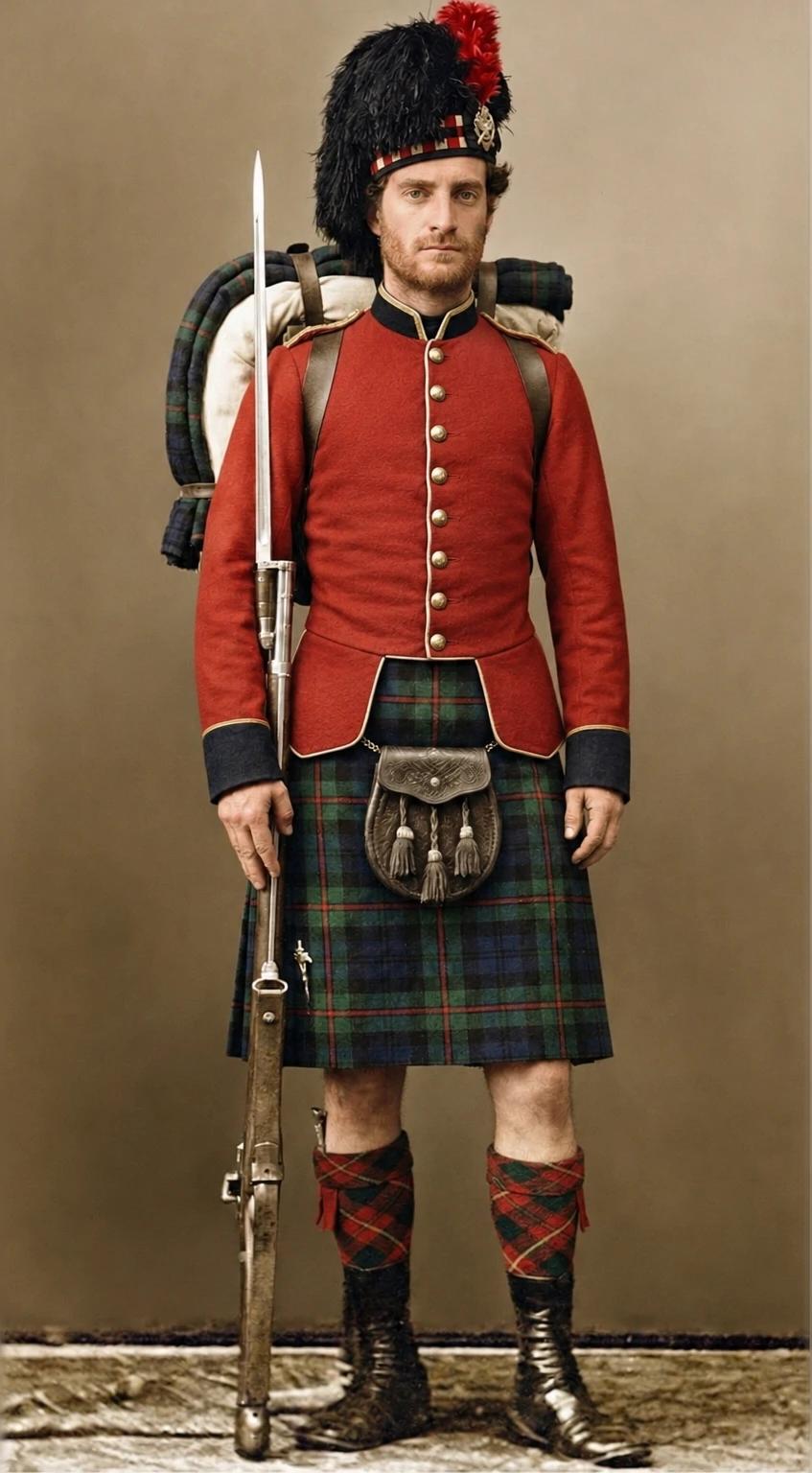
Uniform and equipment
| Uniform | Red coat, dark green tartan kilt, diced hose |
|---|---|
| Dress uniform | Scarlet doublet, full Highland dress |
| Headgear | Feather bonnet with ostrich plumes and clan badge |
| Equipment | Musket, bayonet, dirk, sgian-dubh |
| Insignia and standard | Thistle / St. Andrew’s Cross motif (Order of the Thistle) |
Service record
| First appeared | 1739 |
|---|---|
| Peak strength | 15,000 men |
| Recruited from | Scottish Clansmen / Volunteers |
| Primary tactic | Volley and Bayonet Charge |
| Signature engagement | Battle of Balaclava (Thin Red Line) (1854) |
| Motto or battle cry | Alba gu bràth (Scotland Forever) |
| Obsolescence | Modern Camouflage / Integration |
Timeline
- 1739: Formation of the Black Watch. Independent Highland companies are regimented into the 43rd (later 42nd) Foot to police the Highlands.
- 1759: Battle of Quebec. Fraser's Highlanders scale the Heights of Abraham, proving their loyalty and ferocity to the Crown.
- 1815: Waterloo Campaign. Highland squares hold the line against French cavalry, cementing their reputation as elite shock troops.
- 1854: The Thin Red Line. The 93rd repels Russian cavalry at Balaclava, marking the zenith of linear discipline.
- 1881: Childers Reforms. Regiments are amalgamated and localized, ending the era of numbered regiments but retaining tartan traditions.
- 1914: The Ladies from Hell. German troops coin the nickname for kilted Highlanders facing the horrors of trench warfare.
Battles
Battle of Quatre Bras
The Black Watch (42nd) and Gordons (92nd) were savaged by French lancers while forming squares in tall rye. Despite horrific casualties and chaos, they held the crossroads, preventing Ney from joining Napoleon before Waterloo.
Battle of Balaclava
The 93rd Sutherland Highlanders stood alone against a Russian cavalry charge. Deployed in a line only two deep rather than a square, their disciplined volley fire broke the charge, immortalizing them as 'The Thin Red Line.'
Relief of Lucknow
During the Indian Mutiny, the 93rd Highlanders stormed the Secundra Bagh fortress. With cries of 'Remember Cawnpore!', they engaged in brutal hand-to-hand combat, slaughtering the defenders in a display of raw, vengeful fury.
Commanders
Sir Colin Campbell
A commander of iron nerve who led the Highland Brigade in the Crimea. Famous for his command at Balaclava, 'There is no retreat from here, men. You must die where you stand,' inspiring the legendary 'Thin Red Line' defense against Russian cavalry.
Sir Hector MacDonald
Known as 'Fighting Mac,' he rose from a humble private to Major General through sheer battlefield brilliance. A hero of the Afghan and Boer wars, he embodied the gritty meritocracy and martial prowess of the Highland soldier.
Tactics
The Highland Charge
A psychological shock tactic: a single disciplined volley followed immediately by a sprint through the smoke with bayonets fixed, designed to break enemy morale before contact.
The Thin Line
A risky defensive formation utilizing a two-rank line to maximize frontage and firepower against cavalry, relying entirely on the steely nerve of the men to not break.
Square Formation
Used at Quatre Bras and Waterloo; infantry formed hollow squares to present a wall of bayonets to cavalry while protecting the colors and wounded in the center.