
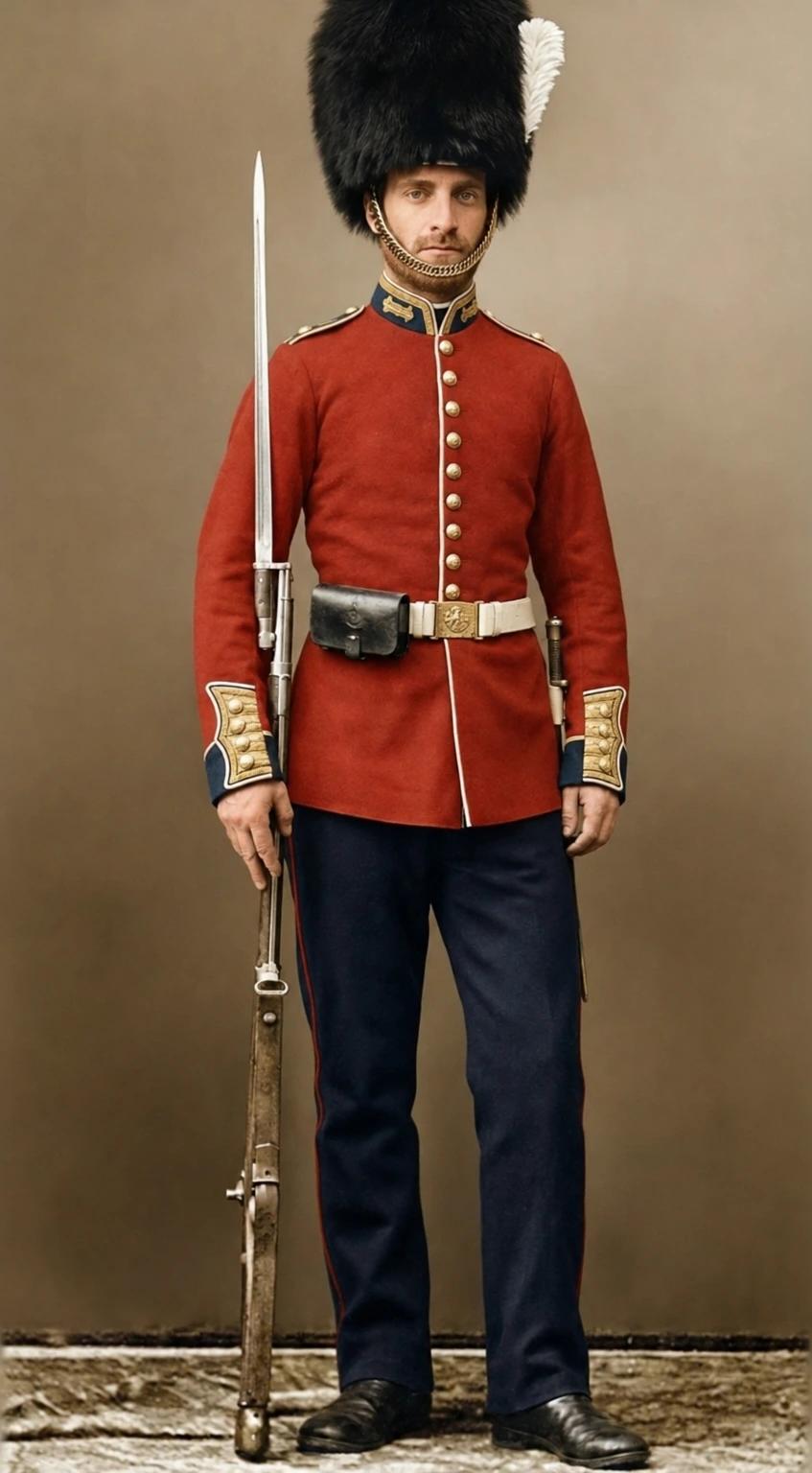
Uniform and equipment
| Uniform | Scarlet tunic with dark blue facings, white belts |
|---|---|
| Dress uniform | Full dress scarlet tunic with gold lace, dark blue collar and cuffs |
| Headgear | Tall bearskin cap with plume on left; officers with finer fur and metal front plates |
| Equipment | Musket or rifle, bayonet, officers with swords |
| Insignia and standard | Fired Grenade (gold sphere with flame) |
Service record
| First appeared | 1656 |
|---|---|
| Peak strength | 3 battalions (~3,000–4,000 men) |
| Recruited from | Volunteers / Elite Height Req. |
| Primary tactic | Disciplined Volley Fire |
| Signature engagement | Battle of Waterloo (1815) |
| Motto or battle cry | Honi soit qui mal y pense (Shame on him who thinks evil of it) |
| Obsolescence | Mechanized Warfare (Adapted) |
Timeline
- 1656: Formation in Exile. Raised in Bruges as Lord Wentworth's Regiment to protect the exiled King Charles II.
- 1660: The Restoration. The regiment returns to England, merging with John Russell's Regiment to form the 1st Regiment of Foot Guards.
- 1704: Battle of Blenheim. Under Marlborough, the regiment plays a crucial role in the major defeat of French forces in Bavaria.
- 1815: Renaming to Grenadier Guards. Following the defeat of the French Imperial Guard grenadiers at Waterloo, the Prince Regent orders the 1st Foot Guards to be styled the 'Grenadier Guards'.
- 1854: Crimean War Deployment. The Guards Brigade deploys to the Crimea, seeing heavy action at Alma and Inkerman.
- 1914: The Great War. Deployment with the British Expeditionary Force. The regiment expands from three battalions to five during the conflict.
Battles
Battle of Waterloo
The regiment's defining hour. Facing the undefeated French Imperial Guard, the 1st Foot Guards rose from the tall rye, delivered a devastating point-blank volley, and shattered Napoleon's elite. In honor of this feat, they were renamed the 'Grenadier Guards'.
Battle of Inkerman
Known as 'The Soldier's Battle.' Fighting in thick fog and rain, the Guards defended the Sandbag Battery against overwhelming Russian numbers. It was a brutal, chaotic melee of bayonets and rifle butts where discipline triumphed over sheer mass.
First Battle of Ypres
The 'Immortal First' held the line against the German advance to the sea. Outnumbered and outgunned, the Grenadiers suffered horrific casualties but refused to break, buying time for the Allies to stabilize the Western Front.
Commanders
Arthur Wellesley, 1st Duke of Wellington
The Iron Duke. Though he commanded the entire Allied army at Waterloo, he served as Colonel of the Grenadier Guards from 1827 until his death. His defensive genius and demand for strict discipline forged the regiment into an immovable object against Napoleonic tyranny.
John Churchill, 1st Duke of Marlborough
A master of maneuver warfare who led the First Regiment of Foot Guards (later Grenadier Guards) during the War of the Spanish Succession. His leadership at Blenheim established the regiment's reputation for steadiness under fire amidst the smoke and slaughter of 18th-century warfare.
Tactics
Disciplined Volley Fire
The Guards were drilled to hold fire until the last second, then unleash a rolling wall of lead. This 'double-shotted' volley often broke enemy charges instantly.
Square Formation
A defensive box formation used to repel cavalry. At Waterloo, the Guards formed squares that withstood repeated charges by French cuirassiers, becoming islands of red in a sea of steel.
The Bayonet Charge
Psychological warfare made physical. After shattering the enemy with volleys, the Guards would advance with leveled steel, relying on aggression and size to rout the survivors.