
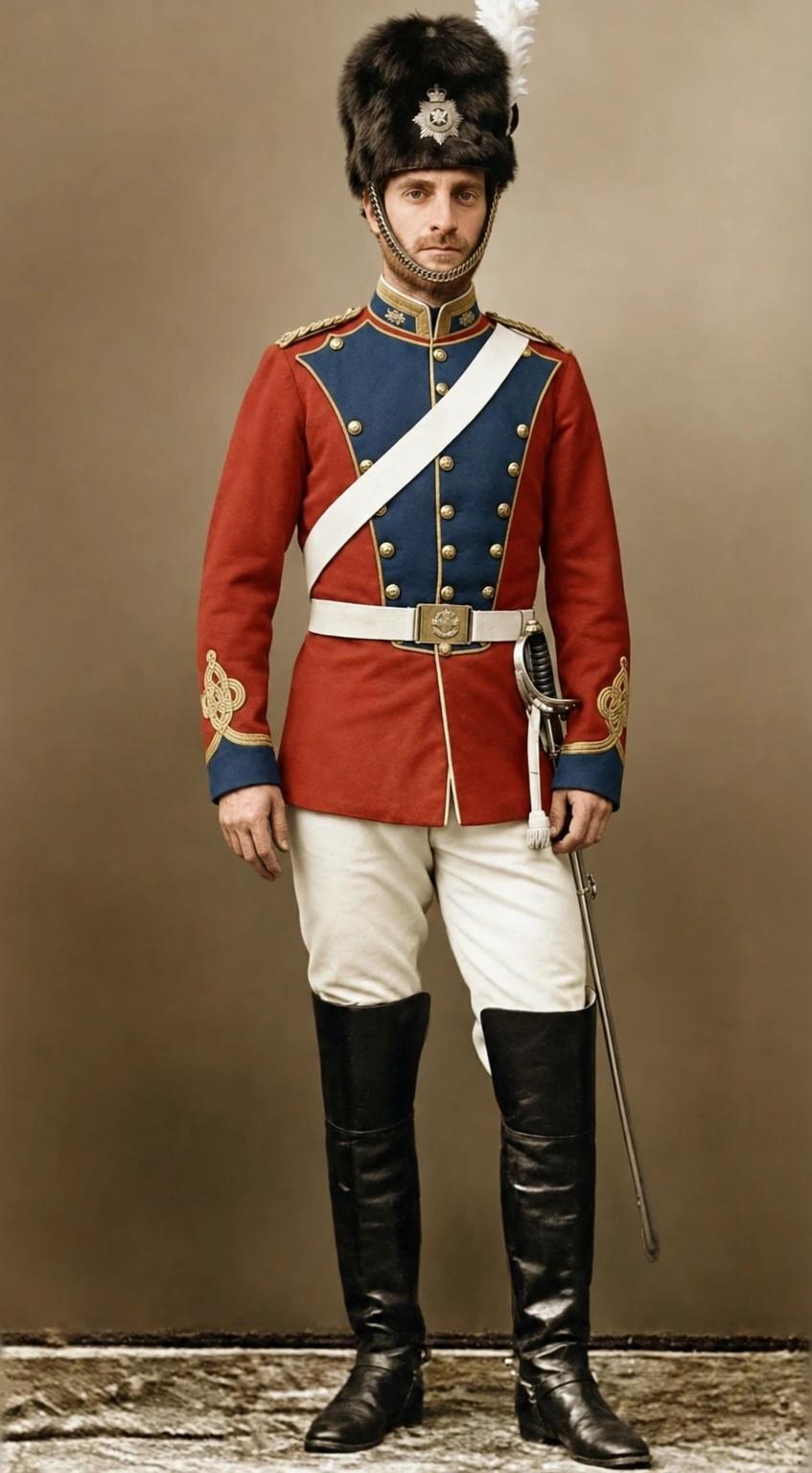
Uniform and equipment
| Uniform | Red coat with blue facings, white breeches |
|---|---|
| Dress uniform | Scarlet tunic, heavy gold braid, medals |
| Headgear | Bearskin cap with white plume |
| Equipment | Heavy cavalry sword, carbine, pistol |
| Insignia and standard | Captured French Eagle with 'Waterloo'; thistle |
Service record
| First appeared | 1681 |
|---|---|
| Peak strength | ~800 troopers |
| Recruited from | Scottish Volunteers |
| Primary tactic | Heavy Cavalry Charge |
| Signature engagement | Battle of Waterloo (1815) |
| Motto or battle cry | Nemo Me Impune Lacessit (No one provokes me with impunity) |
| Obsolescence | Mechanization |
Timeline
- 1681: Regiment Formed. Officially established as The Royal Regiment of Scots Dragoons from independent troops.
- 1706: Ramillies Honors. Captured the standards of the Regiment du Roi; granted the right to wear grenadier caps.
- 1815: Charge at Waterloo. Participated in the charge of the Union Brigade; Sergeant Ewart captures the French Eagle.
- 1854: Crimean Campaign. Executed the successful Charge of the Heavy Brigade at Balaclava.
- 1899: Second Boer War. Deployed to South Africa, adapting traditional cavalry tactics to mobile warfare against Boer commandos.
- 1971: Amalgamation. Merged with the 3rd Carabiniers to form The Royal Scots Dragoon Guards.
Battles
Battle of Ramillies
The Greys charged into the elite French Regiment du Roi, capturing their standards. This victory earned them the unique distinction of wearing grenadier caps (later bearskins), a rare honor for a cavalry regiment, cementing their reputation as shock troops.
Battle of Waterloo
The defining moment. The Greys charged D'Erlon's infantry corps, crying 'Scotland Forever!'. They shattered the French columns and captured an Eagle, but intoxicated by victory, rode too far. Counter-attacked by French lancers, they suffered horrific casualties but saved Wellington's center.
Battle of Balaclava
Part of the Heavy Brigade, the Greys charged uphill against a massive force of Russian cavalry. Despite being outnumbered, their ferocity and heavy horses broke the Russian line in minutes, a brilliant success often overshadowed by the tragic Light Brigade charge later that day.
Commanders
General Thomas Dalziel
The wild, bearded founder of the regiment. A staunch Royalist who refused to shave his beard after the execution of Charles I, he raised the Scots Dragoons to hunt Covenanters. His ruthless discipline forged the iron-hard spirit that would define the regiment for three centuries.
Sir James Campbell
Commanded the regiment during the fateful charge at Waterloo. A veteran of the Peninsular War, he led his men with reckless valor into the French columns. He was struck by a lance and killed in the melee, dying as he lived—at the very tip of the spear.
Sergeant Charles Ewart
A giant of a man and master swordsman, Ewart immortalized the Greys at Waterloo. In the heat of the charge, he cut down a French officer, a lancer, and a foot soldier to seize the Imperial Eagle of the 45th Line Infantry, securing a trophy that remains a symbol of British martial pride.
Tactics
Shock Charge
The Greys utilized the sheer mass of their large grey horses to smash through enemy lines. Unlike light cavalry, they relied on impact rather than speed, crushing infantry formations under hoof and blade.
Union Brigade Assault
At Waterloo, they deployed in a line abreast with the Royals and Inniskillings. This massive wall of heavy horse was designed to sweep the field, though it proved difficult to rally once the momentum carried them too deep into enemy territory.