
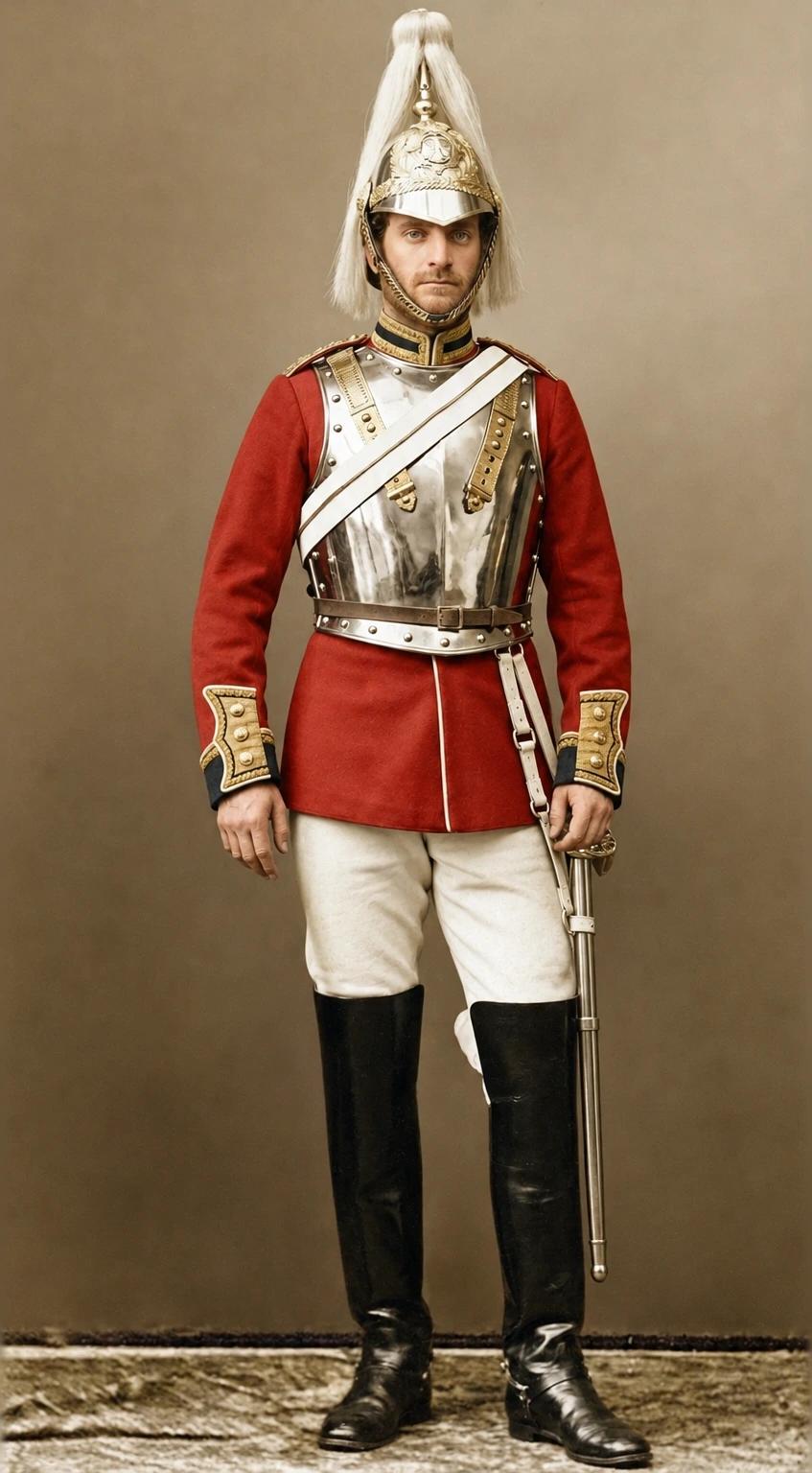
Uniform and equipment
| Uniform | Red coat, blue facings, gold lace, white breeches |
|---|---|
| Dress uniform | Scarlet with extensive gold, blue velvet |
| Headgear | Brass helmet with horsehair plume (later steel with plume) |
| Equipment | Heavy cavalry sword, carbine |
| Insignia and standard | Royal cypher within Garter belt |
Service record
| First appeared | 1660 |
|---|---|
| Peak strength | 1,500 men |
| Recruited from | Aristocracy (Officers) / Selected Troopers |
| Primary tactic | Household Cavalry Charge |
| Signature engagement | Battle of Waterloo (1815) |
| Motto or battle cry | Honi soit qui mal y pense (Shame on him who thinks evil of it) |
| Obsolescence | Mechanization (Tanks) |
Timeline
- 1660: Formation. Formed from the exiled Cavalier bodyguards of Charles II upon the Restoration of the Monarchy.
- 1743: Battle of Dettingen. Confirmed their status as elite heavy cavalry under the direct command of the King.
- 1788: Reorganization. The Horse Grenadier Guards and Horse Guards were reorganized into the 1st and 2nd Regiments of Life Guards.
- 1815: The Waterloo Charge. Legendary charge of the Household Brigade; heavy losses incurred but French infantry assault broken.
- 1821: Adoption of the Cuirass. Following the Napoleonic Wars, the regiment adopted steel breastplates, giving them their modern ceremonial silhouette.
- 1914: First Battle of Ypres. The regiment fought as dismounted infantry, holding the line against German advances in the mud of Flanders.
Battles
Battle of Dettingen
The last time a British monarch (George II) led troops into battle. The Life Guards protected the King, enduring heavy French artillery fire before driving the French Maison du Roi cavalry into the river Main in a desperate, muddy struggle.
Battle of Waterloo
The defining moment of the regiment. The Life Guards smashed into the French columns, turning the tide of the battle. However, the charge was carried too far on adrenaline, resulting in severe casualties when they were counter-attacked by French lancers while blown and disorganized.
Battle of Tel el-Kebir
A grueling night march across the desert followed by a dawn assault. The Life Guards, part of the heavy cavalry contingent, swung around the Egyptian flank, cutting off retreat and turning the engagement into a rout under the burning sun.
Commanders
Lord Edward Somerset
Commander of the Household Brigade at Waterloo. A stoic and fearless leader, he led the Life Guards into the 'hollow way' to crush d'Erlon's Corps. He lost his hat during the initial clash and fought the remainder of the chaotic melee bareheaded in the cannon smoke.
Henry Paget, 1st Marquess of Anglesey
Known as the Earl of Uxbridge during Waterloo. A dashing, aggressive cavalry commander who led the spectacular charge of the heavy cavalry. He lost his leg to grapeshot in the battle's dying moments, coolly remarking to Wellington, 'By God, sir, I've lost my leg!'
Tactics
Shock Action
Utilizing the sheer weight of large men on heavy horses to physically smash through enemy infantry formations.
The Household Charge
A disciplined, knee-to-knee advance accelerating to a gallop only at the final moment to maximize impact cohesion.
Dismounted Service
In later eras (Boer War, WWI), troopers utilized carbines and machine guns to fight as elite infantry when the terrain forbade riding.