
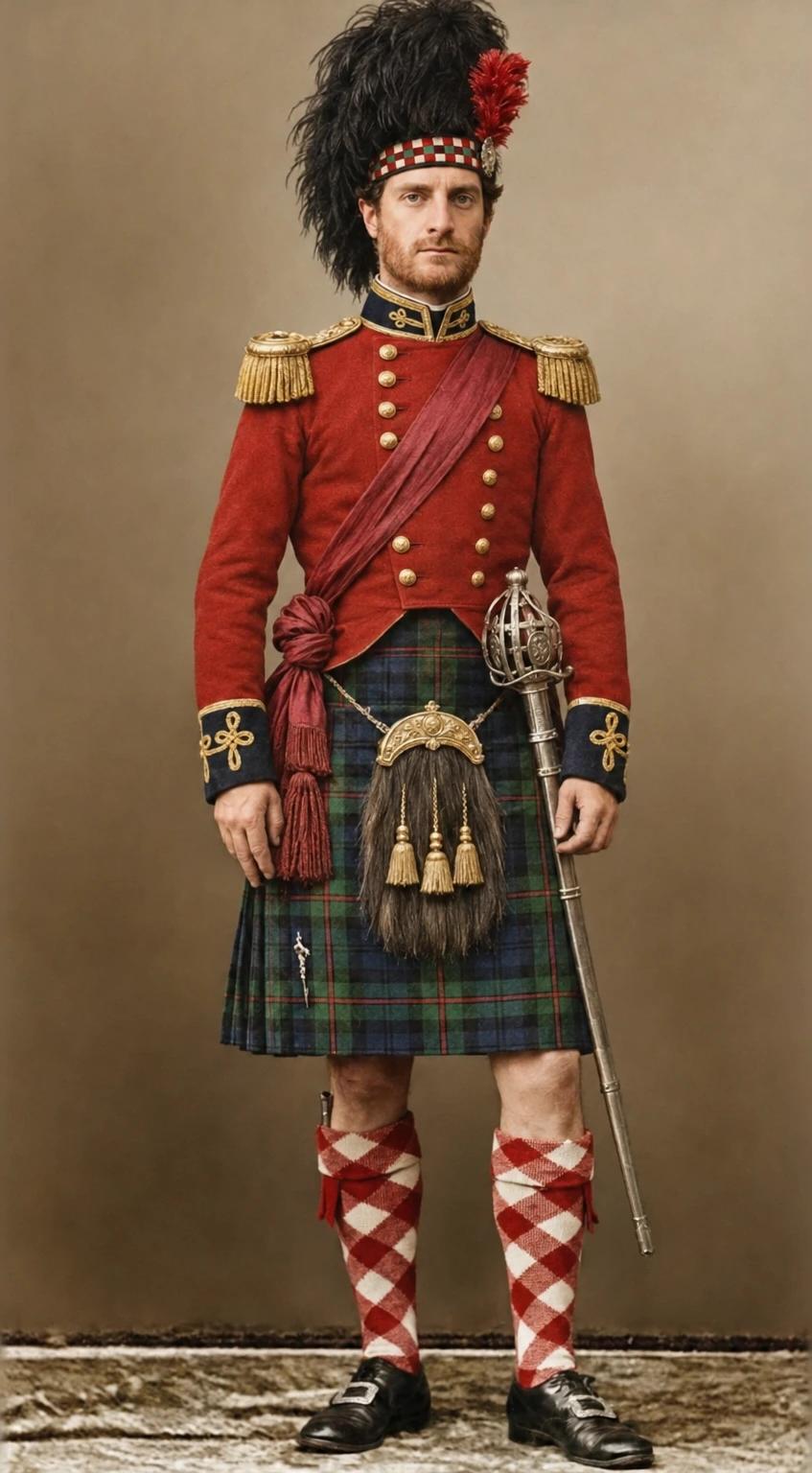
Uniform and equipment
| Uniform | Scarlet coatee with dark blue facings, government tartan kilt, crimson officer sash |
|---|---|
| Dress uniform | Feather bonnet with red hackle, gold-laced scarlet coatee, broadsword and dirk |
| Headgear | Large feather bonnet with hackle and regimental badge |
| Equipment | Officer sword, dirk, pistols (historical), field glass |
| Insignia and standard | Sphinx badge (Egypt 1801) |
Service record
| First appeared | 1739 |
|---|---|
| Peak strength | ~100 officers at a time |
| Recruited from | Scottish Gentry |
| Primary tactic | Infantry Command |
| Signature engagement | Battle of Quatre Bras (1815) |
| Motto or battle cry | Nemo Me Impune Lacessit (No one attacks me with impunity) |
| Obsolescence | Modern Camouflage |
Timeline
- 1739: Regiment Raised. The Independent Highland Companies are amalgamated at Aberfeldy to form the 43rd (later 42nd) Regiment of Foot.
- 1758: Royal Designation. Following the heroism at Ticonderoga, King George II grants the title 'The Royal Highland Regiment'.
- 1801: The Red Hackle. Awarded the distinction of wearing the Red Hackle in their bonnets for recovering a standard in Egypt.
- 1815: Waterloo Campaign. The regiment suffers heavy officer casualties at Quatre Bras and Waterloo but helps break Napoleon's Old Guard.
- 1854: Crimean War. The regiment forms part of the Highland Brigade, earning fame at the Alma and Balaclava.
- 1881: Childers Reforms. The 42nd is amalgamated with the 73rd to form The Black Watch (Royal Highlanders).
Battles
Battle of Ticonderoga
The regiment's bloodiest day. Officers led a suicidal assault against French abatis. Despite losing over half their number, their ferocity earned them the title 'The Royal Highland Regiment' from the King.
Battle of Alexandria
In the swirling sands, the Black Watch annihilated Napoleon's 'Invincibles'. Officers engaged in hand-to-hand combat, capturing the French standard in a chaotic melee that cemented their reputation.
Battle of Quatre Bras
Caught in tall rye by Ney's lancers, the officers struggled to form a square. The formation remained open, yet the Highlanders fought back-to-back, repelling the cavalry with bayonets and sheer stubbornness.
Battle of the Alma
Part of the Highland Brigade's inexorable advance. Under heavy fire, the officers kept the lines dressed perfectly, marching up the heights and breaking the Russian center with a single, devastating volley.
Commanders
Sir John Moore
Though a commander of the army, his bond with the 42nd was forged in blood. Mortally wounded at Corunna, he was carried from the field by Black Watch soldiers, his legacy of light infantry reform forever intertwined with their history.
Sir Colin Campbell
A commander of iron nerve who led the Highland Brigade in the Crimea. Known for his refusal to form square against cavalry, trusting instead in the discipline of the 'Thin Red Line' and the steady aim of his Highlanders.
Sir Robert Munro
The stout-hearted leader at Fontenoy. He ordered his men to drop to the ground to evade French volleys, then rise to pour fire into the enemy ranks. His unorthodox command preserved the regiment in the face of overwhelming odds.
Tactics
Highland Charge
A shock tactic involving a single musket volley followed by a rapid sprint into melee range with broadswords and bayonets.
Infantry Square
A defensive formation where the unit forms a hollow box with bayonets facing outward to repel cavalry charges.
Controlled Volley Fire
Strict fire discipline where officers commanded ranks to fire simultaneously, maximizing impact against enemy columns.