
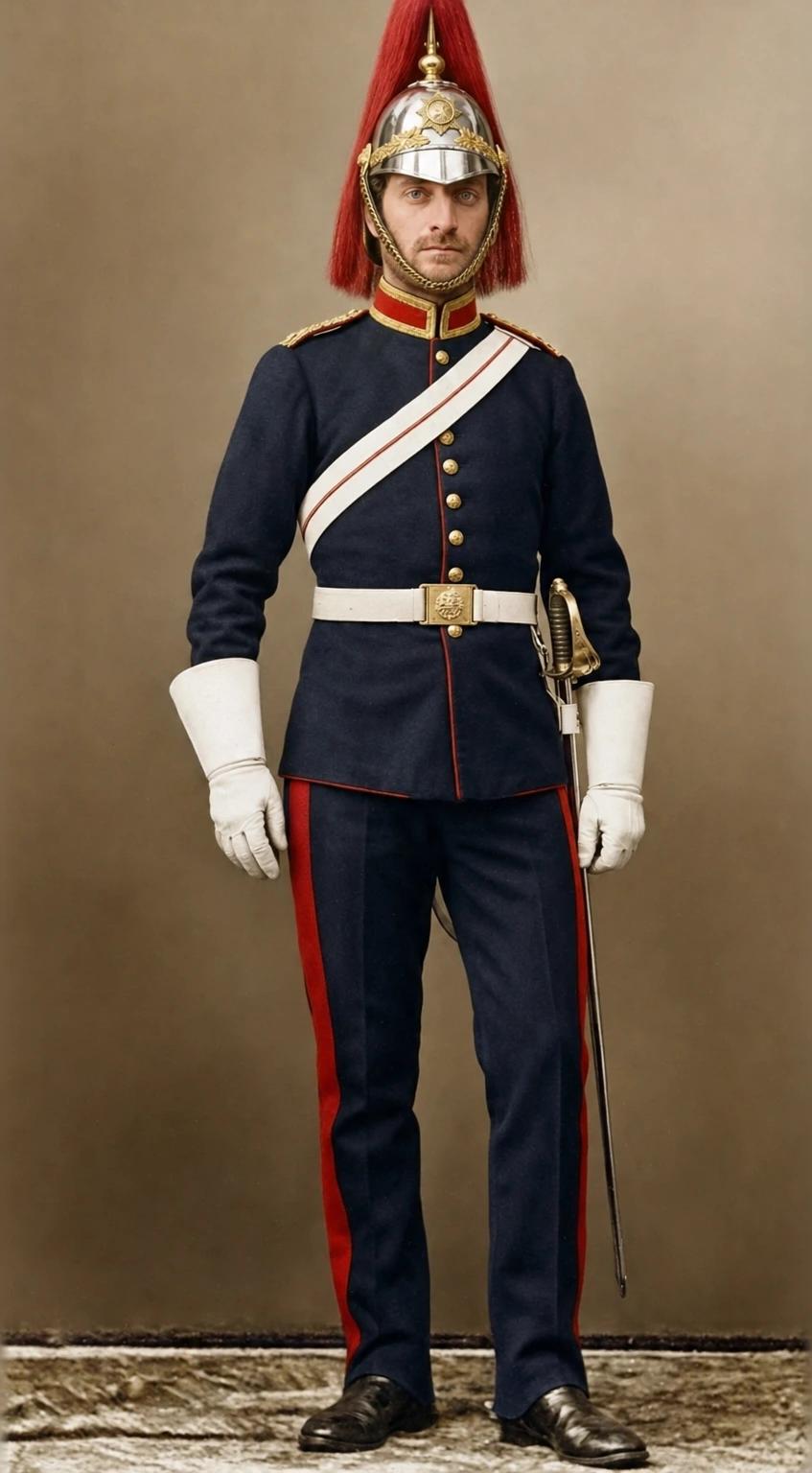
Uniform and equipment
| Uniform | Dark blue tunic, white buckskin breeches, black riding boots |
|---|---|
| Dress uniform | Polished steel cuirass over dark blue, crimson plume, white gauntlets |
| Headgear | Steel helmet with flowing horsehair plume and chin-scales |
| Equipment | Cavalry sword, carbine (field), ceremonial sword only on parade |
| Insignia and standard | Garter Star with Cross of St. George |
Service record
| First appeared | 1661 |
|---|---|
| Peak strength | ~1,000 troopers |
| Recruited from | Aristocracy / Elite Troopers |
| Primary tactic | Shock Cavalry Charge |
| Signature engagement | Battle of Waterloo (1815) |
| Motto or battle cry | Honi soit qui mal y pense (Shame on him who thinks evil of it) |
| Obsolescence | Mechanization (Tanks) |
Timeline
- 1661: Formation of The Blues. Raised as the Royal Regiment of Horse by the Earl of Oxford from disbanded Cromwellian cavalry.
- 1661: Formation of The Royals. Raised as the Tangier Horse to garrison the North African outpost of Tangier.
- 1743: Battle of Dettingen. The Blues fight under King George II, the last British monarch to lead troops into battle.
- 1815: The Waterloo Charge. The Royals capture the French Eagle; the Blues help destroy the French Cuirassiers.
- 1969: Amalgamation. The Royal Horse Guards (The Blues) and The Royal Dragoons (1st Dragoons) merge to form The Blues and Royals.
Battles
Battle of Warburg
The Blues executed a thunderous charge under the Marquess of Granby. Granby lost his wig in the gallop but refused to slow, leading bare-headed into the French lines. The regiment smashed the enemy cavalry, cementing their reputation for unstoppable momentum.
Battle of Waterloo
Both the Blues and the Royals charged to crush d'Erlon's infantry. The Royals captured the Eagle of the 105th, while the Blues, part of the Household Brigade, shattered the French Cuirassiers. A glorious but bloody day that broke the back of Napoleon's grand attack.
Battle of Balaklava
Often overshadowed by the Light Brigade's disaster, the Royals participated in the Charge of the Heavy Brigade. Uphill and outnumbered, they plunged into the mass of Russian cavalry, hacking through the grey coats in a brutal melee that routed the enemy force.
Commanders
Aubrey de Vere, 20th Earl of Oxford
The founding Colonel of the Royal Regiment of Horse. He clad his men in blue coats to distinguish them from the red-coated Royalists, earning the regiment its immortal nickname 'The Blues.' A staunch loyalist who forged the unit's identity in the volatile Restoration era.
Captain Alexander Kennedy Clark
A ferocious officer of the Royal Dragoons at Waterloo. In the heat of the Union Brigade's charge, he spotted the French 105th Ligne's Eagle standard. He cut down the French porte-aigle, seizing the trophy that remains a defining symbol of the regiment's valor.
Tactics
Shock Charge
A disciplined advance starting at a trot and accelerating to a full gallop only yards from the enemy, using the sheer weight of horse and man to shatter infantry formations.
Counter-Charge
Meeting enemy cavalry head-on. Instead of receiving a charge statically, the unit advances to meet the blow, relying on sword skill and momentum to break the opponent's cohesion.