
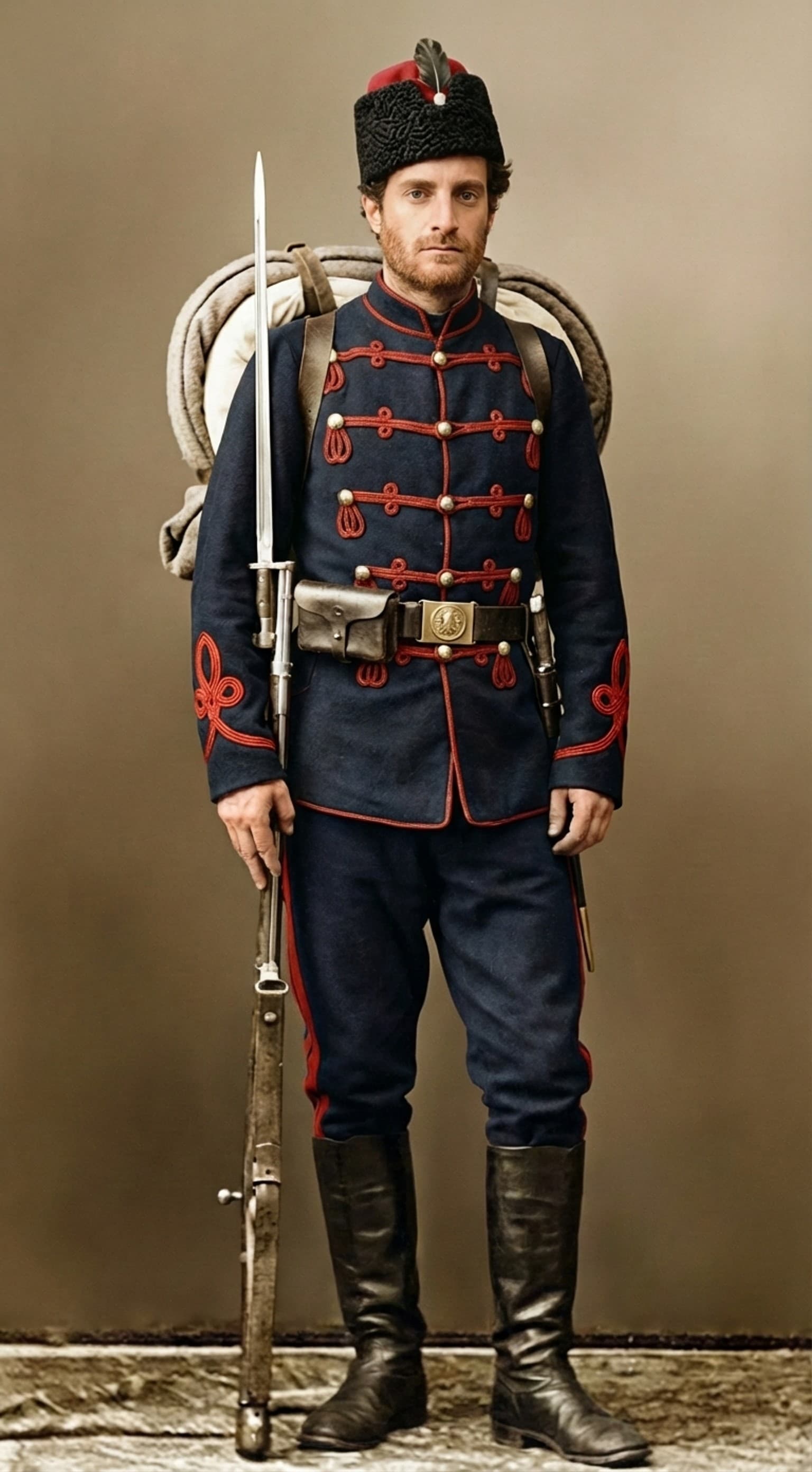
Uniform and equipment
| Uniform | White peasant tunic, turkey feather in hat |
|---|---|
| Dress uniform | N/A |
| Headgear | Căciulă (fur hat) with feather |
| Equipment | Peabody-Martini rifle |
| Insignia and standard | Long turkey feather on caciula |
Service record
| First appeared | 1870s |
|---|---|
| Peak strength | Divisions |
| Recruited from | Peasant Levies |
| Primary tactic | Infantry Assault |
| Signature engagement | Siege of Plevna (1877) |
| Motto or battle cry | Pe ei! (Get them!) |
| Obsolescence | Army Modernization |
Timeline
- 1864: Military Reform. Under Alexandru Ioan Cuza, the Dorobanti are formalized as territorial infantry to supplement the small standing army.
- 1877: Mobilization. Romania declares independence from the Ottoman Empire; the Dorobanti regiments are called up from the countryside.
- 1877: Crossing the Danube. The army crosses into Bulgaria on pontoon bridges to support the stalled Russian offensive.
- 1877: Assault on Grivitsa. The bloodiest day of the war; Dorobanti suffer massive casualties taking the Grivitsa 1 redoubt.
- 1877: Fall of Plevna. Osman Pasha surrenders; the Dorobanti have successfully besieged one of the strongest fortresses in the Balkans.
- 1878: Treaty of Berlin. Romania's independence is internationally recognized, largely due to the blood sacrifice of its territorial troops.
- 1880: Army Modernization. Post-war reforms begin to integrate territorial units more closely with the regular line infantry, standardizing equipment.
Battles
Battle of Rahova
A critical engagement to secure the Danube crossing points. The Dorobanti executed a difficult assault against fortified Ottoman positions, securing the right flank of the main army and cutting off Ottoman supply lines.
Siege of Plevna
The crucible of Romanian independence. Ill-equipped Dorobanti stormed the formidable Grivitsa Redoubt under withering fire. Despite horrific casualties, their tenacity in the 'Valley of Tears' proved to Europe that Romania was a sovereign military power.
Battle of Smardan
Part of the operations around Vidin. In a brutal bayonet charge through mud and snow, Romanian troops routed the Ottoman defenders, effectively ending organized resistance in the sector just before the armistice.
Commanders
King Carol I
The German-born Domnitor who personally commanded the Russo-Romanian West Army at Plevna. His steely discipline and refusal to retreat when Russian morale wavered were pivotal in maintaining the siege that eventually broke Osman Nuri Pasha.
Alexandru Cernat
Minister of War and commander of the Operational Army. He orchestrated the crossing of the Danube and the integration of Romanian forces with Russian allies, transforming a territorial militia into a professional fighting force capable of breaking the Ottoman lines.
Valter Maracineanu
A Captain of the 8th Line Regiment (fighting alongside Dorobanti), he became the martyr of the Grivitsa Redoubt. Leading a suicidal charge against entrenched Ottoman positions, he died planting the Romanian tricolor on the parapet, shouting 'Follow me, boys!'
Tactics
Atac la Baioneta (Bayonet Charge)
Lacking sufficient artillery support, Dorobanti often closed the distance rapidly to engage in hand-to-hand combat, overwhelming defenders with sheer numbers and ferocity.
Skirmish Lines
Operating in loose formations to harass enemy fortifications and draw fire before the main assault columns advanced.
Siege Entrenchment
Rapid digging of zig-zag approach trenches (saps) to encroach upon Ottoman redoubts like Grivitsa, allowing for close-range assaults.