
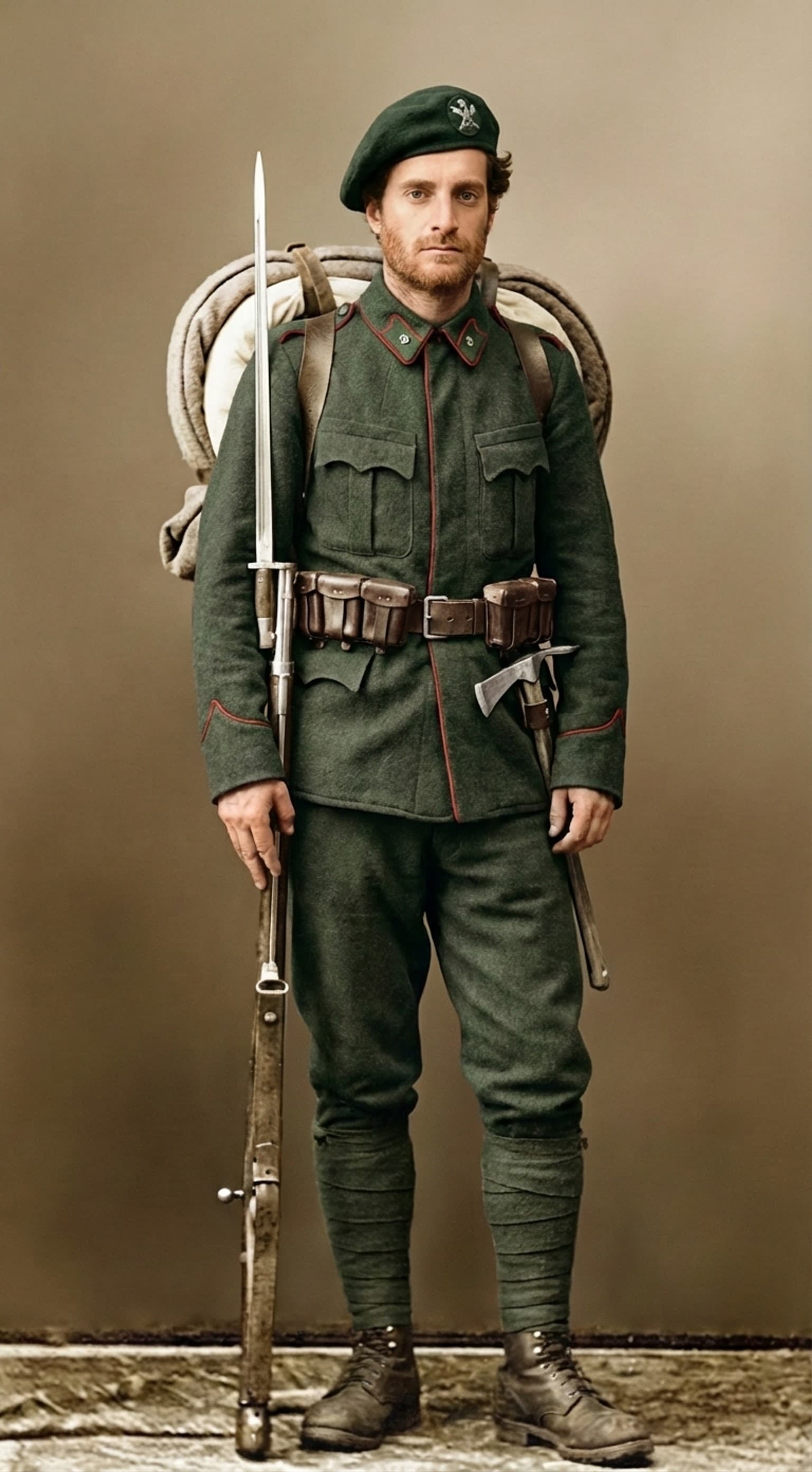
Uniform and equipment
| Uniform | Grey-green tunic, breeches, puttees; officers with green piping |
|---|---|
| Dress uniform | Field-grey dress with badges, cords for buglers, medals |
| Headgear | Mountain cap with edelweiss-style badge |
| Equipment | Rifle, bayonet, mountaineering gear |
| Insignia and standard | Green fir branch with hunting horn |
Service record
| First appeared | 1916 |
|---|---|
| Peak strength | ~40,000 men |
| Recruited from | Carpathian Mountaineers |
| Primary tactic | Alpine Defense |
| Signature engagement | Campaign of 1917 |
| Motto or battle cry | Per aspera ad astra (Through hardships to the stars) |
| Obsolescence | N/A (Still Active) |
Timeline
- 1916: Formation. Following the entry of Romania into WWI, the first Battalion of Mountain Hunters is established by order of the General Staff to counter elite enemy alpine units.
- 1917: The Triangle of Death. The unit achieves legendary status during the defensive campaigns at Mărăști, Mărășești, and Oituz.
- 1923: Standardization. The Mountain Troops are formally expanded into a distinct branch of the army with specialized doctrine and equipment.
- 1941: Operation Barbarossa. The Mountain Corps joins the invasion of the Soviet Union, tasked with the liberation of Bessarabia and Northern Bukovina.
- 1942: Caucasus Campaign. The furthest advance of the Romanian Army; the hunters fight at high altitudes alongside German Gebirgsjäger.
- 1944: The Great Switch. Following King Michael's Coup, the unit turns its weapons against the Axis, fighting to liberate Romania and pushing into Hungary and Czechoslovakia.
- 1945: Tatra Campaign. The unit ends the war fighting in the Tatra Mountains, suffering heavy casualties to dislodge entrenched German forces.
Battles
Battle of Oituz
The unit's baptism of fire. Against overwhelming German and Austro-Hungarian odds, the Mountain Hunters held the peaks, adopting the motto 'Nu pe aici se trece' (You shall not pass here), preventing the collapse of the Romanian front.
Battle of the Caucasus
Fighting at the roof of the world. The unit pushed deep into the Caucasus, securing high-altitude passes. Though tactically successful, the strategic situation eventually forced a harrowing retreat through frozen hell.
Siege of Sevastopol
Engaged in brutal siege warfare, the Vânători de Munte stormed heavily fortified Soviet positions. Their ability to scale cliffs and infiltrate bunkers was crucial in breaking the stubborn Soviet defense lines.
Liberation of Transylvania
After switching sides, the Mountain Hunters turned their fury against the Axis. They spearheaded the assault to reclaim Northern Transylvania, fighting fiercely to liberate their homeland's peaks.
Commanders
Gheorghe Avramescu
Commander of the Mountain Corps during the grueling Eastern Front campaigns. Known for his strategic acumen in alpine warfare, he navigated the complex political and military landscape of Romania's war.
Leonard Mociulschi
A gritty tactician of WWII, Mociulschi led the Mountain Corps from the burning steppes of Crimea to the peaks of the Tatras. Respected by foes for his chivalry and by his men for leading from the front lines.
Virgil Bădulescu
The father of the Romanian Mountain Troops. In 1916, he transformed a ragtag group into an elite fighting force. His leadership at Târgu Ocna cemented the unit's reputation for ferocity and discipline in unforgiving terrain.
Tactics
Vertical Envelopment
Bypassing enemy strongpoints by scaling 'impassable' cliffs or steep slopes to attack from the rear or flanks where defenses were weak.
Ridge-Line Defense
Establishing fortified positions on crests and ridges to dominate the valleys below, forcing the enemy to fight uphill under withering fire.
Infiltration Patrols
Small, lightly equipped teams moving silently through forests and ravines to conduct reconnaissance, sabotage, or ambushes behind enemy lines.