
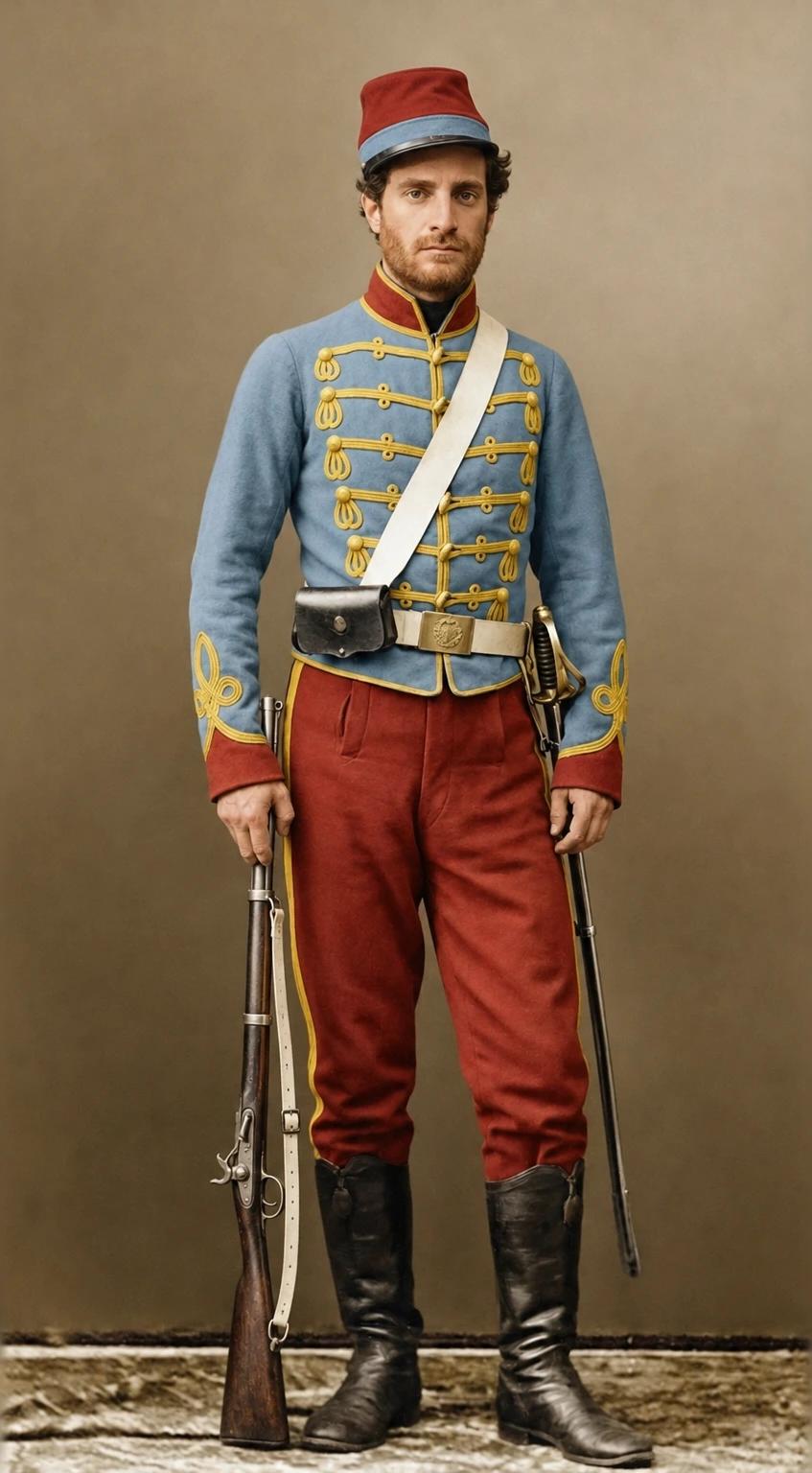
Uniform and equipment
| Uniform | Sky-blue jacket, madder red trousers, yellow braid |
|---|---|
| Dress uniform | Sky-blue tunic with gold lace, white gloves, crimson sash |
| Headgear | Casquette d'Afrique (sky-blue and crimson peaked cap) |
| Equipment | Sabre, carbine, pistols |
| Insignia and standard | Silver hunting horn on light blue kepi |
Service record
| First appeared | 1831 |
|---|---|
| Peak strength | ~12,000 troopers |
| Recruited from | French Volunteers/Conscripts |
| Primary tactic | Light Cavalry Charge |
| Signature engagement | Charge of the Light Brigade (Support) |
| Motto or battle cry | Tant qu'il en restera un (As long as one remains) |
| Obsolescence | Mechanization (Armored Cars) |
Timeline
- 1831: Formation. Created in Algeria to provide a cavalry force capable of matching local Arab horsemen, utilizing hardy indigenous Barb horses.
- 1844: Battle of Isly. Decisive victory against Morocco, cementing the reputation of the 'Blue Hunters' as the masters of North African warfare.
- 1854: Crimean Campaign. Deployed to the Crimea, earning eternal fame for saving the British Light Brigade at Balaclava.
- 1863: Mexican Expedition. Deployed to Mexico to support Maximilian I, fighting guerilla actions in harsh, arid terrain similar to their home turf.
- 1870: Franco-Prussian War. Participated in the disastrous charges at Sedan, sacrificing the regiment to cover the retreat of the infantry.
- 1914: World War I. Initially deployed on the Western Front, later moved to the Macedonian Front where cavalry remained viable.
- 1942: Mechanization. During WWII, the regiments traded horses for M10 Tank Destroyers and Shermans, fighting in Italy and Southern France.
- 1962: Dissolution. Following Algerian independence, the historic regiments were disbanded or transformed into metropolitan armored units.
Battles
Battle of Isly
A defining colonial engagement where French forces, spearheaded by cavalry, routed a vastly larger Moroccan army. This victory solidified French control over Algeria and demonstrated the Chasseurs' mastery of North African terrain.
Battle of Balaclava
Overshadowed by the British disaster, the Chasseurs executed a brilliant flank charge against Russian artillery on the Fedyukhin Heights. Their intervention silenced the batteries tearing into the British Light Brigade, allowing the survivors to retreat.
Battle of Sedan
In a desperate bid to break the Prussian encirclement, the Chasseurs launched repeated, suicidal charges at Floing. Their heroism moved King Wilhelm I to exclaim, 'Ah! Les braves gens!' (Ah! The brave people!), though the battle ended the Second Empire.
Battle of Uskub
One of the last great cavalry operations in history. The Chasseurs d'Afrique, traversing difficult mountain terrain in fog, surprised the German-Bulgarian forces, cutting off their retreat and forcing a capitulation that knocked Bulgaria out of WWI.
Commanders
Louis-Michel Morris
A stoic commander during the Crimean War, Morris led the 4th Chasseurs d'Afrique. While the British Light Brigade charged the valley floor, Morris brilliantly assaulted the Fedyukhin Heights, silencing the Russian guns flanking the British, preventing total annihilation.
Yusuf (Joseph Vantini)
An enigmatic figure of uncertain origin, Yusuf was instrumental in organizing the indigenous Spahis and the early Chasseurs. A master of desert warfare, he taught the French how to fight and survive in the scorching Maghreb terrain.
Gaston de Galliffet
The 'Prince of the Trenches.' A ruthless disciplinarian and fearless cavalier, he led the suicidal charge at Sedan in 1870. Despite severe wounds from Mexico, he commanded his men into the Prussian guns until the Emperor himself ordered the slaughter to cease.
Tactics
Charge en Muraille
A tight, knee-to-knee formation charge designed to deliver maximum kinetic impact and break enemy infantry squares through sheer psychological and physical shock.
Razzia
Adopted from Arab tribes, this was a lightning-fast raid intended to seize livestock and supplies, destroying the enemy's economic base rather than seeking pitched battle.
Voltigeur Screen
Deploying loose skirmish lines to harass the enemy with carbine fire and screen the main force's movements before regrouping for a saber charge.
Mounted Reconnaissance
Utilizing the endurance of Barb horses to patrol vast distances in arid terrain, locating enemy encampments and water sources.