
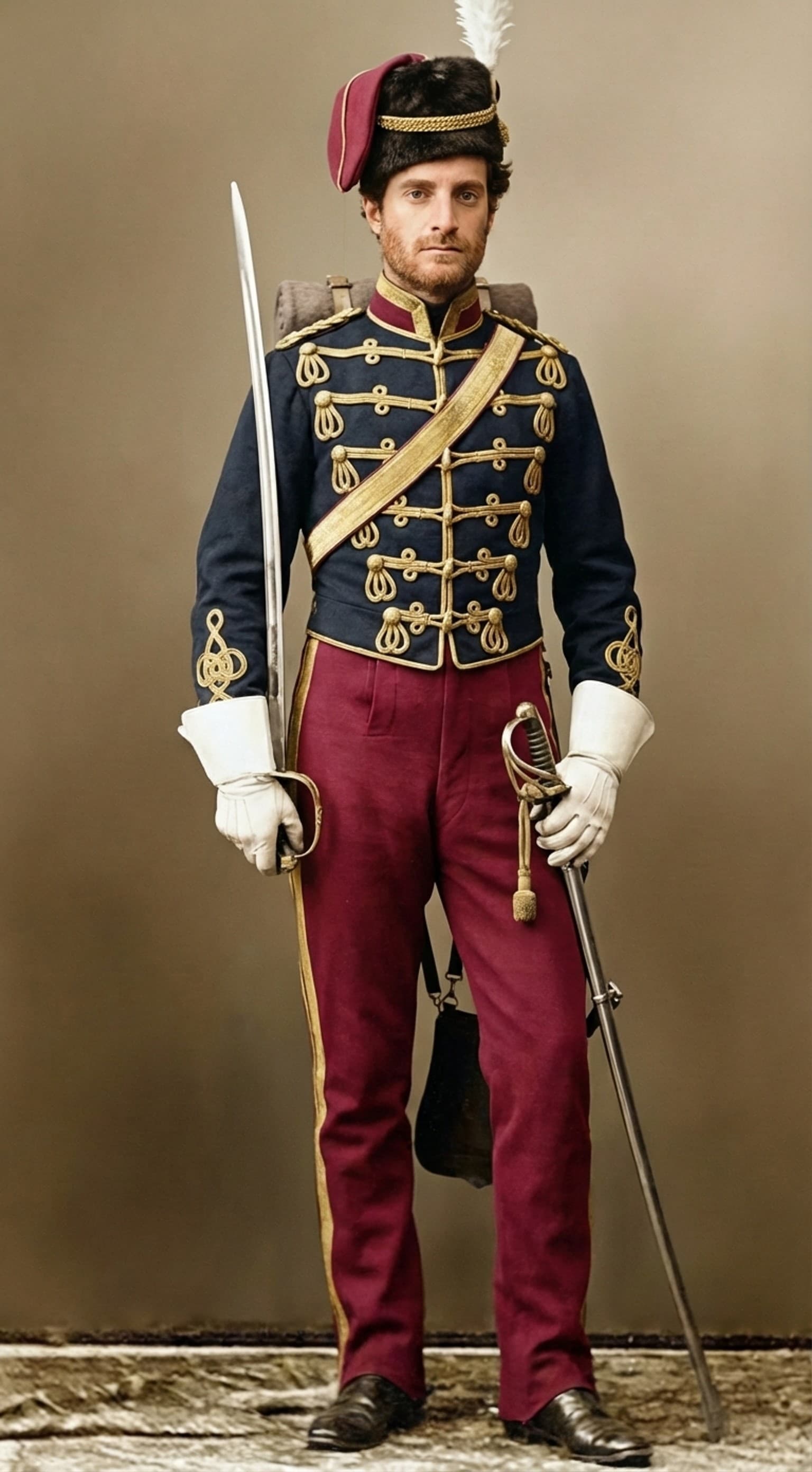
Uniform and equipment
| Uniform | Dark blue dolman with gold lace, spectacular crimson overalls |
|---|---|
| Dress uniform | Highly braided dolman and pelisse, cherry-colored trousers |
| Headgear | Fur busby with colored bag and plume |
| Equipment | Light cavalry sabre, carbine, pistols |
| Insignia and standard | Sphinx over 'Egypt' badge |
Service record
| First appeared | 1715 |
|---|---|
| Peak strength | 600–800 men |
| Recruited from | Aristocratic Officers / Volunteers |
| Primary tactic | Light Cavalry Charge |
| Signature engagement | Charge of the Light Brigade (1854) |
| Motto or battle cry | Treu und Fest (Loyal and Sure) |
| Obsolescence | Machine Gun |
Timeline
- 1715: Formation. Raised as Honeywood's Regiment of Dragoons in Essex to suppress the Jacobite rising.
- 1811: The Cherry Pickers Incident. During the Peninsular War, a patrol was surprised by the French while raiding a cherry orchard, earning the regiment its enduring nickname.
- 1840: Royal Escort & Renaming. Escorted Prince Albert to his wedding with Queen Victoria. Renamed 'Prince Albert's Own' and granted the unique distinction of wearing crimson trousers.
- 1854: The Charge. Led the Light Brigade at Balaclava. Of the 600+ men who charged, the 11th suffered grievous losses but gained legendary status.
- 1914: The Great War. Participated in the initial cavalry actions on the Western Front, leading a charge near Mons before the war settled into trenches.
- 1969: Amalgamation. Amalgamated with the 10th Royal Hussars to form The Royal Hussars (Prince of Wales's Own), ending its independent lineage.
Battles
Battle of Salamanca
Operating in the Peninsula, the regiment executed a textbook charge against French infantry. They broke the squares, demonstrating that light cavalry, when properly led, could shatter disciplined foot soldiers.
Battle of Waterloo
Then a Light Dragoon regiment, they guarded the British right flank. While not involved in the heavy cavalry charges, they engaged French lancers late in the day, supporting the final advance that shattered Napoleon's army.
Battle of Balaclava (Charge of the Light Brigade)
The 11th rode into the 'Valley of Death' against Russian artillery. Despite taking horrific casualties from crossfire, they reached the guns, cutting down the crews. It was a tactical suicide born of a misunderstood order, yet it immortalized the regiment's courage forever.
Commanders
Alexander Roberts Dunn
A towering Canadian officer who won the Victoria Cross at Balaclava. Amidst the chaos of the Valley of Death, he turned his horse to cut down three Russian lancers attacking a sergeant, saving his life with brutal efficiency before rallying the shattered remnants of the troop.
James Brudenell, 7th Earl of Cardigan
An aristocrat of immense wealth and arrogance, Cardigan was as despised by his officers as he was fearless in battle. A strict disciplinarian who spent a fortune outfitting the regiment, he famously led the Charge of the Light Brigade, riding straight into the Russian guns without looking back.
Tactics
The Light Cavalry Charge
A rapid advance starting at a trot and accelerating to a gallop. The goal was to use speed and shock to overrun artillery positions or break disorganized infantry before they could reload.
Vedette Screening
Deploying mounted sentries (vedettes) ahead of the main army to observe enemy movements and prevent surprise attacks, relying on the speed of the Hussar mount to escape if engaged.
Pursuit
The ruthless chasing down of a retreating enemy. Once an enemy line broke, Hussars were tasked with running down fleeing soldiers to prevent them from rallying.