
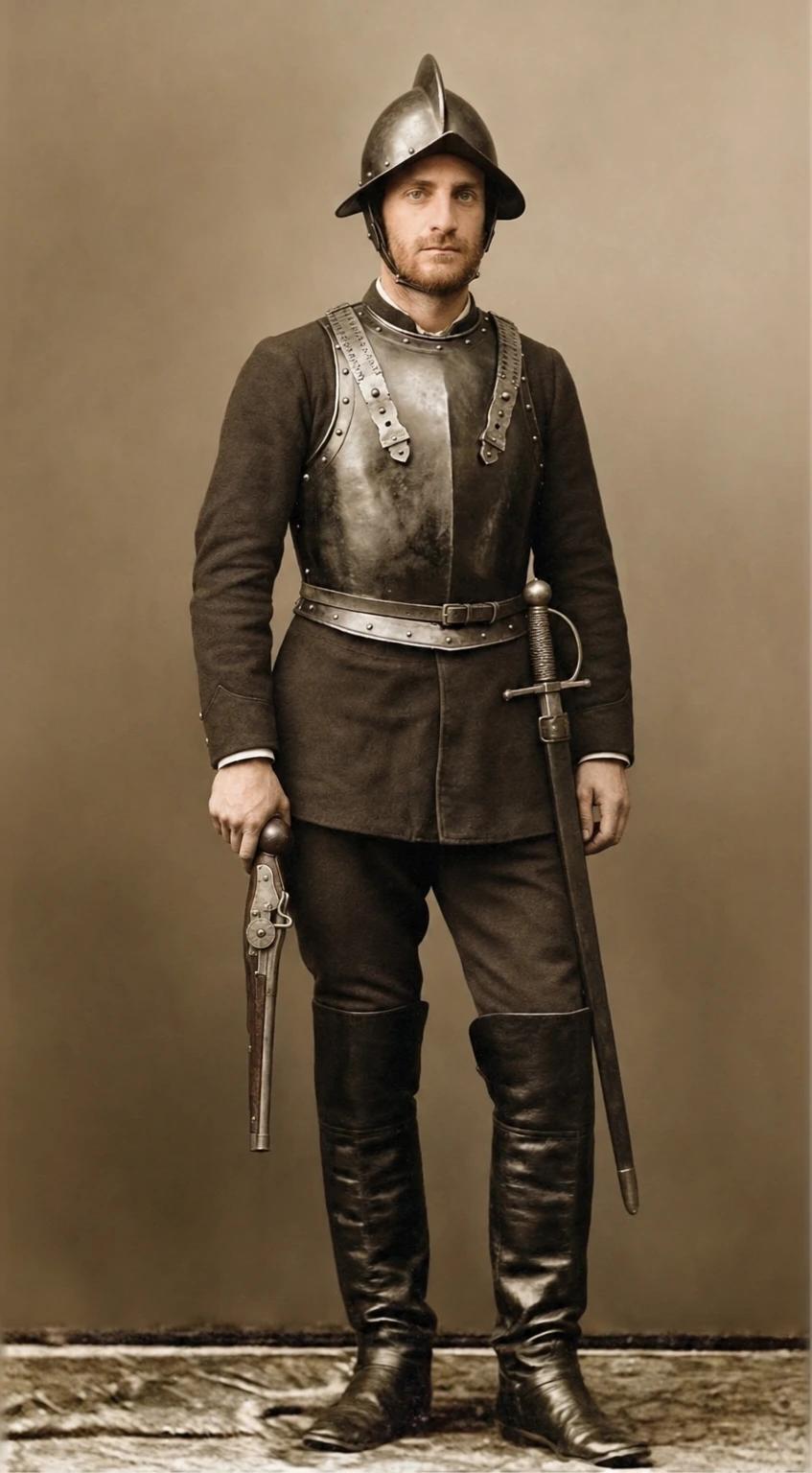
Uniform and equipment
| Uniform | Blackened full plate armor, black clothing |
|---|---|
| Dress uniform | Polished black armor with gold etching |
| Headgear | Closed burgonet helmet |
| Equipment | Multiple wheel-lock pistols, sword |
| Insignia and standard | Blackened armor signature |
Service record
| First appeared | 1540s |
|---|---|
| Peak strength | 15,000 men |
| Recruited from | Mercenary Cavalry |
| Primary tactic | Caracole (Pistol Volley) |
| Signature engagement | French Wars of Religion |
| Motto or battle cry | The Devil's Black Riders |
| Obsolescence | Return to Shock Tactics (Gustavus) |
Timeline
- 1546: Schmalkaldic War Origins. First significant deployment of pistol-armed cavalry in the Holy Roman Empire, replacing the traditional heavy lancer.
- 1554: Battle of Renty. French observers note the devastating effectiveness of German Reîtres utilizing the 'Caracole' maneuver against heavy gendarmes.
- 1562: Intervention in France. Large bands of mercenary Reîtres enter the French Wars of Religion, becoming a staple of both Catholic and Huguenot armies.
- 1587: Tactical Obsolescence. The defeat at Coutras highlights the vulnerability of the stationary caracole against aggressive sword-charges.
- 1618: Evolution to Cuirassiers. By the start of the Thirty Years' War, the distinct Reître identity merges into the general 'Cuirassier' type, adopting the sword-charge.
Battles
Battle of Sievershausen
The bloodiest battle of the Second Margrave War. Here, the Reîtres proved their worth against traditional lancers. Despite the death of Elector Maurice, the pistol-armed cavalry shattered the enemy lines, signaling the end of the knightly lance's dominance.
Battle of Dreux
A chaotic engagement where German Reîtres, hired by the Huguenots, executed a devastating charge against the Royalist Swiss pike blocks. Though the battle was tactically inconclusive, the Reîtres' ability to break infantry formations with pistol fire was brutally demonstrated.
Battle of Coutras
A turning point where the limitations of the Reître tactics were exposed. Henry of Navarre's cavalry charged home with swords, catching the Reîtres mid-caracole. It marked the beginning of the shift from pure pistol tactics back to the shock charge.
Commanders
Günther XL1 von Schwarzburg-Arnstadt
The archetype of the Schwarzreiter, Günther was a mercenary captain of grim repute. Known for his tactical acumen and imposing black armor, he led his riders through the chaos of the Schmalkaldic War and the early French Wars of Religion, professionalizing the pistol-cavalry doctrine.
Johann Casimir of the Palatinate
A staunch Calvinist prince who turned war into a holy enterprise. He led massive armies of German Reîtres into France to support the Huguenots. While not a tactical genius, his ability to muster thousands of 'Black Riders' made him a kingmaker in the religious wars.
Tactics
The Caracole
A maneuver where ranks of cavalry rode up to the enemy, fired their pistols at point-blank range, and then wheeled to the rear to reload, creating a rolling cycle of fire.
Point-Blank Volley
Riders were trained to hold fire until the muzzle nearly touched the enemy's armor, maximizing the armor-piercing potential of the wheel-lock pistol.