
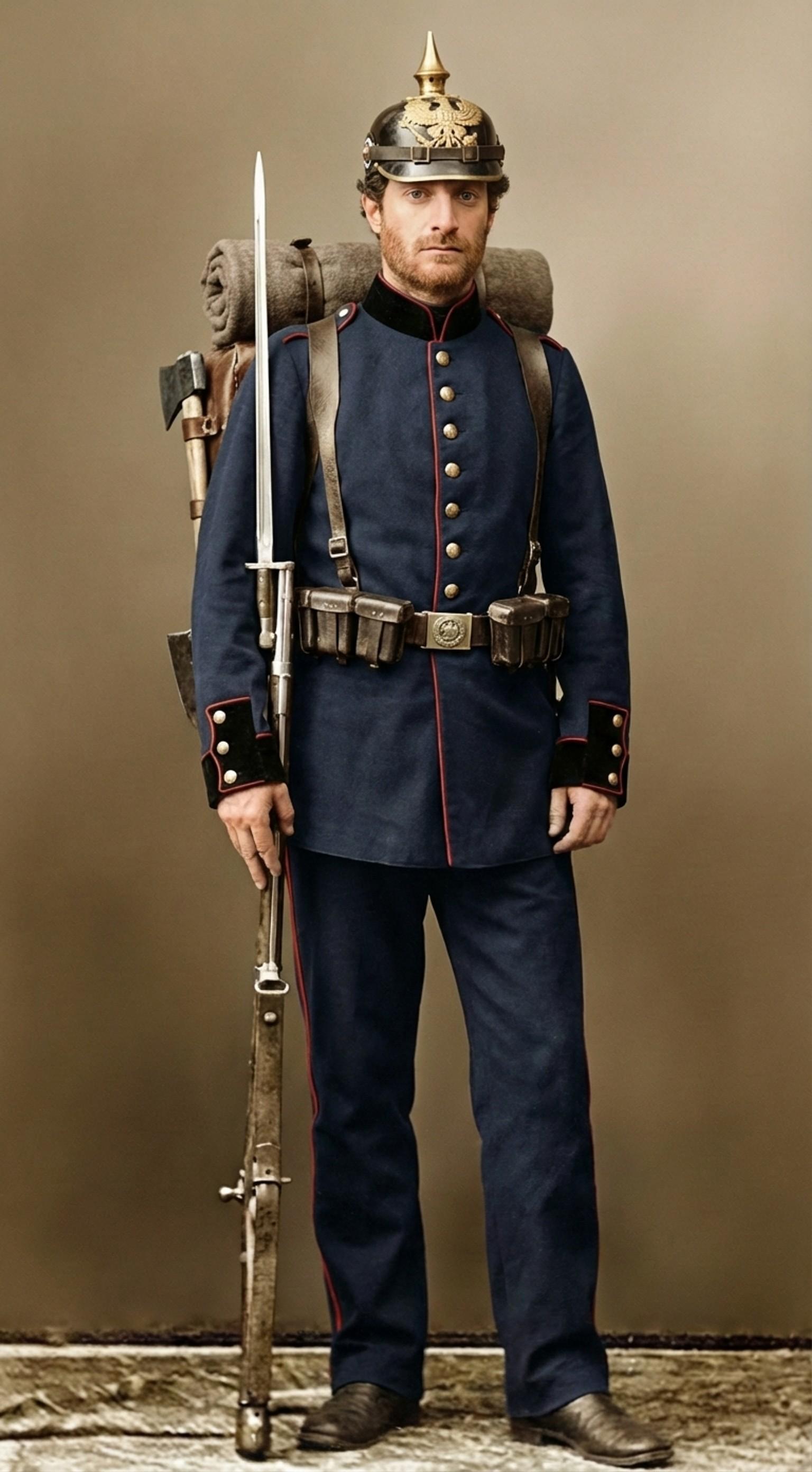
Uniform and equipment
| Uniform | Dark blue with black facings, white buttons |
|---|---|
| Dress uniform | Blue with silver appointments |
| Headgear | Black leather Pickelhaube with brass fittings |
| Equipment | Axe, shovel, carbine, specialized tools |
| Insignia and standard | Prussian eagle helmet plate (silver) |
Service record
| First appeared | 1650s |
|---|---|
| Peak strength | ~3,000 men |
| Recruited from | Skilled Tradesmen |
| Primary tactic | Sapping / Obstacle Clearing |
| Signature engagement | Siege of Strasbourg (1870) |
| Motto or battle cry | Gott mit uns (God is with us) |
| Obsolescence | Combat Engineering Vehicles |
Timeline
- 1729: Formation of the Pontooniers. Frederick William I establishes the first permanent companies dedicated to bridging, separating them from the artillery.
- 1742: Creation of the Miners Corps. Frederick the Great establishes a distinct corps for siege mining, recognizing the need for specialists in fortress warfare.
- 1762: Triumph at Schweidnitz. Prussian engineering prowess peaks with the successful use of overcharged mines to breach Austrian defenses.
- 1810: Scharnhorst's Reforms. The engineering and pontoon corps are reorganized and integrated more closely with the line army to support mobile warfare.
- 1813: The Wars of Liberation. Pioneers play a critical role in the rapid movement of Prussian armies across major rivers, contributing to Napoleon's defeat.
- 1860: Modernization. Adoption of new technologies and organization structures leading into the wars of German Unification.
Battles
Siege of Schweidnitz
The apex of subterranean warfare. Prussian miners, engaging in a terrifying duel of tunnels against Austrians, detonated a massive 'Globe of Compression.' The explosion obliterated the defenses, allowing the infantry to storm the breach and securing Silesia for Frederick.
Siege of Danzig
A stubborn, gritty defense against overwhelming French forces. Prussian engineers worked tirelessly to repair shattered bastions under constant bombardment, delaying Napoleon's Grand Armée for months and proving their resilience even in the face of inevitable capitulation.
Crossing of the Elbe at Wartenburg
A triumph of field engineering. Under heavy fire, Prussian pontooniers threw bridges across the Elbe, allowing Blücher's Army of Silesia to flank Napoleon. This technical feat was the linchpin that enabled the encirclement at Leipzig.
Commanders
Gerhard Cornelius von Walrave
The architect of Prussian impregnability. A brilliant but tempestuous engineer who designed the massive fortifications of Magdeburg and Neisse. He turned soil and stone into geometric nightmares for attackers, though his own hubris eventually led to his imprisonment.
Gerhard von Scharnhorst
A visionary reformer who recognized that intellect was as lethal as gunpowder. Beginning as an artilleryman and engineer, he transformed the Prussian technical corps from a rigid guild into a dynamic, scientific force capable of adapting to Napoleonic warfare.
Tactics
Sapping
Digging zig-zag approach trenches (saps) towards enemy fortifications to allow infantry to advance protected from enfilade fire.
Globe of Compression
A mining tactic involving the detonation of massive gunpowder charges underground to create shockwaves that collapse enemy tunnels and galleries.
Pontooning
The rapid deployment of floating bridges using boats or specialized pontoons, enabling armies to cross rivers where stone bridges were destroyed.
Abatis Clearing
Pioneers moved ahead of storming columns with axes to chop through felled trees (abatis) and palisades under direct fire.