
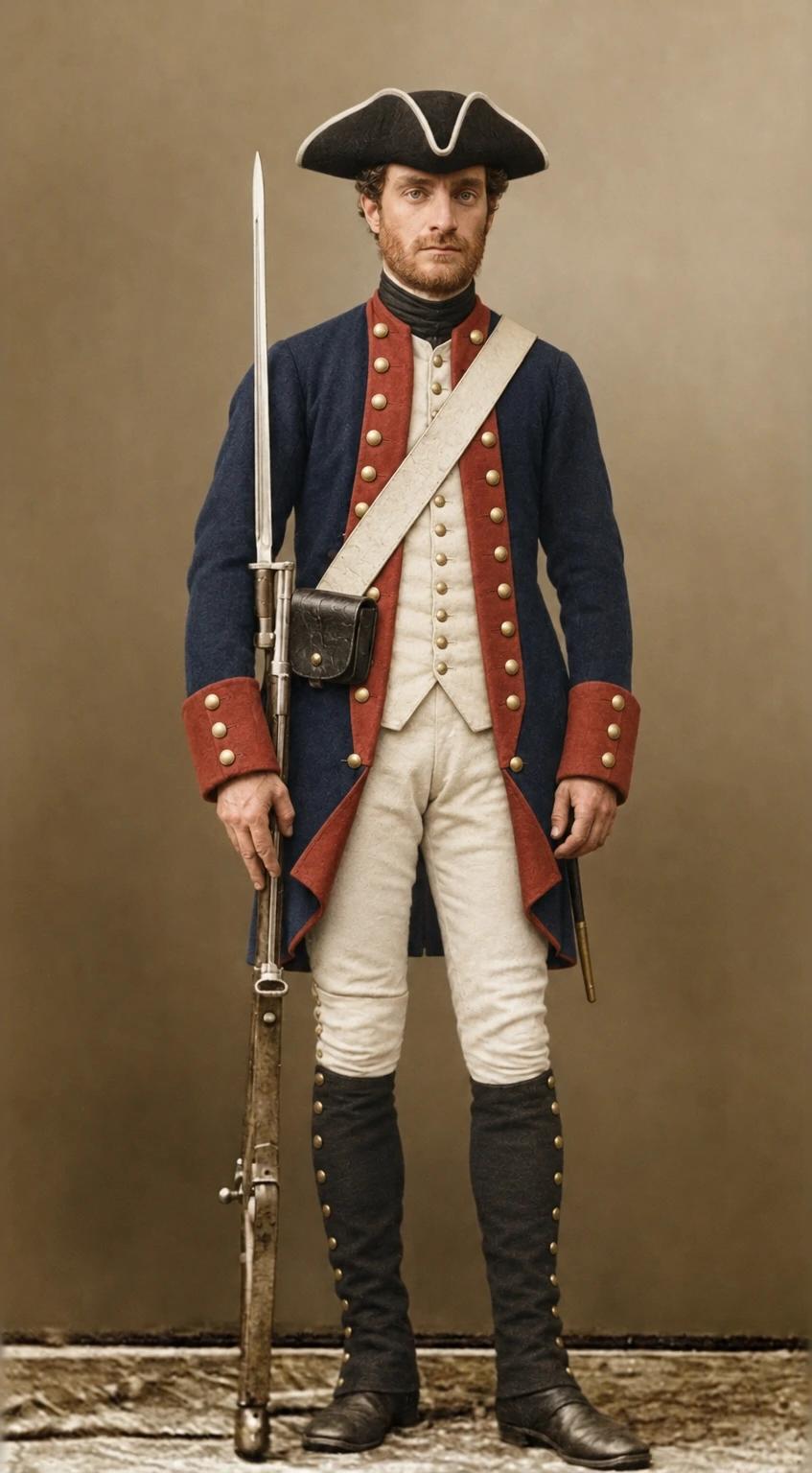
Uniform and equipment
| Uniform | Prussian blue coat with red lapels and cuffs, white breeches |
|---|---|
| Dress uniform | Dark blue with white facings, more ornate braiding |
| Headgear | Black tricorne with white tape |
| Equipment | Musket, bayonet, cartridge box, knapsack |
| Insignia and standard | Hohenzollern eagle brass plate on Pickelhaube |
Service record
| First appeared | 1640s |
|---|---|
| Peak strength | ~150,000 men |
| Recruited from | Conscripted Peasantry (Cantonal System) |
| Primary tactic | Linear Volley Fire |
| Signature engagement | Battle of Leuthen (1757) |
| Motto or battle cry | Gott mit uns (God with us) |
| Obsolescence | Flexible Skirmish Tactics / Rifled Muskets |
Timeline
- 1713: Ascension of the Soldier King. Frederick William I takes the throne, beginning the massive expansion and drilling of the army that Frederick the Great would later wield.
- 1740: Invasion of Silesia. Frederick II invades Austrian Silesia, testing the Line Infantry in combat for the first time at Mollwitz.
- 1745: Refinement of Cavalry and Infantry. After the Second Silesian War, Frederick reforms the cooperation between arms, perfecting the aggressive infantry advance.
- 1756: Outbreak of Seven Years' War. Prussia faces a coalition of major powers; the infantry becomes the bulwark of the state's survival.
- 1757: The Miracle Year. Victories at Rossbach and Leuthen cement the reputation of the Prussian Line Infantry as the finest in the world.
- 1763: Treaty of Hubertusburg. Prussia retains Silesia. The infantry returns to garrison, their reputation securing peace through deterrence.
- 1806: Collapse at Jena-Auerstedt. The aging Frederician system, frozen in time and lacking innovation, is destroyed by Napoleon's dynamic Grande Armée.
Battles
Battle of Hohenfriedberg
Frederick's decisive victory in the Second Silesian War. The infantry advanced with muskets shouldered into the face of enemy fire before unleashing devastating volleys, proving their superior drill.
Battle of Leuthen
The masterpiece of the Oblique Order. Outnumbered nearly 2-to-1, Prussian infantry executed a complex flank march under fire, rolling up the Austrian line in a display of discipline that stunned Europe.
Battle of Rossbach
A crushing defeat of the combined French and Imperial armies. The Prussian infantry moved with such speed that they caught the enemy on the march, shattering them in less than 90 minutes with minimal Prussian casualties.
Battle of Kunersdorf
Prussia's greatest calamity. Despite initial success, the infantry was ground down by Russian artillery and terrain. It demonstrated the limits of the linear tactic against entrenched positions, nearly costing Frederick his crown.
Commanders
Frederick the Great (Friedrich II)
The Philosopher King who transformed Prussia into a European superpower. A master of maneuver warfare and discipline, he demanded absolute obedience and precision, leading his 'walking batteries' personally into the thickest fire.
Kurt Christoph von Schwerin
One of Frederick's most trusted Field Marshals. A veteran of multiple wars, he met a soldier's end at the Battle of Prague, seizing a color from a wavering regiment and leading them forward before being struck by canister shot.
Leopold I, Prince of Anhalt-Dessau
Known as 'The Old Dessauer,' he was the drillmaster of the Prussian Army. He introduced the iron ramrod and the cadenced step, turning the infantry into a relentless, mechanical force capable of firing faster than any enemy.
Tactics
Oblique Order
A maneuver where the army reinforces one wing to crush the enemy flank while refusing (holding back) the weaker wing, requiring precise marching discipline.
Platoon Fire (Pelotonfeuer)
A rolling volley system where platoons fired in succession down the line, creating a continuous, demoralizing wall of lead.
The Advance
Marching steadily into enemy fire without pausing to shoot until close range (approx. 50 paces), maximizing the psychological shock of the first volley.
Cadenced March
Standardized step rate allowing large formations to wheel, deploy, and change front rapidly on the battlefield without losing cohesion.