
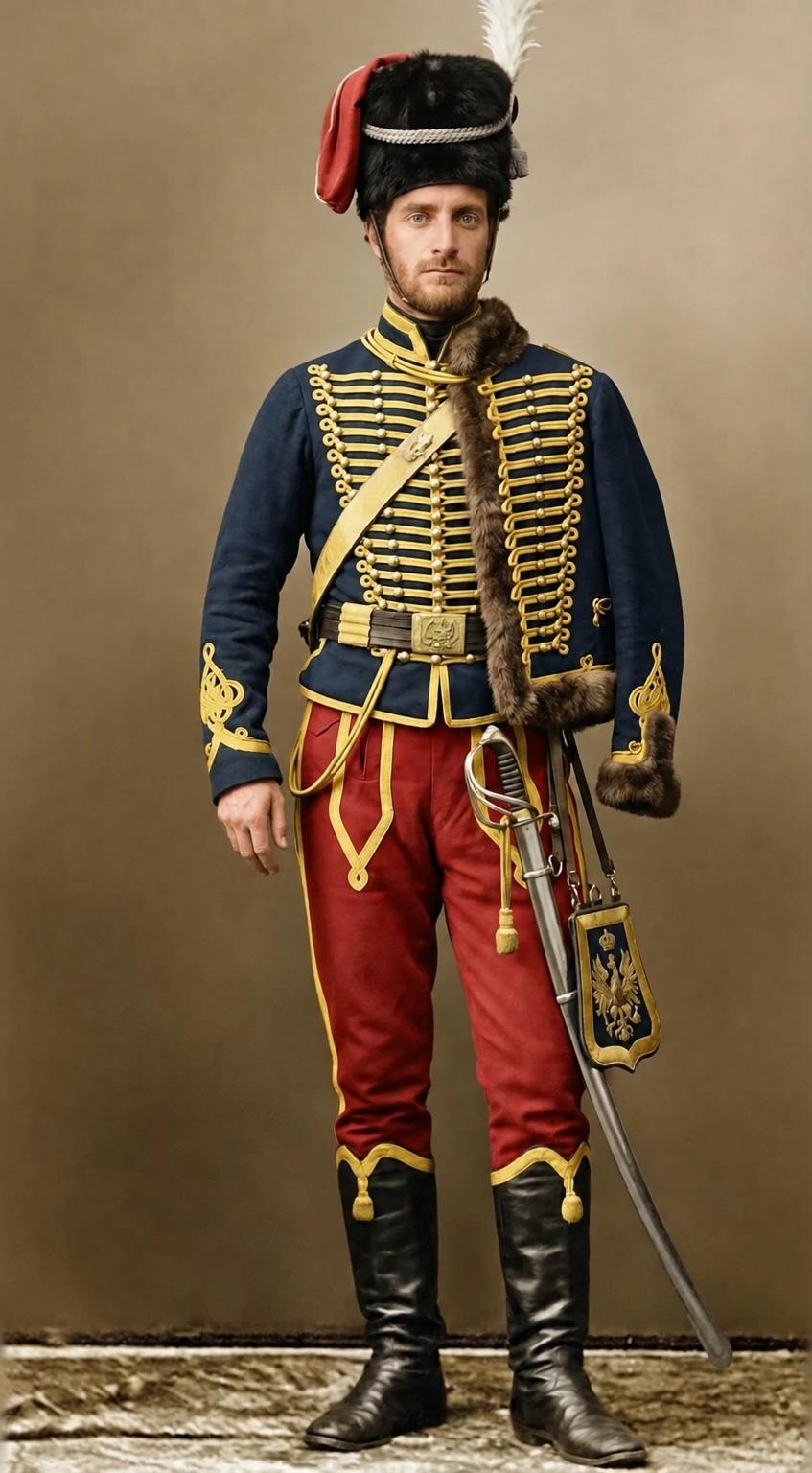
Uniform and equipment
| Uniform | Dolman jacket, pelisse, colored by regiment |
|---|---|
| Dress uniform | Heavily braided dolman, fur-trimmed pelisse |
| Headgear | Fur busby (kolpak) or mirliton cap |
| Equipment | Curved sabre, carbine, pistols |
| Insignia and standard | Mirliton wing cap, regimental colors |
Service record
| First appeared | 1721 |
|---|---|
| Peak strength | ~12,000 men |
| Recruited from | Volunteers / Adventurers |
| Primary tactic | Hit-and-Run / Pursuit |
| Signature engagement | Battle of Zorndorf (1758) |
| Motto or battle cry | Vincere aut mori (To conquer or die) |
| Obsolescence | Aircraft Reconnaissance |
Timeline
- 1721: Formation. The first dedicated Prussian Hussar regiments are established, initially modeled on Hungarian irregulars.
- 1740: Frederickian Reforms. Frederick the Great ascends the throne and drastically expands the Hussar corps, demanding stricter discipline and aggressive tactics.
- 1745: Zieten's Rise. Following the Battle of Hohenfriedberg and Hennersdorf, the Prussian Hussars are recognized as the premier light cavalry in Europe.
- 1756: Seven Years' War Begins. The Hussars enter their golden age, serving as the eyes and ears of the army across multiple fronts.
- 1763: Peace of Hubertusburg. The war ends; the Hussars have suffered massive casualties but achieved legendary status.
- 1806: Collapse at Jena. The stagnated Prussian army is crushed by Napoleon; the old Hussar regiments are largely destroyed or disbanded.
- 1813: Reorganization. New Hussar regiments are raised for the Wars of Liberation, blending old traditions with modern light cavalry doctrine.
Battles
Battle of Hennersdorf
A quintessential Hussar action. Zieten led a surprise charge against a superior Saxon force. Emerging from concealment, the Hussars shattered the enemy infantry squares, securing a vital strategic advantage for Frederick II through sheer speed and shock.
Battle of Rossbach
The Hussars played a critical role in the trap sprung by Frederick. As the French and Imperial army attempted to flank, the Prussian cavalry, including the Hussars, smashed them in column formation, routing an army twice their size in less than 90 minutes.
Battle of Zorndorf
In one of the bloodiest battles of the century, the Hussars, alongside Seydlitz's heavy cavalry, executed repeated charges into the stubborn Russian masses. Amidst dust and carnage, their refusal to break turned a potential disaster into a strategic hold.
Commanders
Wilhelm Sebastian von Belling
A pious yet ferocious commander who formed the legendary 'Black Hussars' (Death's Head Hussars). Known for carrying a Bible in one hand and a sabre in the other, his unit became synonymous with terror on the battlefield and unyielding discipline.
Gebhard Leberecht von Blücher
Before becoming the field marshal who defeated Napoleon, Blücher began his Prussian service as a Hussar officer. His aggressive, forward-momentum style ('Marschall Vorwärts') was forged in the saddle of a light cavalry charger during the Seven Years' War.
Hans Joachim von Zieten
The archetypal Hussar general, known as 'Zieten out of the Bush' for his surprise attacks. A favorite of Frederick the Great, he transformed the Prussian Hussars from undisciplined raiders into an elite shock force, blending reckless bravery with tactical brilliance.
Tactics
Kleinkrieg (Little War)
Relentless harassment of enemy supply lines, foraging parties, and outposts. This attrition warfare bled enemy armies dry before major engagements occurred.
The Knee-to-Knee Charge
Unlike other light cavalry who skirmished, Prussian Hussars were trained to charge in tight formation at a full gallop, delivering a kinetic shock comparable to heavy dragoons.
Strategic Pursuit
After a victory, Hussars were unleashed to chase down fleeing troops, turning a tactical retreat into a total rout by preventing the enemy from rallying.