
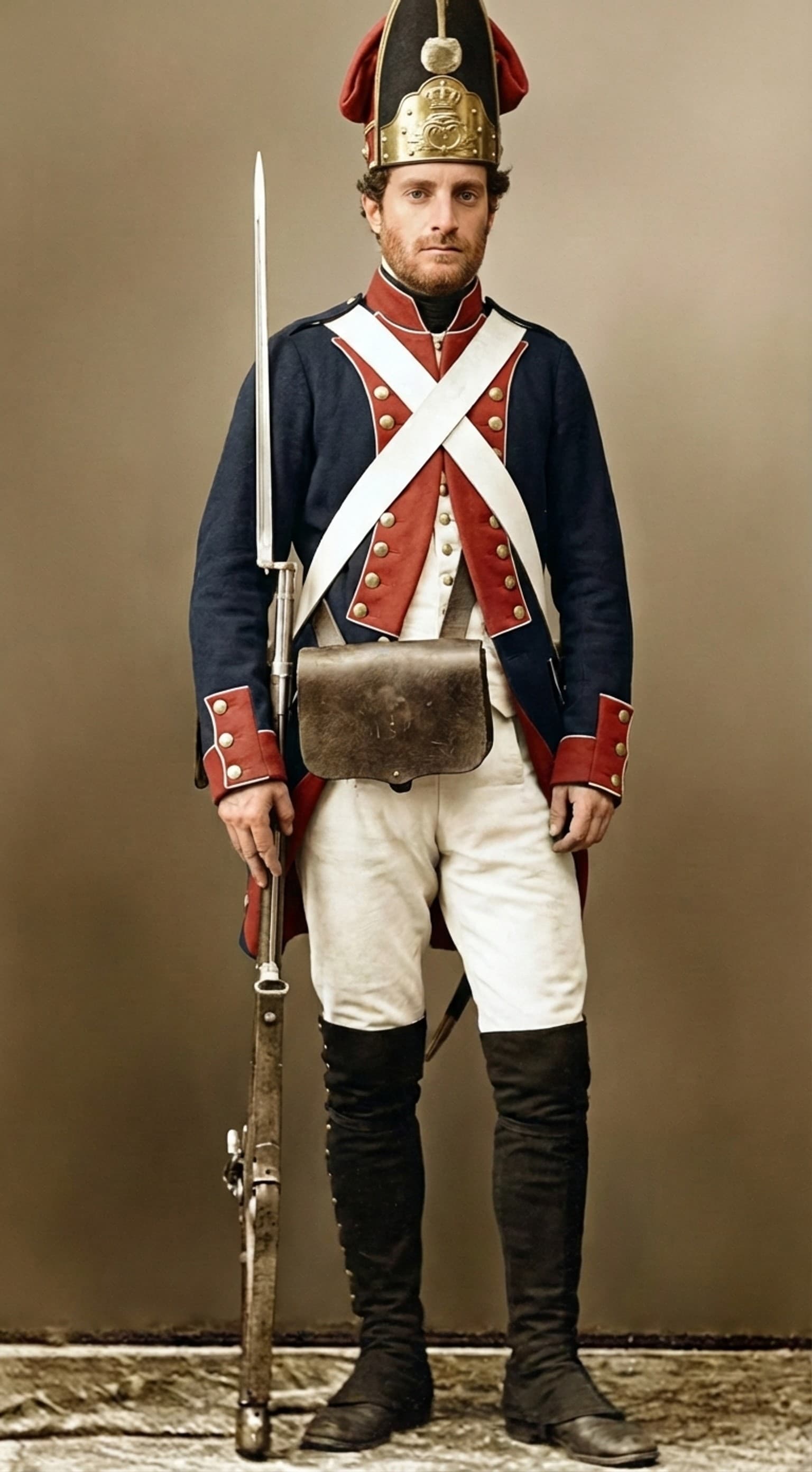
Uniform and equipment
| Uniform | Blue coat, red facings, tall mitre cap |
|---|---|
| Dress uniform | High mitre cap to exaggerate height |
| Headgear | Grenadier mitre cap |
| Equipment | Musket, grenade |
| Insignia and standard | Huge brass grenadier eagle on tall mitre |
Service record
| First appeared | 1713 |
|---|---|
| Peak strength | Regiment |
| Recruited from | Recruited for height (>6ft) |
| Primary tactic | Intimidation |
| Signature engagement | Parade Duty (Mostly) |
| Motto or battle cry | Pro Gloria et Patria (For Glory and Fatherland) |
| Obsolescence | Disbanded by Frederick the Great |
Timeline
- 1675: Regimental Origins. The unit traces its lineage to the 'Red Grenadiers' formed under the Great Elector, long before the height requirement became an obsession.
- 1713: Ascension of the Soldier King. Frederick William I takes the throne and immediately begins recruiting men over 6 Prussian feet (approx. 6'2") from across Europe.
- 1730: Peak Strength. The regiment swells to around 3,000 giants, funded by the King's extreme austerity elsewhere in the state budget.
- 1740: The Great Disbandment. Frederick the Great ascends and dissolves the 'Lange Kerls' as a distinct entity, merging the best soldiers into the Grenadier Garde No. 6.
- 1806: Final Dissolution. The successor unit surrenders near Erfurt following the disastrous Prussian defeat at Jena-Auerstedt against Napoleon.
Battles
The Potsdam Reviews
Not a kinetic engagement, but a campaign of psychological warfare. Foreign dignitaries were subjected to the terrifying sight of hundreds of giants executing clockwork drills. This display of biological and martial superiority deterred aggression without firing a shot.
Battle of Hohenfriedberg
Following their reorganization into the Grenadier Garde No. 6 by Frederick the Great, the remnants of the unit proved they were more than showpieces. They advanced with iron discipline against Austrian forces, validating their elite status in the blood and smoke of real war.
Commanders
King Frederick II (The Great)
Inheriting the regiment upon his father's death, Frederick viewed the 'Giants' as an expensive folly. He pragmatically disbanded the ceremonial unit, redistributing the capable soldiers into combat-ready guard battalions to forge Prussia's expansionist destiny.
King Frederick William I
Known as the 'Soldier King,' his obsession with tall men drove the creation of the unit. A frugal, gritty monarch who traded jewels and alliances for giants, he drilled them personally in the rain but loved them too dearly to risk their lives in actual combat.
Tactics
Psychological Intimidation
Leveraging sheer physical size to demoralize the enemy before engagement. The sight of a wall of giants was intended to break enemy resolve instantly.
Precision Drill
The unit mastered the 'goose-step' and rapid reloading drills, turning the regiment into a single, terrifying machine capable of firing faster than any other European infantry.
Grenadier Assault
While rarely used by the Giants, the tactic involved lighting fuses and hurling iron spheres at close range before a bayonet charge.