
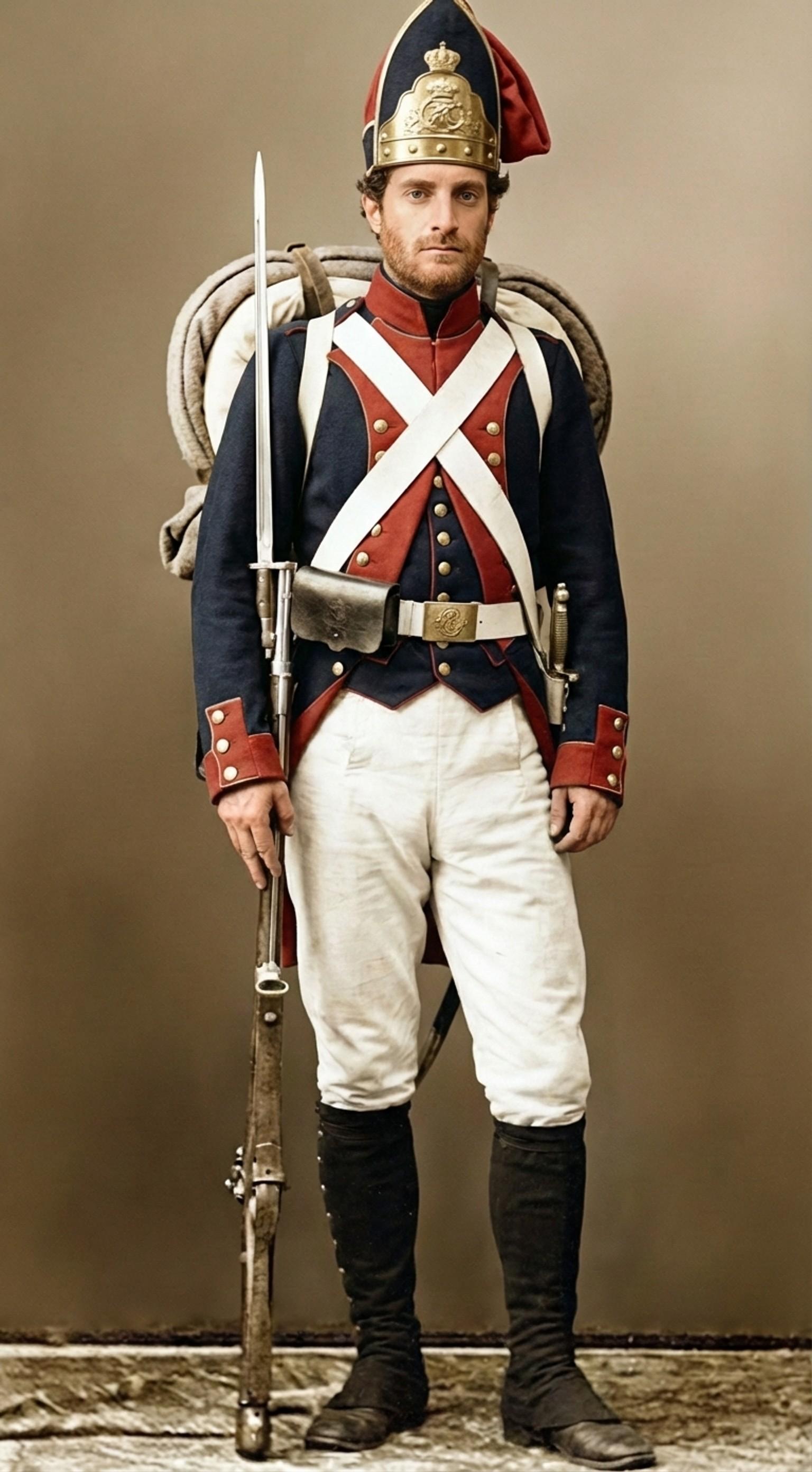
Uniform and equipment
| Uniform | Dark blue coat, red facings, white trousers |
|---|---|
| Dress uniform | More elaborate blue coat with gold lace |
| Headgear | Distinctive mitre cap (until 1807), then shako with special plume |
| Equipment | Musket, bayonet, grenades (early period), sabre |
| Insignia and standard | Black Eagle brass front plate |
Service record
| First appeared | 1670s |
|---|---|
| Peak strength | ~20,000 men |
| Recruited from | Selected Veterans / Tall Conscripts |
| Primary tactic | Shock Assault / Grenade Volley |
| Signature engagement | Battle of Hohenfriedberg (1745) |
| Motto or battle cry | Semper Talis (Always Such) |
| Obsolescence | Rifled Muskets (Grenades abandoned) |
Timeline
- 1713: Ascension of the Soldier King. Frederick William I expands the army and creates the 'Potsdam Giants', establishing the cult of the tall Grenadier.
- 1718: Introduction of the Iron Ramrod. Leopold I introduces the steel ramrod, drastically increasing the rate of fire for Prussian infantry.
- 1740: Invasion of Silesia. Frederick the Great unleashes the Grenadiers in the First Silesian War, testing the new military machine.
- 1745: Triumph at Hohenfriedberg. The Grenadiers prove their dominance in open field combat, cementing Prussia as a Great Power.
- 1756: Start of Seven Years' War. The unit enters its most grueling conflict, facing Austria, France, and Russia simultaneously.
- 1806: Disaster at Jena-Auerstedt. The outdated tactics of the Grenadiers fail against Napoleon's dynamic warfare, leading to the collapse of the old Prussian army.
Battles
Battle of Hohenfriedberg
At dawn, the Prussian Grenadiers smashed the Saxon-Austrian lines. Their discipline allowed them to advance silently before unleashing devastating volleys. It was the decisive clash of the Second Silesian War, proving the superiority of Prussian drill.
Battle of Leuthen
Outnumbered nearly 2 to 1, the Grenadiers executed a perfect Oblique Order maneuver, rolling up the Austrian flank. Moving like clockwork through snow and mud, they shattered the enemy line in Frederick's greatest tactical masterpiece.
Battle of Zorndorf
A brutal, bloody slugfest against the Russians. The Grenadiers engaged in savage hand-to-hand combat when ammunition ran dry. Though the field was held, the elite infantry suffered horrific casualties, thinning the ranks of the veteran 'giants'.
Commanders
Leopold I, Prince of Anhalt-Dessau
Known as 'The Old Dessauer,' he was the architect of the Prussian infantry's mechanical perfection. He introduced the iron ramrod and the cadence step, transforming the Grenadiers into a relentless firing machine that dominated 18th-century Europe.
Frederick II (Frederick the Great)
The Philosopher King who wielded the weapon his father and the Old Dessauer forged. He led the Grenadiers personally, utilizing their discipline to execute complex maneuvers like the Oblique Order against vastly superior Austrian and Russian numbers.
Tactics
The Rolling Volley
Utilizing platoon fire, the line maintained a continuous stream of lead. As one section fired, the next was priming, creating a wall of death that demoralized enemies.
Oblique Order
A difficult maneuver where the line advanced diagonally, refusing one flank while overwhelming the enemy's weak point with local superiority of numbers.
Shock Assault
Advancing with muskets shouldered into the teeth of enemy fire, relying on iron discipline to close the distance before delivering a single volley and a bayonet charge.