
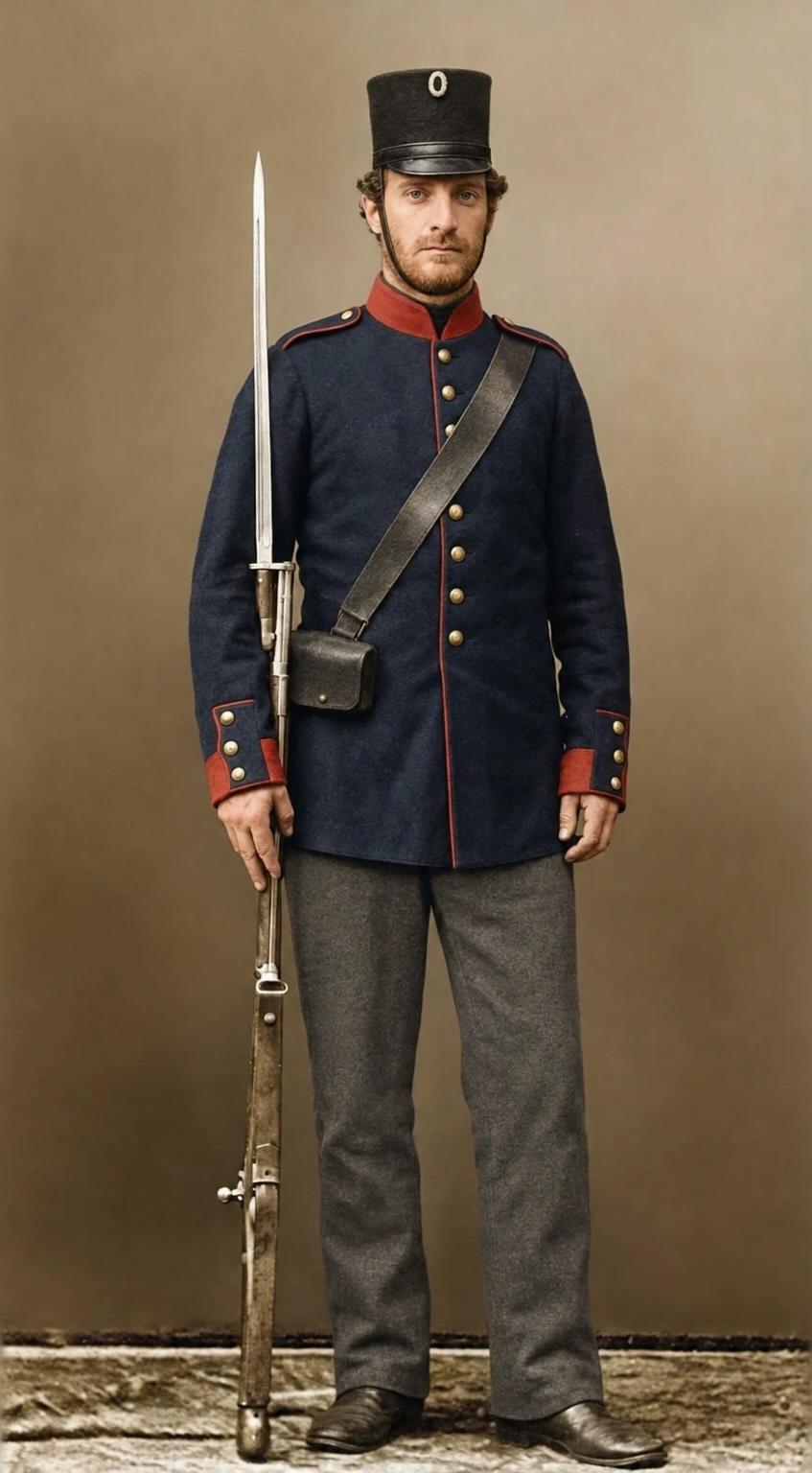
Uniform and equipment
| Uniform | Dark blue coat, black facings with light blue piping |
|---|---|
| Dress uniform | Similar with silver buttons and trim |
| Headgear | Black felt shako (plume for parade only) |
| Equipment | Lighter musket, bayonet, ammunition pouches |
| Insignia and standard | Smaller black leather helmet with distinct eagle |
Service record
| First appeared | 1680s |
|---|---|
| Peak strength | ~40,000 men |
| Recruited from | Smaller Conscripts / Peasantry |
| Primary tactic | Skirmishing / Flanking |
| Signature engagement | Battle of Nations (Leipzig) (1813) |
| Motto or battle cry | Pro Gloria et Patria (For Glory and Fatherland) |
| Obsolescence | Universal Conscription / Breech-loaders |
Timeline
- 1787: Formation. Frederick William II establishes Fusilier battalions as distinct light infantry units to counter Austrian skirmishers.
- 1806: Collapse at Jena. The destruction of the old army necessitates a complete doctrinal overhaul.
- 1808: Scharnhorst Reforms. Fusiliers are integrated as the third battalion of every Line Infantry regiment, specializing in skirmishing.
- 1812: Convention of Tauroggen. Prussian units, including Fusiliers, defect from the French alliance to join Russia, starting the War of Liberation.
- 1813: The Iron Cross. King Frederick William III institutes the Iron Cross; many Fusiliers are among the first recipients for valor at Leipzig.
- 1815: Waterloo Campaign. The unit plays a decisive role in the final defeat of Napoleon, proving the efficacy of the new Prussian system.
Battles
Battle of Jena-Auerstedt
The old Prussian war machine shattered against Napoleonic flexibility. The Fusiliers fought bravely but were hamstrung by obsolete linear tactics. This catastrophic defeat became the crucible for the sweeping reforms that forged the modern Fusilier.
Battle of Leipzig (Battle of Nations)
At Möckern, Yorck's Fusiliers faced a murderous crossfire. Abandoning cover, they charged Marmont's corps with bayonets fixed, turning the tide in the north. It was a bloody triumph of discipline over French artillery supremacy.
Battle of Waterloo
Arriving late to the field, Prussian Fusiliers engaged the Imperial Guard in the burning streets of Plancenoit. Fighting house-to-house in a gritty melee, they drew Napoleon's reserves away from Wellington's crumbling line, sealing the Emperor's fate.
Commanders
Ludwig Yorck von Wartenburg
A stern pragmatist and the father of Prussian light infantry tactics. He transformed the Fusiliers from rigid automatons into flexible skirmishers capable of independent thought. His defiance at the Convention of Tauroggen sparked the War of Liberation.
Gebhard Leberecht von Blücher
The indomitable 'Marshal Forwards' whose aggressive spirit permeated the Prussian ranks. While a cavalryman at heart, he relied heavily on the tenacity of his Fusilier battalions to hold villages and break French lines through sheer attrition and willpower.
Tactics
Schützenlinie (Skirmish Line)
Deploying in open order ahead of the main column to harass the enemy with aimed fire, using terrain for cover rather than standing in rigid lines.
Attack Column (Angriffskolonne)
Rapidly transitioning from skirmishing to a dense column to punch through enemy lines with bayonets after softening them up with musketry.
Independent Fire
Unlike line infantry volley fire, Fusiliers were trained to fire at will, picking individual targets to disrupt enemy officers and artillery crews.