
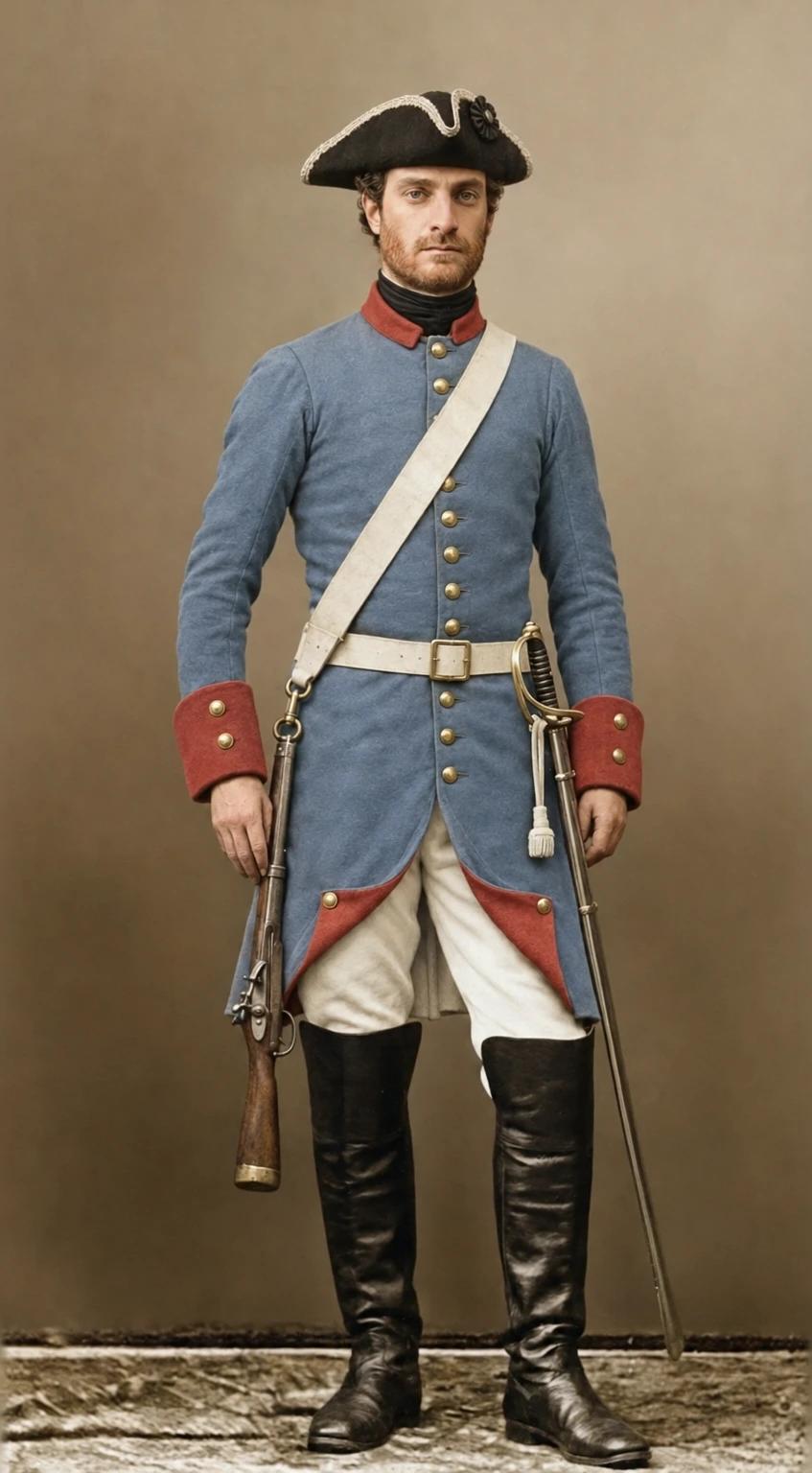
Uniform and equipment
| Uniform | Light blue coat, various facing colors |
|---|---|
| Dress uniform | Light blue with regimental distinctions |
| Headgear | Black tricorne with white lace |
| Equipment | Carbine, sabre, pistols |
| Insignia and standard | Prussian eagle helmet plate (gold) |
Service record
| First appeared | 1670s |
|---|---|
| Peak strength | ~15,000 men |
| Recruited from | Mixed Conscripts / Middle Class |
| Primary tactic | Mobile Firepower / Charge |
| Signature engagement | Battle of Krefeld (1758) |
| Motto or battle cry | Gott mit uns (God is with us) |
| Obsolescence | Mechanization (Tanks) |
Timeline
- 1689: Standardization. Elector Frederick III begins standardizing dragoon regiments, moving away from mercenary bands.
- 1740: Frederician Reforms. Frederick II ascends and immediately bans firing from the saddle during charges, demanding 'cold steel' aggression.
- 1745: Legend of Bayreuth. The Bayreuth Dragoons achieve legendary status at Hohenfriedberg, elevating the prestige of the arm.
- 1756: Seven Years' War. The unit type sees extensive service across all fronts, acting as the workhorse of the Prussian army.
- 1806: Collapse at Jena. Outdated tactics and aging leadership lead to the destruction of the classic Prussian Dragoon regiments by Napoleon.
- 1808: The Great Reform. Scharnhorst and Gneisenau restructure the cavalry, modernizing the Dragoons for the War of Liberation.
Battles
Battle of Hohenfriedberg
The defining moment of Prussian cavalry history. The Bayreuth Dragoons exploited a gap in the Austrian line, charging 'en muraille' and shattering the enemy infantry. It remains one of the most successful cavalry charges in history.
Battle of Krefeld
Under Ferdinand of Brunswick, Prussian Dragoons executed a brilliant flanking maneuver through difficult terrain (the 'Green Road'), catching the French off guard and rolling up their line with disciplined ferocity.
Battle of Zorndorf
A bloodbath against the Russians. In the dust and confusion, the Dragoons fought hand-to-hand in a grinder of men and horses, proving their resilience when tactical finesse broke down into sheer butchery.
Commanders
Dubislav Gneomar von Natzmer
A titan of the Old Prussian discipline, Natzmer served three kings, transforming the Dragoons from ragtag mounted infantry into a disciplined, iron-willed corps. His rigid standards laid the foundation for the cavalry that would later shake Europe under Frederick the Great.
Friedrich Leopold von Gessler
The hero of Hohenfriedberg. In a single, thunderous charge, Gessler led the Bayreuth Dragoons into the Austrian center, annihilating 20 battalions and capturing 67 standards. He proved that Dragoons could deliver shock impacts rivaling the heaviest Cuirassiers.
Tactics
Charge at the Gallop
Contrary to previous doctrine, Frederick ordered Dragoons to charge at full speed, knee-to-knee, forbidding pistol fire to maximize the shock of impact.
En Muraille
A tight, wall-like formation where troopers rode boot-to-boot, creating an unbreakable wave of horses and steel designed to shatter infantry squares.
Dismounted Action
Retaining their infantry roots, Dragoons could dismount to hold bridges or villages with carbine fire, though this became secondary to shock action.