
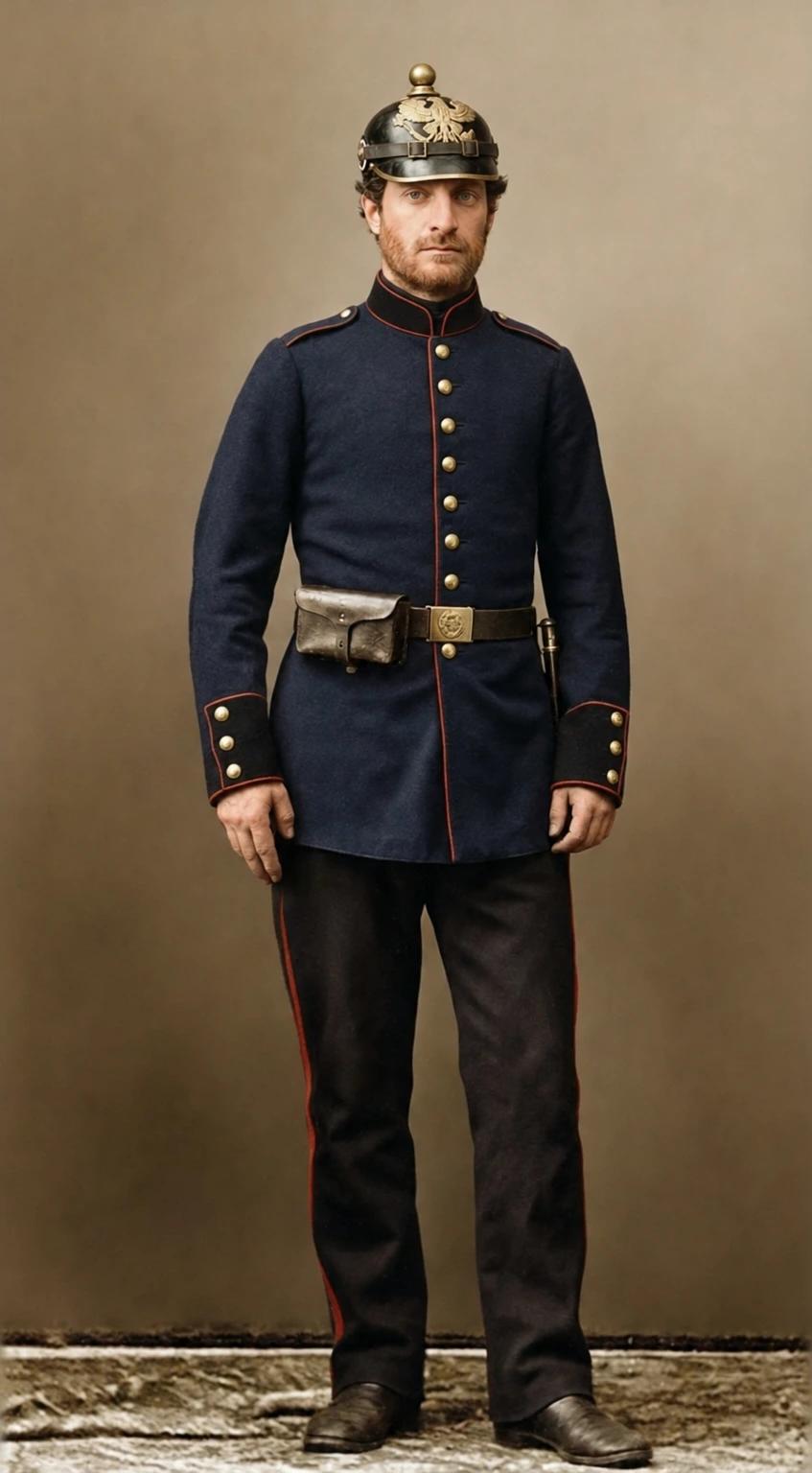
Uniform and equipment
| Uniform | Dark blue with black facings, red piping |
|---|---|
| Dress uniform | Blue with red trim, brass buttons |
| Headgear | Black leather Pickelhaube with ball top |
| Equipment | Short sword, pistol, artillery tools |
| Insignia and standard | Crossed cannons with grenade/eagle |
Service record
| First appeared | 1650s |
|---|---|
| Peak strength | ~15,000 men |
| Recruited from | Educated Specialists |
| Primary tactic | Bombardment / Counter-Battery |
| Signature engagement | Siege of Paris (1870) |
| Motto or battle cry | Zu Gleich! (Load together) |
| Obsolescence | Self-Propelled / Missile Technology |
Timeline
- 1759: Frederick's Horse Artillery. Frederick the Great establishes the first true horse artillery, prioritizing speed and mobility to keep pace with cavalry.
- 1808: Scharnhorst Reforms. Following the defeat at Jena-Auerstedt, the artillery is reorganized into a distinct, professional corps independent of the infantry.
- 1861: Adoption of the C-61. Prussia becomes the first nation to adopt a rifled, breech-loading steel cannon, rendering bronze muzzle-loaders obsolete.
- 1866: Bohemian Campaign Reforms. After Königgrätz, tactical doctrine shifts to massing batteries early in the battle rather than keeping them in reserve.
- 1870: Franco-Prussian War. Prussian artillery dominates the French, proving the superiority of steel breech-loaders and percussion-fused shells.
- 1872: Imperial Integration. The Prussian artillery structure becomes the template for the entire Imperial German Army artillery corps.
Battles
Battle of Königgrätz
While the infantry's needle guns stole the glory, the artillery learned hard lessons here. Outranged by Austrian guns, the Prussians reorganized rapidly post-battle, leading to the superior tactics used four years later against France.
Siege of Paris
A grueling test of endurance and logistics. Prussian siege batteries pounded the city's fortifications and civilian sectors through a freezing winter. The psychological terror of the shelling, combined with starvation, forced the capitulation of the French capital.
Battle of Sedan
The masterpiece of Prussian gunnery. Krupp breech-loaders formed a 'Ring of Steel' around the French army. The relentless, rapid-fire bombardment shattered French morale and forced Emperor Napoleon III to surrender, cementing the dominance of steel artillery.
Commanders
Prince Kraft zu Hohenlohe-Ingelfingen
The tactical genius behind the Prussian artillery's modernization. He advocated for pushing guns forward to support infantry aggressively, a doctrine that turned the tide at Sedan. A gritty commander who believed the smell of cordite was the only perfume a soldier needed.
Karl von Rottmeister
A stoic disciplinarian known as the 'Iron Calculator.' Rottmeister revolutionized siege logistics, treating bombardment not as art, but as an industrial process. His cold precision at the Siege of Paris broke the city's spirit while preserving his own crews from counter-fire.
Tactics
Massed Battery Fire
Concentrating the fire of multiple batteries (often 100+ guns) onto a single point to obliterate enemy lines before the infantry advance.
Counter-Battery Fire
Prioritizing the destruction of enemy artillery first to ensure friendly supremacy, allowing unmolested bombardment of infantry.
Forward Deployment
Aggressively pushing guns to the front lines, sometimes ahead of infantry, to deliver canister shot at close range during critical moments.