
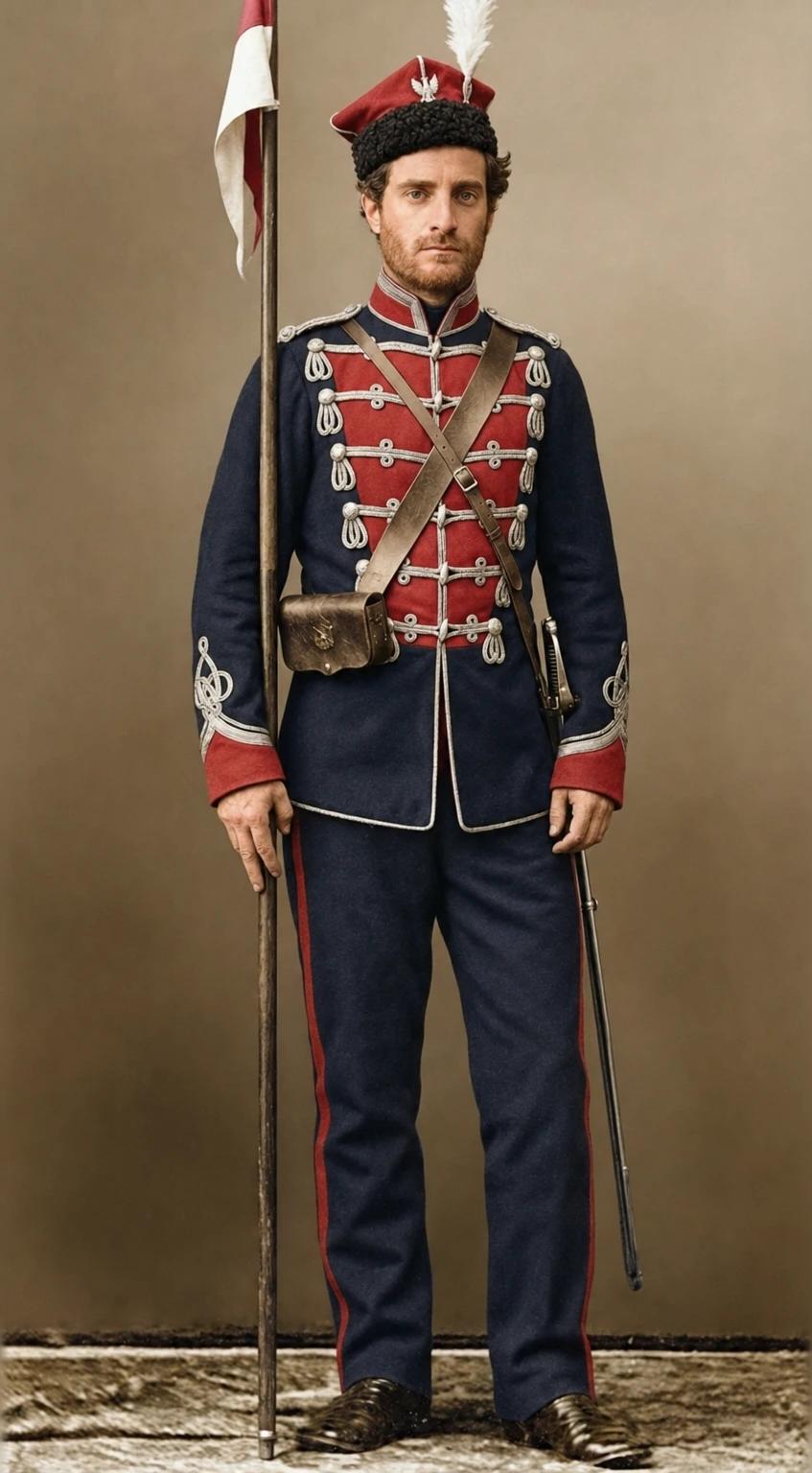
Uniform and equipment
| Uniform | Short navy jacket with crimson facings, navy trousers with crimson stripe, simple cloak |
|---|---|
| Dress uniform | Embroidered kurtka, richly trimmed cloaks |
| Headgear | Crimson square-topped krakuska cap with black lambskin band and plume |
| Equipment | Lance, sabre, pistols |
| Insignia and standard | None (irregular) |
Service record
| First appeared | 1813 |
|---|---|
| Peak strength | 1,000–2,000 men |
| Recruited from | Polish Volunteers (Cossack Style) |
| Primary tactic | Scouting / Skirmishing |
| Signature engagement | Campaign of France (1814) |
| Motto or battle cry | Bóg, Honor, Ojczyzna (God, Honor, Fatherland) |
| Obsolescence | Partition of Poland |
Timeline
- 1812: Decree of Formation. Following the disastrous retreat from Moscow, a decree calls for a levy of light cavalry from the Kraków department.
- 1813: Integration into Grande Armée. The unit is formally organized and joins the VIII Corps under Poniatowski in Saxony.
- 1813: Battle of Leipzig. The unit suffers heavy casualties covering the French retreat; Poniatowski dies.
- 1814: Campaign of France. The Krakus earn a fearsome reputation as 'Polish Cossacks', winning skirmishes at Brienne and Laon.
- 1814: Review at Saint-Denis. After Napoleon's abdication, Tsar Alexander I reviews the surviving Krakus before allowing them to return to Poland with their arms.
Battles
Battle of Leipzig
In the chaotic 'Battle of Nations', the Krakus regiment fought desperately as the personal escort to Prince Poniatowski. Amidst the carnage of the retreat, they held the line against overwhelming Allied numbers, witnessing their commander's tragic death in the Elster river.
Defense of Paris (Clichy)
The final stand of the Napoleonic Wars. The Krakus fought a gritty delaying action at the Clichy barrier, defending the French capital against the advancing Russian and Prussian armies until the inevitable capitulation.
Battle of Berry-au-Bac
A defining moment where Napoleon ordered the Krakus to clear the bridge. They charged with such ferocity that they routed two regiments of Russian Cossacks. The Emperor, watching through his spyglass, reportedly exclaimed, 'These are the finest light cavalry in my army!'
Commanders
Colonel Józef Dwernicki
A pugnacious commander who forged the Krakus into a lethal fighting force. He famously led the charge at Berry-au-Bac, proving that Polish light cavalry could outmatch the dreaded Russian Cossacks at their own game. He later became a key general in the November Uprising.
Prince Józef Poniatowski
A tragic and gallant figure, Poniatowski was the only foreigner to receive the baton of a Marshal of France. He personally led the Polish forces, including the Krakus, with reckless bravery. He drowned in the Elster river covering the retreat at Leipzig, becoming a martyr for the Polish cause.
Tactics
The Wolf Pack
Unlike rigid heavy cavalry, the Krakus swarmed enemies in loose formations, exploiting gaps and harassing flanks with relentless aggression.
Counter-Cossack Operations
Specifically trained to counter Russian irregulars, they used superior discipline and lance-work to scatter Cossack swarms.
Screening and Scouting
Acting as the eyes of the army, they created a fog of war, masking the movements of the main French columns while gathering vital intelligence.