
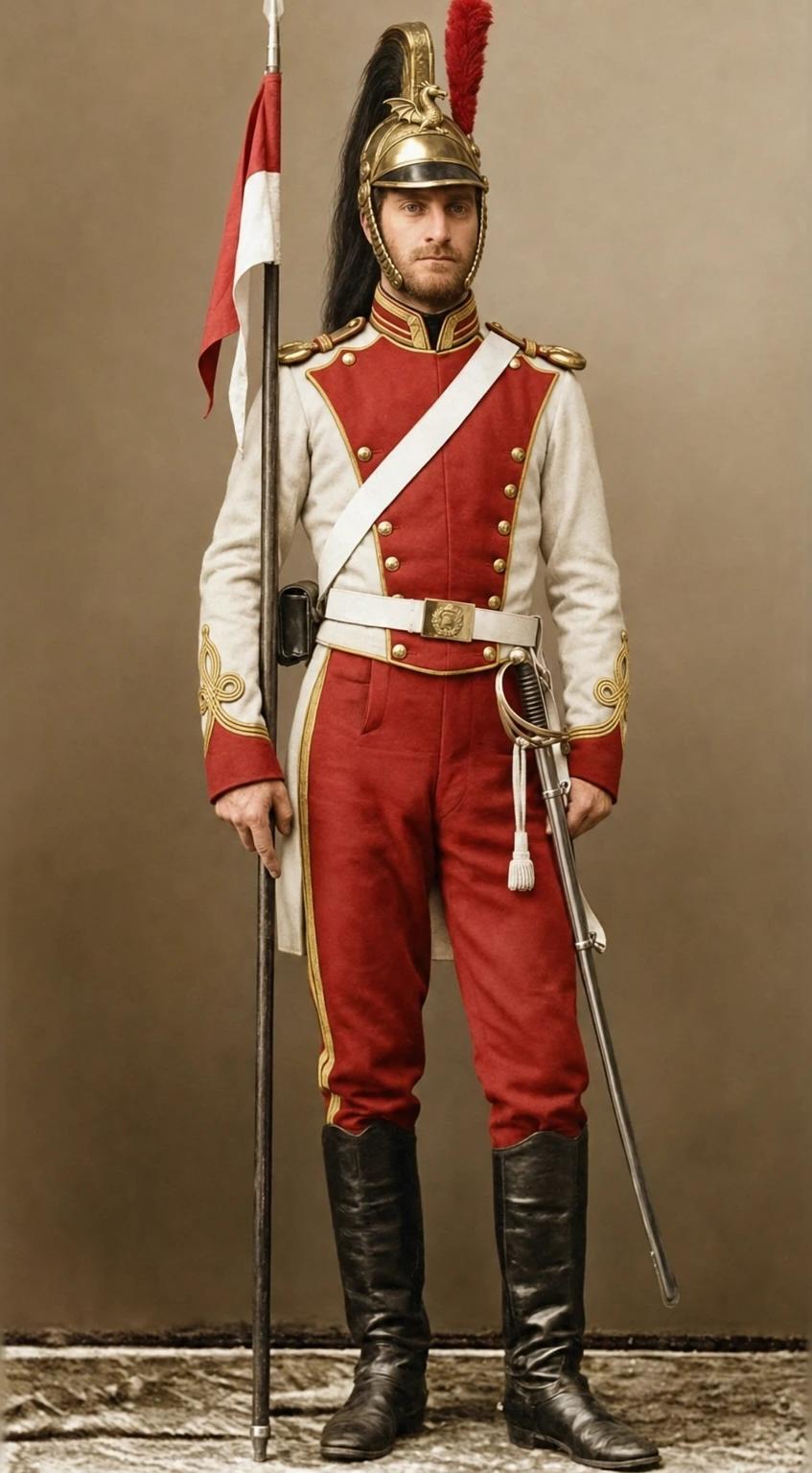
Uniform and equipment
| Uniform | White coatee with red plastron, collar and cuffs, gold epaulettes |
|---|---|
| Dress uniform | White coatee with red plastron, gold epaulettes, white crossbelts |
| Headgear | Crested helmet with colored plume |
| Equipment | Lance with pennon, sabre, pistols |
| Insignia and standard | Green Wyvern or Imperial arms on helmet |
Service record
| First appeared | 1823 |
|---|---|
| Peak strength | 1,000 men |
| Recruited from | Loyalist Volunteers |
| Primary tactic | Cavalry Shock |
| Signature engagement | Cisplatine War |
| Motto or battle cry | Independência ou Morte (Independence or Death) |
| Obsolescence | Fall of Empire (1889) |
Timeline
- 1822: Formation of the Imperial Guard. Following independence, Emperor Pedro I establishes the Imperial Guard of Honor, the nucleus of the elite cavalry.
- 1827: Baptism of Fire. The unit suffers heavy casualties but proves its mettle at the Battle of Ituzaingó during the Cisplatine War.
- 1852: The Platine Intervention. Imperial Lancers play a crucial role in the overthrow of the Argentine dictator Rosas at Caseros.
- 1864: Invasion of Paraguay. The unit is mobilized for the War of the Triple Alliance, serving as the eyes and shock force of the army.
- 1868: The Dezembrada. A series of victorious battles (Itororó, Avay, Lomas Valentinas) where the cavalry breaks the back of the Paraguayan army.
- 1889: Proclamation of the Republic. With the fall of the Monarchy, the Imperial Guard is disbanded and reorganized into the republican army cavalry regiments.
Battles
Battle of Ituzaingó
In the Cisplatine War, Imperial cavalry clashed violently with Argentine forces. Despite individual acts of heroism and thunderous charges by the lancers, the lack of coordination led to a tactical reverse, teaching the young Empire hard lessons in cavalry warfare.
Battle of Caseros
Brazilian lancers formed the spearhead of the Grand Army allied against Rosas. In a decisive engagement, the Imperial cavalry swept the flanks, breaking the Argentine federation's power in a display of disciplined shock tactics.
Battle of Avay
During the War of the Triple Alliance, Caxias unleashed his cavalry in a rain-swept annihilation of Paraguayan forces. It was a brutal melee of lance and sabre, cementing the reputation of the Imperial horsemen as the finest in South America.
Commanders
Luís Alves de Lima e Silva (Duke of Caxias)
Known as 'The Peacemaker' and 'The Iron Duke', he began his career as a junior officer in the Imperial Guard. A master of logistics and strategy, he commanded Brazilian forces to victory in three major wars, embodying the discipline and loyalty of the Empire's elite cavalry.
Manuel Luís Osório (Marquis of Erval)
The patron of Brazilian Cavalry, Osório was a fearless frontline commander. Known for leading charges personally with his lance in hand, he rose from the ranks to Marshal, earning legendary status for his bravery in the muddy, blood-soaked fields of the Platine wars.
Tactics
Shock Charge
A coordinated gallop in line formation, utilizing the reach of the lance to break enemy infantry squares or cavalry formations upon impact.
Vanguard Screening
Operating ahead of the main force to locate the enemy, skirmish with pickets, and mask the movements of the heavy infantry columns.
Pursuit à outrance
Relentless pursuit of a broken enemy to prevent them from rallying, turning a tactical retreat into a disorganized rout.