
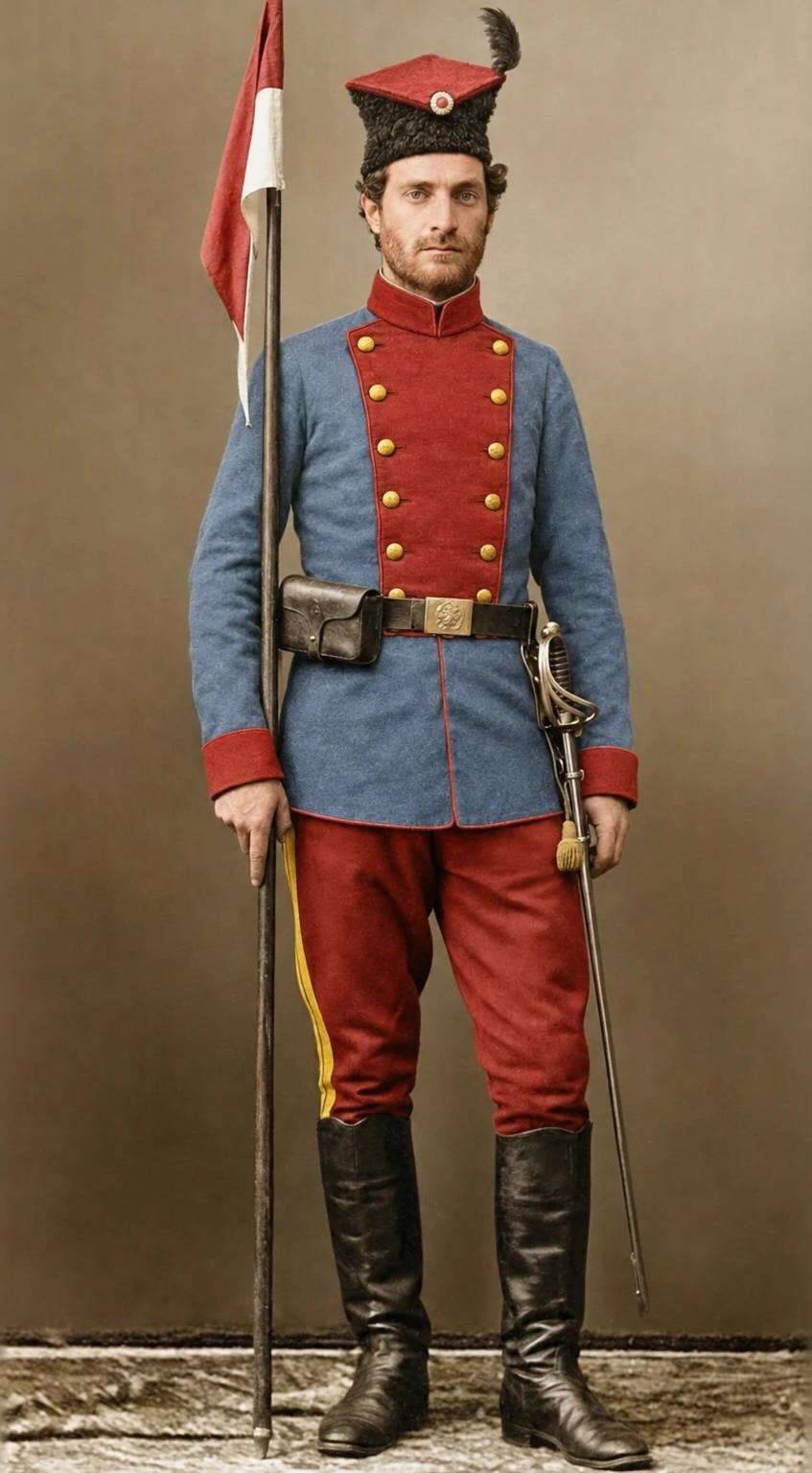
Uniform and equipment
| Uniform | Light (azure) blue ulanka with red plastron and facings |
|---|---|
| Dress uniform | Brightly colored kurtka, tight overalls with double stripes |
| Headgear | Square-topped czapka with national cockade and plume |
| Equipment | Lance with pennon, sabre, pistols or carbine |
| Insignia and standard | Imperial eagle plate on czapka |
Service record
| First appeared | 1780s |
|---|---|
| Peak strength | ~20,000 men |
| Recruited from | Polish/Galician Subjects |
| Primary tactic | Lance Charge |
| Signature engagement | Battle of Custoza (1866) |
| Motto or battle cry | Viribus Unitis (With United Forces) |
| Obsolescence | WWI Trench Warfare |
Timeline
- 1791: Establishment of Regular Uhlans. The first regular Uhlan regiments are formed, integrating Polish volunteer corps into the Imperial Army.
- 1809: Napoleonic Wars. Uhlans distinguish themselves at Aspern-Essling and Wagram, cementing their role as elite light cavalry.
- 1866: The Charge at Custoza. The zenith of the lancer's history; a heroic but costly charge against modern rifled infantry.
- 1884: Weaponry Reform. Introduction of the hollow steel lance to replace wooden shafts, increasing durability in combat.
- 1914: The Great War. Initial success in Galicia followed by the realization that cavalry was obsolete against trenches.
- 1918: Dissolution. With the collapse of the Austro-Hungarian Empire, the Imperial Uhlan regiments are disbanded.
Battles
Battle of Solferino
Amidst the carnage that inspired the Red Cross, Uhlan regiments fought desperately to protect the crumbling Austrian flanks. Despite the strategic defeat, their disciplined maneuvering prevented the total annihilation of the retreating Austrian forces.
Battle of Custoza
The defining moment of the Uhlans. Rodakowski's regiment charged headlong into the Villafranca road, taking horrific casualties from Italian rifles but panicking the enemy divisions. Their sacrifice disrupted the Italian advance, securing a decisive Habsburg victory.
Battle of Jarosławice
The 'Last Knight's Battle.' In one of history's final major cavalry-on-cavalry engagements, the 4th Cavalry Division clashed with Russian dragoons. It was a chaotic melee of lances and sabres, proving the Uhlans' martial prowess even as the machine gun age dawned.
Commanders
Maximilian von Rodakowski
The epitome of the dashing Uhlan commander. At the Battle of Custoza, he led the 13th Uhlan Regiment in a legendary, suicidal charge against Italian infantry squares. Known for his magnificent beard and reckless courage, he broke the enemy's morale through sheer shock and steel.
Leopold von Edelsheim-Gyulai
A brilliant cavalry tactician who commanded Austrian horsemen during the Second Italian War of Independence. He famously covered the retreat at Magenta and led counter-attacks at Solferino, utilizing his Uhlans to screen the chaotic withdrawal of the main army.
Tactics
The Shock Charge
A formation attack starting at a trot and accelerating to a gallop, utilizing the reach of the lance to pierce enemy lines before they could close distance.
Screening and Reconnaissance
Operating ahead of the main force to locate the enemy and mask the movements of the slow-moving Austrian infantry.
Dismounted Skirmishing
Adopted reluctantly in WWI; troopers left horses in the rear to fight as light infantry using carbines.