
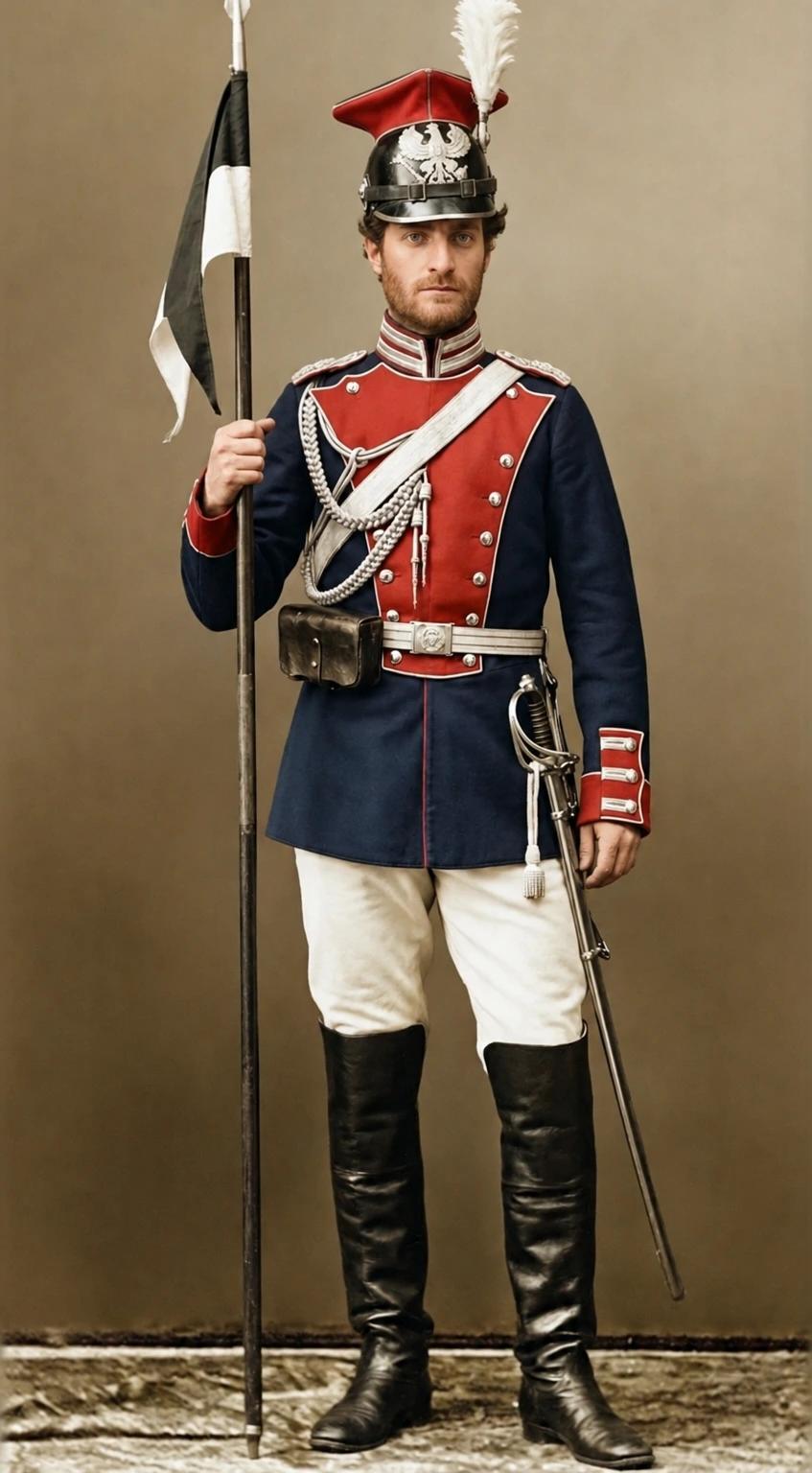
Uniform and equipment
| Uniform | Dark blue or green kurtka with colored plastron, breeches |
|---|---|
| Dress uniform | Polished buttons, silver or gold lace, bright lance pennons |
| Headgear | Square-topped czapka with eagle plate and plume |
| Equipment | Lance, sabre, pistol |
| Insignia and standard | Guard Star on czapka |
Service record
| First appeared | 1860s |
|---|---|
| Peak strength | ~3,000 riders |
| Recruited from | Aristocracy |
| Primary tactic | Lance Charge |
| Signature engagement | Franco-Prussian War (1870) |
| Motto or battle cry | Suum Cuique (To each his own) |
| Obsolescence | Machine Guns / Trench Warfare |
Timeline
- 1819: Formation. The Guard Landwehr Uhlan Regiment is established, evolving into the elite 1st Guard Uhlan Regiment based in Potsdam.
- 1866: Austro-Prussian War. The unit sees major combat in Bohemia, validating Prussian cavalry reforms and the utility of the lance.
- 1870: Franco-Prussian War. The zenith of the Uhlans; they spearhead the invasion of France, earning a reputation for relentless pursuit and shock action.
- 1893: Modernization. Introduction of the tubular steel lance, replacing older wooden shafts to increase durability and lethality in the charge.
- 1914: World War I Mobilization. Deployed to the Western Front. After initial scouting successes, the reality of machine guns forces them into trench warfare.
- 1919: Disbandment. Following the collapse of the German Empire, the regiment is demobilized and dissolved, its traditions passing to the Reichswehr.
Battles
Battle of Königgrätz
The decisive clash of the Austro-Prussian War. The Guard Uhlans participated in the final crushing pursuit of the Austrian forces, turning a retreat into a rout and proving the supremacy of Prussian organization.
Battle of Sedan
The catastrophe of the French Empire. Guard Uhlans helped seal the encirclement of Napoleon III's army, patrolling the perimeter and cutting off escape routes, effectively acting as the steel bars of the Prussian cage.
Battle of Mars-la-Tour
A chaotic, bloody engagement where Prussian cavalry aggression saved the day against superior French numbers. The Uhlans executed daring charges to silence French artillery and disrupt infantry squares, buying time for reinforcements at a high cost in men and horses.
Commanders
Prince Friedrich Karl of Prussia
Known as the 'Red Prince' for his distinctive hussar uniform, he was a brilliant, if harsh, cavalry reformer. He transformed the Prussian cavalry into a lethal, aggressive force prior to 1870, emphasizing the shock of the lance and independent initiative.
Prince Eitel Friedrich of Prussia
The second son of Kaiser Wilhelm II, he served as the commander of the 1st Guard Uhlan Regiment from 1911 to 1914. A symbol of the aristocracy's devotion to the cavalry arm, he led his men with a mix of imperial pageantry and grim determination during the early clashes of WWI.
Tactics
The Shock Charge
A tight-formation gallop using the 3-meter lance to break enemy infantry squares or cavalry lines through sheer kinetic impact and psychological terror.
Deep Reconnaissance
Operating far ahead of the main army to locate the enemy, screen friendly movements, and disrupt supply lines, serving as the 'eyes' of the General Staff.
Dismounted Action
Adopted reluctantly in WWI; troopers would leave horses in the rear to fight as light infantry with carbines when facing entrenched machine guns.