
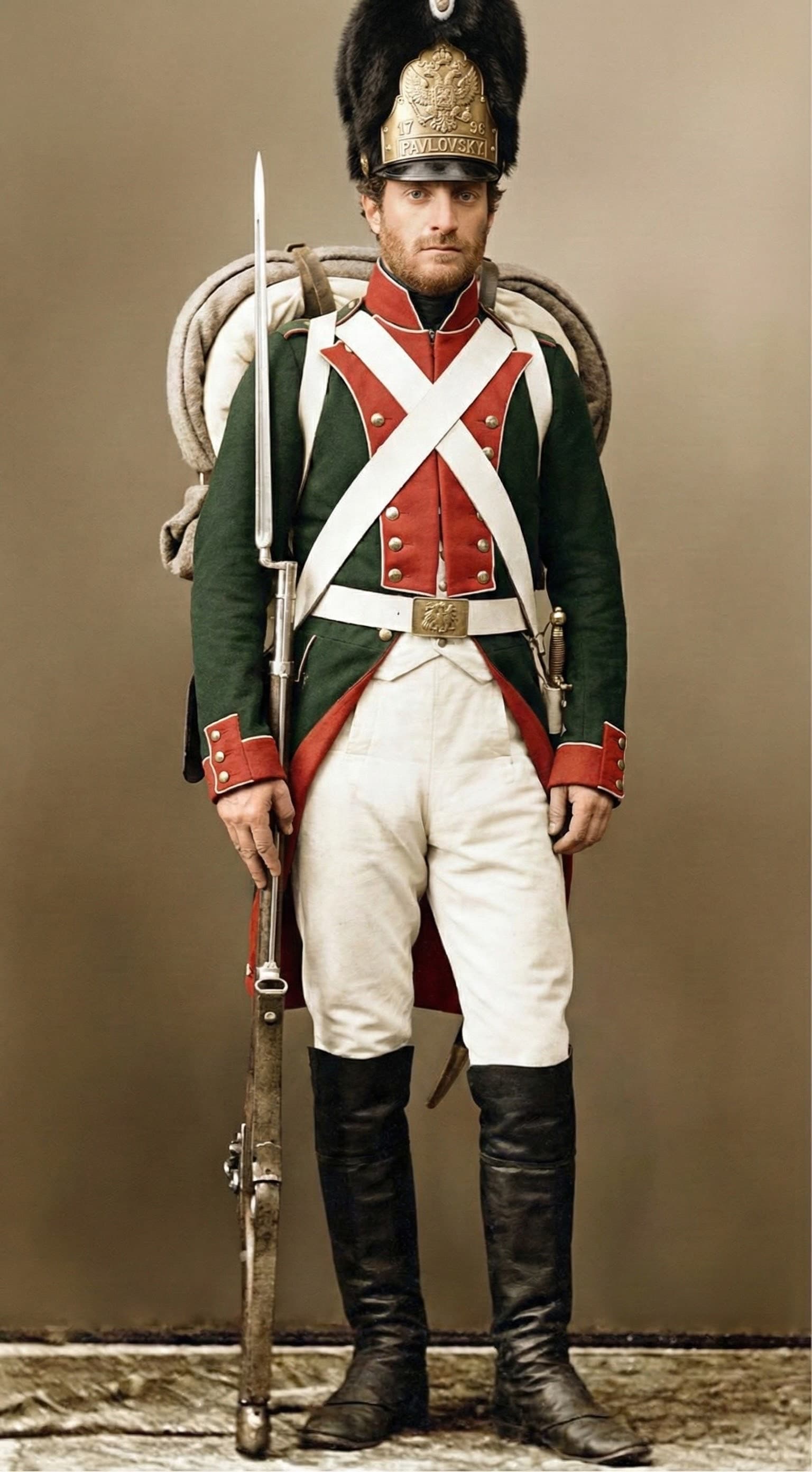
Uniform and equipment
| Uniform | Dark green coat, red facings, white breeches |
|---|---|
| Dress uniform | Green with gold lace, red collar/cuffs |
| Headgear | Distinctive brass mitre cap (retained when others switched) |
| Equipment | Musket, bayonet, pioneer axe |
| Insignia and standard | Retained bullet-scarred brass mitre caps |
Service record
| First appeared | 1796 |
|---|---|
| Peak strength | 2,000 men |
| Recruited from | Snub-nosed Conscripts (Tradition) |
| Primary tactic | Bayonet Charge |
| Signature engagement | Battle of Friedland (1807) |
| Motto or battle cry | S Nami Bog (God is with us) |
| Obsolescence | End of Russian Empire (1917) |
Timeline
- 1796: Formation. Formed by Tsar Paul I from independent grenadier battalions, initially wearing the Prussian-style mitre caps.
- 1807: The Friedland Decree. Following their heroism at Friedland, Alexander I orders the regiment to retain their damaged caps rather than switching to the new shakos.
- 1813: Elevation to Old Guard. In recognition of their service in 1812, the regiment is promoted to the Imperial Guard, becoming the Pavlovsky Life-Guard Regiment.
- 1814: Entry into Paris. The regiment marches into Paris, culminating the campaigns against Napoleon.
- 1918: Disbandment. Following the Russian Revolution and the collapse of the Imperial Army, the storied unit is dissolved.
Battles
Battle of Friedland
The regiment's defining hour. Acting as the rear guard against Napoleon's overwhelming force, they held the line along the Alle River. Despite horrific casualties and the death of their commander, their discipline prevented a total rout of the Russian army.
Battle of Borodino
Stationed at the Utitsa Mound, the Pavlovskys withstood relentless artillery barrages and assaults by Poniatowski's Polish corps. They held the extreme left flank, engaging in brutal hand-to-hand combat to deny the French a decisive breakthrough.
Battle of Krasnoi
During Napoleon's retreat, the regiment participated in the encirclement of the Grande Armée. Now on the offensive, they exacted vengeance for 1807, cutting off French retreat lines and capturing significant supplies and prisoners in the freezing snow.
Commanders
Major General Nikolai Mazovsky
The soul of the regiment. At Friedland, wounded and unable to ride, he ordered two grenadiers to carry him at the front of the line. He died leading a desperate bayonet counter-charge, his last words reportedly, "Friends, do not leave me!"
Tsar Alexander I
Though a monarch, he served as the honorary Colonel-in-Chief. Moved by their valor at Friedland, he decreed the regiment keep their bullet-riddled brass mitre caps "in the state in which they left the battlefield" as a visible mark of their courage.
Tactics
Suvorovian Bayonet Charge
Adhering to the maxim 'The bullet is a fool, the bayonet is a sheep,' they specialized in closing distance rapidly to engage in shock melee, often foregoing firing to break enemy morale.
Stubborn Defense
Unlike light infantry, they were trained to hold ground at all costs, absorbing artillery fire and cavalry charges in dense formations without breaking ranks.