
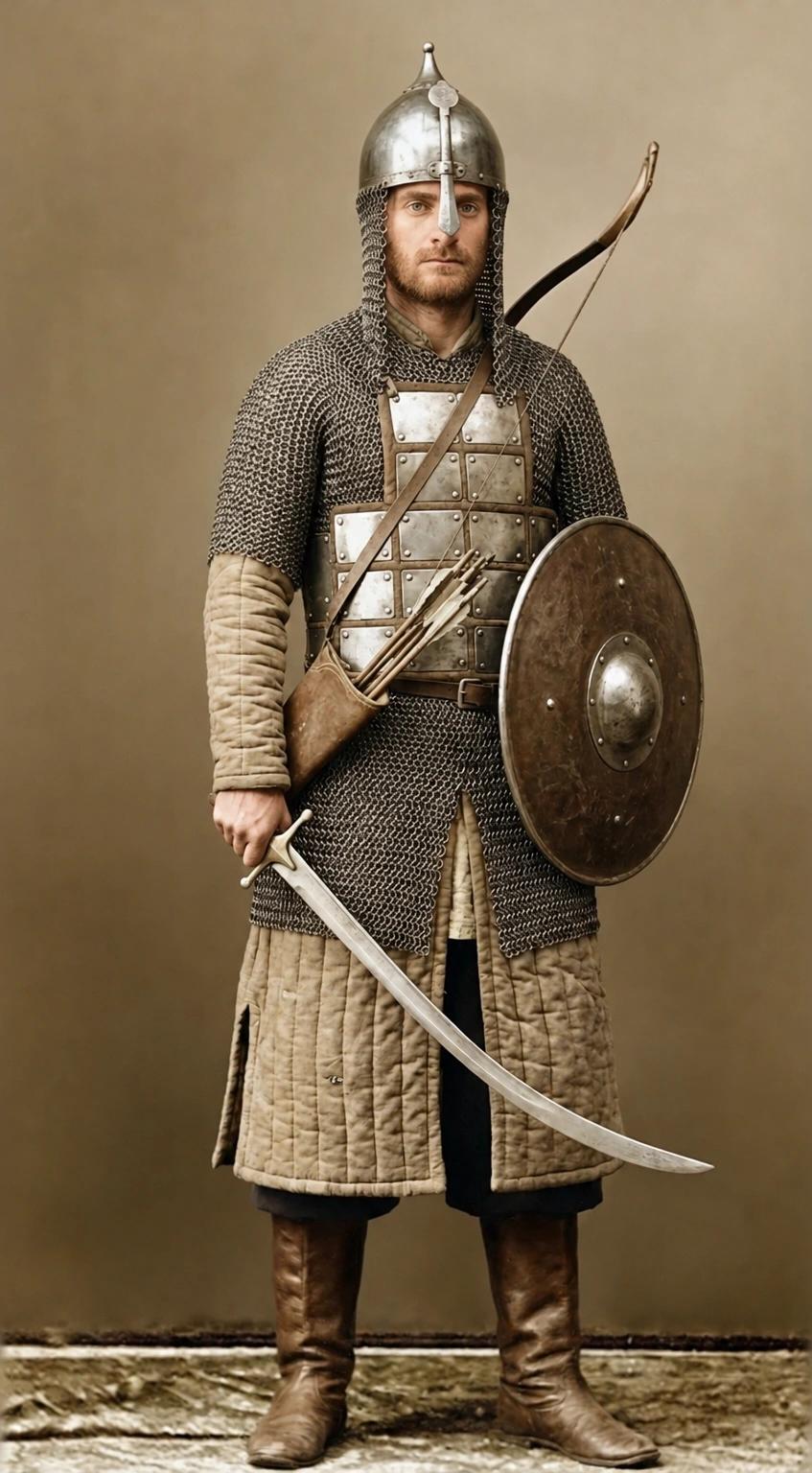
Uniform and equipment
| Uniform | Mail or brigandine over silk robes, colorful sashes |
|---|---|
| Dress uniform | Gold-brocaded robes, richly caparisoned horses |
| Headgear | Layered turban over mail coif or helmet |
| Equipment | Lance, composite bow, kilij sword, shield |
| Insignia and standard | Tugh standard with crescent and horse tails |
Service record
| First appeared | 15th century |
|---|---|
| Peak strength | ~80,000 cavalry |
| Recruited from | Landholders (Timar System) |
| Primary tactic | Cavalry Encirclement |
| Signature engagement | Battle of Mohács (1526) |
| Motto or battle cry | Allah! Allah! (God! God!) |
| Obsolescence | Inflation / Rise of Infantry |
Timeline
- 1362: Formalization of the Timar System. Murad I institutionalizes the practice of granting land (Timars) in exchange for military service, creating the Sipahi class.
- 1396: Triumph at Nicopolis. Sipahis prove their superiority over Western European chivalry tactics.
- 1453: Fall of Constantinople. Sipahis secure the perimeter and cut off relief routes, aiding the final capture of the city.
- 1526: Zenith at Mohács. The Sipahis reach the peak of their prestige and tactical efficiency under Suleiman I.
- 1596: Battle of Keresztes. One of the last great victories for the Sipahis, though discipline issues begin to surface.
- 1600: The Celali Rebellions. Economic inflation and loss of land lead many dispossessed Sipahis to rebel against the central state.
- 1831: Abolition of the Timar. Sultan Mahmud II officially abolishes the Timar system, replacing the feudal Sipahis with a modern, paid cavalry corps.
Battles
Battle of Nicopolis
The Sipahis executed a devastating counter-attack against exhausted French knights. Their discipline held the wings while the center baited the Crusaders, resulting in the destruction of the last great Crusade of the Middle Ages.
Battle of Mohács
The definitive Sipahi engagement. They feigned retreat to draw Hungarian heavy armor into the range of Ottoman cannons, then closed the steel trap from the flanks, annihilating the Hungarian monarchy in under two hours.
Battle of Vienna
Despite fierce fighting, the Sipahis were unable to withstand the massive charge of the Polish Winged Hussars. This defeat marked the beginning of the end for the Sipahi dominance in open-field warfare.
Commanders
Suleiman the Magnificent
The Sultan who led the Empire to its zenith. He personally commanded the Sipahis in major campaigns, utilizing their mobility to shatter European heavy cavalry formations at Mohács.
Malkoçoğlu Bali Bey
A legendary Akinji commander and Sanjak-bey often associated with the Sipahi vanguard. His relentless raids and mastery of psychological warfare paved the way for the main cavalry charges.
Lala Mustafa Pasha
Grand Vizier and general who effectively deployed Sipahi contingents during the conquest of Cyprus and the campaigns against the Safavids in the rugged terrain of the Caucasus.
Tactics
Turan Tactic (Feigned Retreat)
The unit would charge, then abruptly turn and flee, drawing the enemy out of formation before turning back to surround and slaughter the disorganized pursuers.
Hilal (Crescent Formation)
Deploying in a crescent shape, the center would withdraw while the wings advanced, enveloping the enemy flanks in a deadly pocket.
Caracole Archery
Riding in rotating circles to deliver a continuous stream of arrows against a static enemy formation before closing in for melee.