
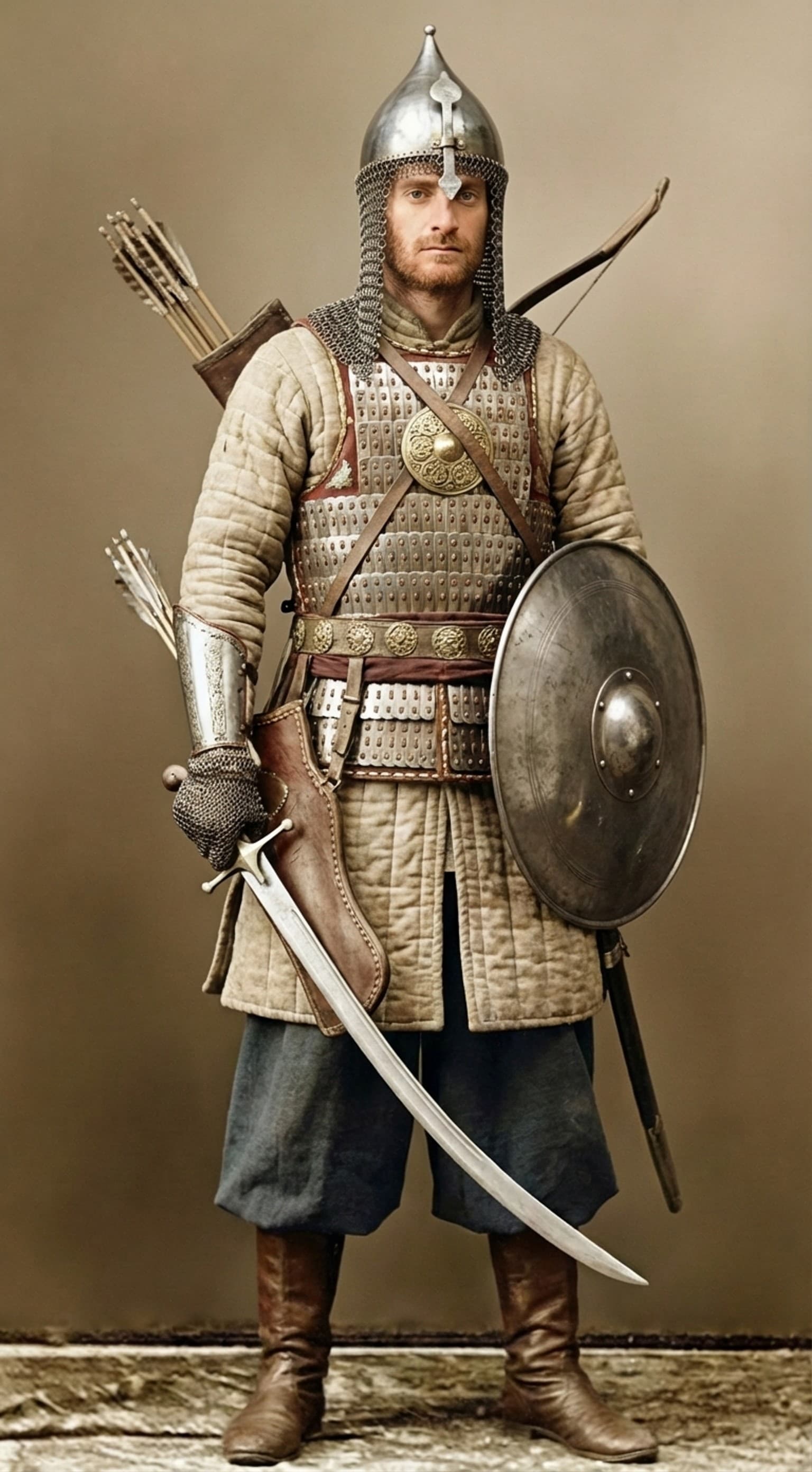
Uniform and equipment
| Uniform | Mail and lamellar armor over rich robes, brightly colored surcoats |
|---|---|
| Dress uniform | Silk robes with calligraphic designs, gilded armor, jeweled sword belts |
| Headgear | Large turbans over mail coifs, sometimes helmets concealed beneath |
| Equipment | Lance, composite bow, straight or curved sword, mace |
| Insignia and standard | Personal blazons on shields (cup, pen-box, lozenge, etc.) |
Service record
| First appeared | 13th century |
|---|---|
| Peak strength | 10,000–15,000 men |
| Recruited from | Slave Soldiers (Kipchak/Circassian) |
| Primary tactic | Furusiyya (Martial Arts) / Shock |
| Signature engagement | Battle of Ain Jalut (1260) |
| Motto or battle cry | Allah! Allah! (God! God!) |
| Obsolescence | Ottoman Cannons (1517) |
Timeline
- 1250: Rise of the Mamluks. Mamluk generals assassinate the last Ayyubid sultan and defeat the Seventh Crusade, establishing their own sultanate.
- 1260: Victory at Ain Jalut. Sultan Qutuz and Baibars defeat the Mongol Ilkhanate, securing Mamluk legitimacy.
- 1268: Conquest of Antioch. Baibars captures the Principality of Antioch, a major Crusader stronghold.
- 1291: Fall of Acre. Sultan Al-Ashraf Khalil captures Acre, effectively ending the Crusader presence in the Levant.
- 1382: Burji Dynasty Established. Power shifts from the Turkic Bahri Mamluks to the Circassian Burji Mamluks.
- 1517: Ottoman Conquest. Cairo falls to Sultan Selim I; the Mamluk Sultanate ends, though Mamluks remain as a ruling class under the Ottomans.
Battles
Battle of Al-Mansurah
In the narrow streets of Mansurah, the Bahri Mamluks ambushed the knights of the Seventh Crusade. The ferocious close-quarters slaughter resulted in the capture of King Louis IX of France and signaled the rise of Mamluk power.
Battle of Ain Jalut
History turned on this field. The Royal Mamluks, utilizing a feigned retreat and heavy shock cavalry, shattered the myth of Mongol invincibility, saving the Islamic world from total annihilation and marking the first permanent defeat of the Mongol Empire.
Siege of Acre
The final death knell of the Crusader states. Mamluk engineers and elite troops breached the massive walls after a relentless bombardment, storming the city in a brutal assault that ended two centuries of Latin rule in the Levant.
Battle of Marj Dabiq
The twilight of the Mamluks. Despite their individual valor and mastery of the blade, the Royal Mamluks were decimated by the disciplined gunpowder volleys and artillery of the Ottoman Empire, marking the end of their sultanate.
Commanders
Baibars al-Bunduqdari
A giant of a man with a cataract in one eye, Baibars rose from a slave sold for a low price to become the Sultan who broke the Mongol tide and crushed the Crusader states. His ruthlessness was matched only by his administrative genius and battlefield prowess.
Qalawun
A disciplined tactician known as 'The Thousand Man' for his high purchase price. He solidified the Mamluk dynasty, captured the impregnable Hospitaller fortress of Marqab, and laid the groundwork for the final expulsion of the Crusaders.
Tactics
Furusiyya
A comprehensive martial art combining supreme horsemanship with mastery of the lance, sword, and bow. It emphasized individual skill and discipline, allowing Mamluks to outmaneuver heavier European knights.
The Mamluk Shower
A disciplined rotation of horse archers delivering a continuous, withering barrage of arrows to disrupt enemy formations before the heavy cavalry charge.
Feigned Retreat
Adopted from steppe warfare, a unit would simulate panic to draw the enemy out of formation, only to wheel around and encircle the disorganized pursuers.
Shock Charge
Unlike light steppe cavalry, Mamluks were heavily armored and trained to deliver a crushing lance charge into the center of an enemy line to break their morale.