
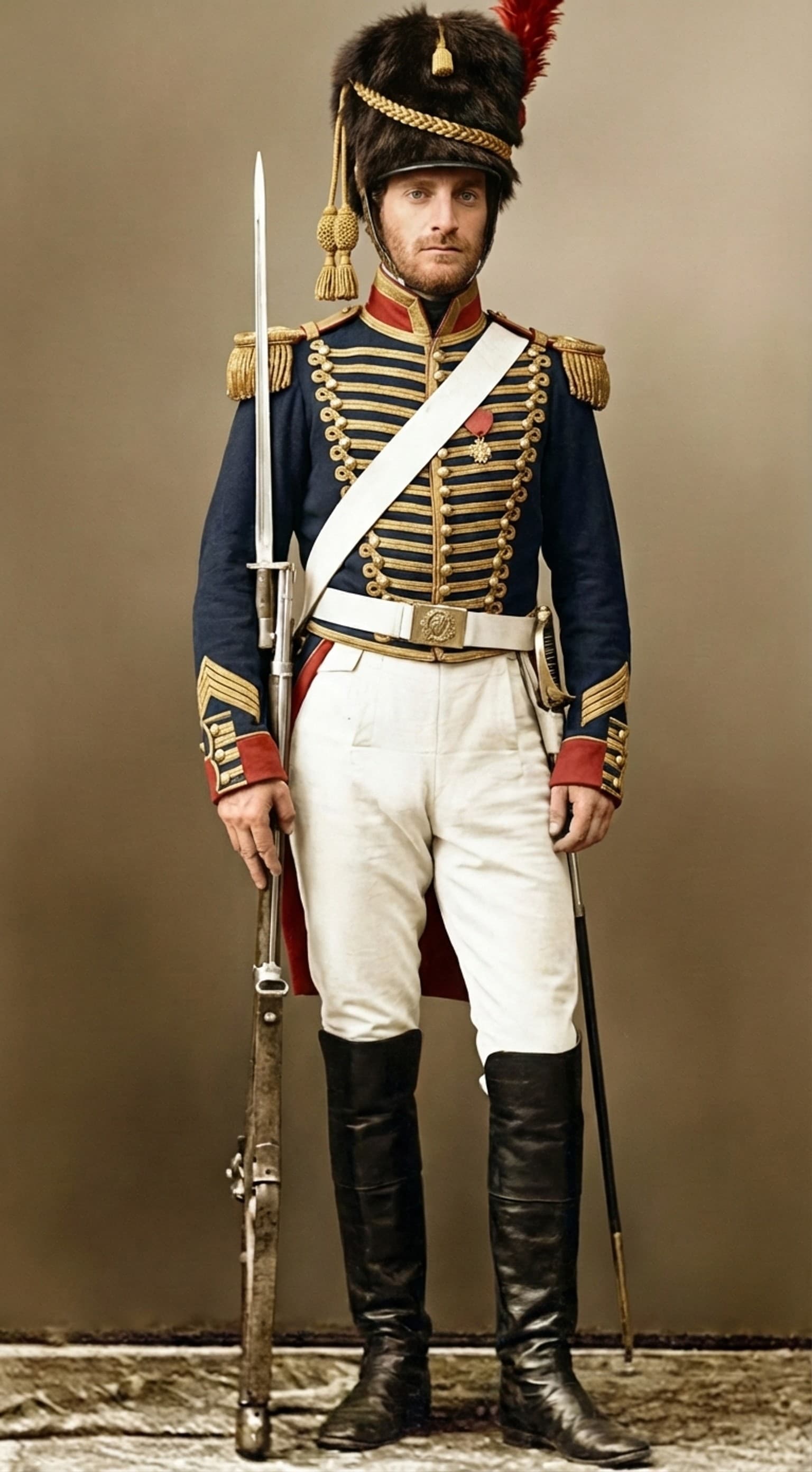
Uniform and equipment
| Uniform | White or light-colored tunic, dark trousers with green stripe |
|---|---|
| Dress uniform | White tunic with green and gold facings, ceremonial epaulettes |
| Headgear | High crested helmet with green and yellow plume |
| Equipment | Sabre, carbine or rifle, ceremonial lances for mounted elements |
| Insignia and standard | Imperial Crown of Brazil in starburst |
Service record
| First appeared | 1822 |
|---|---|
| Peak strength | ~1,000 men |
| Recruited from | Elite Volunteers |
| Primary tactic | Ceremonial Escort |
| Signature engagement | Paraguayan War |
| Motto or battle cry | Independência ou Morte (Independence or Death) |
| Obsolescence | Republic Proclamation (1889) |
Timeline
- 1822: Formation. Created by Prince Regent Pedro (later Pedro I) as a personal escort during his trip to São Paulo, culminating in the declaration of Independence.
- 1831: Dissolution. Following the abdication of Pedro I, the unit was temporarily disbanded amidst anti-Portuguese sentiment and Regency reforms.
- 1852: Platine War. Reconstituted Imperial units participate in the campaign against Oribe and Rosas, cementing Brazil's hegemony in the Platine region.
- 1864: Invasion of Paraguay. The outbreak of the War of the Triple Alliance sees the mobilization of the Empire's elite forces for a grueling six-year conflict.
- 1868: The Dezembrada. A series of decisive battles in December where the Imperial leadership broke the back of the Paraguayan resistance.
- 1889: Republic Proclaimed. The Empire falls to a military coup. The Imperial Guard is disbanded or absorbed into the new Republican army structures (later becoming the Independence Dragoons).
Battles
Siege of Uruguaiana
Significant for the presence of Emperor Pedro II himself. The Guard of Honour fulfilled its primary duty, protecting the monarch near the front lines as the Paraguayan garrison surrendered, boosting national morale.
Battle of Tuiuti
The largest battle in South American history. Imperial forces repelled a massive surprise attack by the Paraguayan army. The cavalry played a decisive role, counter-charging into the flanks of the enemy columns in a muddy, blood-soaked field.
Battle of Itororó
A brutal engagement over a narrow bridge. The Imperial forces wavered under withering fire until the elderly Duke of Caxias led a desperate charge. The Guard and regular troops followed, storming the position in hand-to-hand combat.
Commanders
Manuel Luís Osório (Marquis of Erval)
A legendary cavalry commander known for his reckless bravery and tactical brilliance. While he commanded the army's vanguard, his spirit defined the aggressive ethos of the Imperial cavalry and the elite mounted units during the Paraguayan War.
Luís Alves de Lima e Silva (Duke of Caxias)
The 'Iron Duke' and Patron of the Brazilian Army. A disciplinarian who transformed the Imperial forces into a professional war machine. At the Battle of Itororó, he famously drew his sword and charged the bridge himself, shouting 'Follow me!', rallying the Guard to a bloody victory.
Dom Pedro I
The first Emperor and founder of the Guard. A dashing, impulsive cavalryman at heart, he created the Guard of Honour on the eve of independence. He famously declared 'Independence or Death' while surrounded by this very escort on the banks of the Ipiranga.
Tactics
Shock Charge
A coordinated cavalry assault using lances and sabres to break enemy infantry formations or rout opposing cavalry.
Royal Escort
A defensive formation designed to shield the Emperor or high-ranking commanders from assassination or capture during travel.
Vanguard Screening
Acting as the eyes of the army, scouting ahead to locate enemy positions and engaging in skirmishes to delay their advance.