
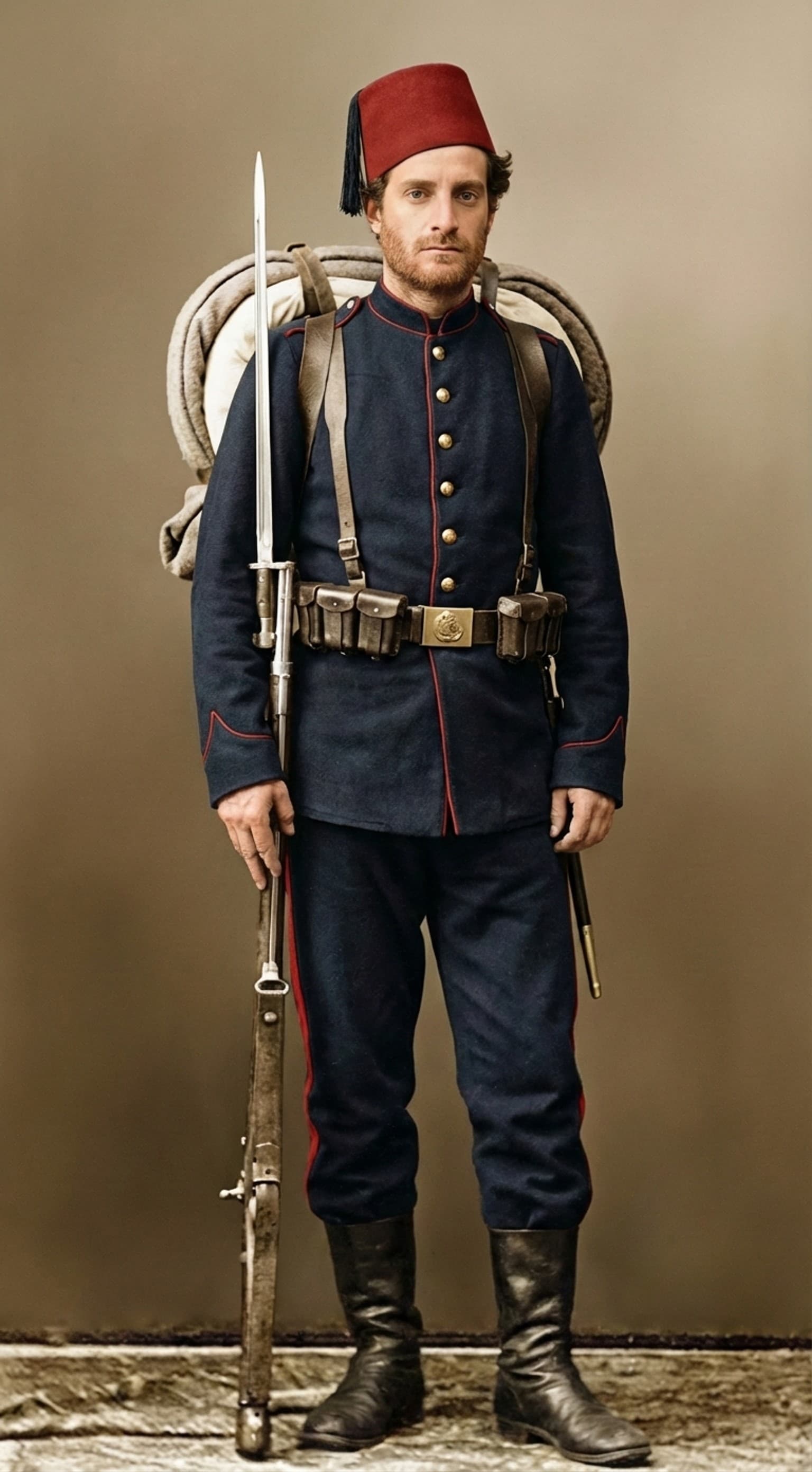
Uniform and equipment
| Uniform | Dark blue tunic, red fez |
|---|---|
| Dress uniform | N/A |
| Headgear | Fez |
| Equipment | Mauser rifle |
| Insignia and standard | Star and Crescent brass badge on fez/belt |
Service record
| First appeared | 1840s |
|---|---|
| Peak strength | Hundreds of thousands |
| Recruited from | Conscription |
| Primary tactic | Defensive Infantry |
| Signature engagement | Gallipoli (1915) |
| Motto or battle cry | Allah Allah! (God! God!) |
| Obsolescence | Fall of Empire (1922) |
Timeline
- 1826: The Auspicious Incident. Sultan Mahmud II abolishes the Janissary corps, establishing the Asakir-i Mansure-i Muhammediye, the precursor to the modern Nizamiye.
- 1843: Army Reorganization. The army is divided into the Nizamiye (regulars) and Redif (reserves), with fixed conscription terms introduced.
- 1877: Defense of Plevna. The Nizamiye demonstrates its defensive capabilities against Russia, utilizing earthworks and repeating rifles effectively.
- 1913: German Military Mission. General Liman von Sanders arrives to modernize the army's training and logistics, heavily influencing doctrine prior to WWI.
- 1915: Defense of the Dardanelles. The army halts the Allied advance at Gallipoli, securing the capital and boosting national morale.
- 1918: Armistice of Mudros. The Ottoman Empire surrenders; the Nizamiye is demobilized, though many units transition into the National Forces for the War of Independence.
Battles
Battle of Sarikamish
A tragic offensive in freezing winter conditions. Enver Pasha attempted a complex encirclement of Russian forces, but tens of thousands of Ottoman soldiers froze to death before firing a shot. A testament to bravery undone by logistics.
Gallipoli Campaign
The defining moment of the late empire. Ottoman troops, dug into the steep ridges, repelled a massive amphibious invasion by British and French forces. It was a brutal war of attrition where the Nizamiye proved their defensive supremacy.
Siege of Kut
A humiliating defeat for the British Army. Ottoman forces besieged General Townshend's division on the Tigris river, forcing the surrender of over 13,000 British and Indian troops after a grueling starvation blockade.
Commanders
Mustafa Kemal Atatürk
A visionary tactician who forged his legend in the fires of Gallipoli. Known for his steely gaze and the famous order, 'I do not order you to fight, I order you to die,' he rallied the Nizamiye to hold the line against overwhelming Allied forces.
Enver Pasha
The ambitious Minister of War and architect of the Ottoman-German alliance. A polarizing figure who modernized the army's structure but led the disastrous winter offensive at Sarikamish. His drive for empire defined the late Ottoman military spirit.
Osman Nuri Pasha
The 'Lion of Plevna.' He embodied the defensive grit of the Ottoman soldier. During the Russo-Turkish War, he held the fortress of Plevna for five months against a vastly superior Russian army, earning worldwide respect for the tenacity of the Turkish infantry.
Tactics
Süngü Hücumu (Bayonet Charge)
A psychological and physical assault where infantry would rise from trenches en masse to overwhelm the enemy in close quarters, often used to retake lost ground immediately.
Defense in Depth
Utilizing the rugged terrain to create multiple lines of resistance. If the first trench fell, the enemy faced immediate counter-fire from prepared secondary positions.
Night Infiltration
Small groups of soldiers would navigate no-man's-land under darkness to raid enemy trenches or gather intelligence, particularly effective at Gallipoli.