
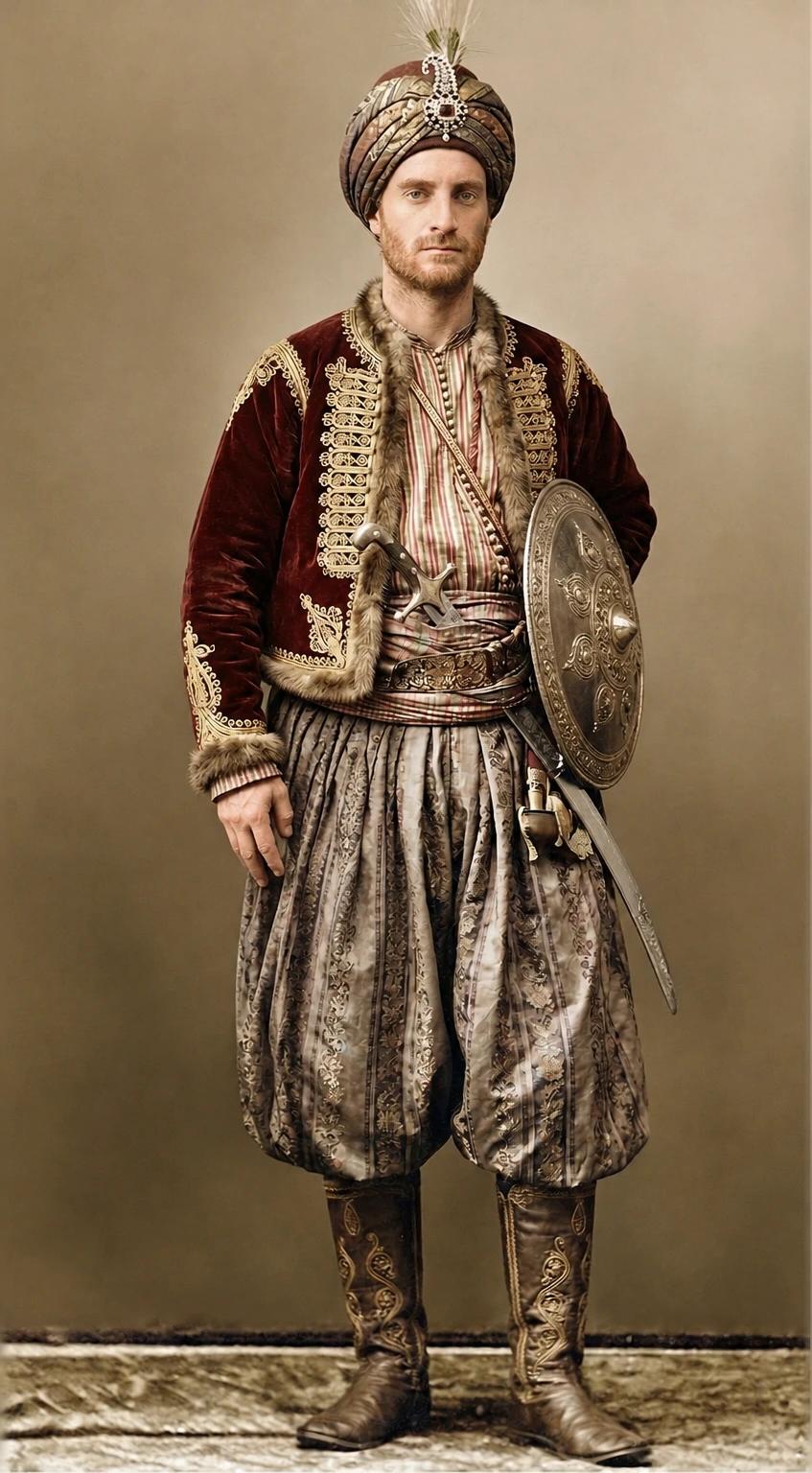
Uniform and equipment
| Uniform | Silk robes, mail armor, colorful turbans |
|---|---|
| Dress uniform | Gold-threaded silk, jeweled armor |
| Headgear | Elaborate turban with aigrette and jewels |
| Equipment | Composite bow, kilij sword, mace, lance |
| Insignia and standard | Colored standards: Red (Sipahis), Yellow (Silahdars), Green/White (Ulufecis) |
Service record
| First appeared | 1450s |
|---|---|
| Peak strength | 5,000 men |
| Recruited from | Kapikulu (Household Slaves) |
| Primary tactic | Heavy Cavalry Shock |
| Signature engagement | Battle of Mohács (1526) |
| Motto or battle cry | Allah! Allah! (God! God!) |
| Obsolescence | Auspicious Incident / Modernization |
Timeline
- 1362: Formation. Murad I establishes the Kapıkulu Sipahis as a standing household cavalry corps, paid directly by the treasury, to counterbalance the landed feudal cavalry.
- 1444: Triumph at Varna. The corps distinguishes itself as the backbone of the Ottoman army, defeating a major European coalition.
- 1526: Apex at Mohács. The Sipahis destroy the Hungarian Kingdom's military power, cementing their reputation as the finest cavalry in the world.
- 1596: Battle of Keresztes. In a chaotic battle, the Sipahis rally to save the Sultan when the Janissary lines break, turning a near-rout into a decisive victory.
- 1630: Reforms of Murad IV. Sultan Murad IV purges corrupt members and restores the warrior ethos to the 'Six Divisions' of cavalry.
- 1683: Disaster at Vienna. The failure to take Vienna and the subsequent rout exposes the tactical obsolescence of the Sipahis against modernized European warfare.
- 1826: The Auspicious Incident. Following the massacre of the Janissaries, Sultan Mahmud II disbands the Sipahis of the Porte, replacing them with a modern, western-style cavalry.
Battles
Battle of Varna
A cataclysmic clash where the Sipahis held the line against the Polish-Hungarian vanguard. Their resilience allowed the Sultan to counter-attack, resulting in the death of King Władysław III and the collapse of the Crusade.
Battle of Chaldiran
Facing the fanatical Safavid Qizilbash cavalry, the Sipahis demonstrated superior discipline. Despite taking heavy losses, they protected the artillery train that ultimately shredded the Persian ranks.
Battle of Mohács
The defining moment of Ottoman dominance. While cannons broke the Hungarian charge, the Sipahis executed a lethal flanking maneuver, encircling and slaughtering King Louis II's heavy knights in the marshes.
Battle of Vienna
The high-water mark of Ottoman expansion. The Sipahis fought desperately against the Polish Winged Hussars but were ultimately swept away by the largest cavalry charge in history, marking the beginning of the end for the corps.
Commanders
Suleiman the Magnificent
Under his reign, the Sipahis of the Porte reached their zenith as the premier heavy cavalry of Europe. He commanded them from the center at Mohács, unleashing them to shatter the Hungarian nobility in a storm of composite arrows and steel.
Bayezid I
Known as 'The Thunderbolt' for the speed of his campaigns, Bayezid utilized the Sipahis as a rapid-response hammer. At Nicopolis, his decisive use of the palace cavalry crushed the last great Crusade of the Middle Ages.
Murad IV
A warrior-sultan of immense physical strength who restored iron discipline to the corps. Known for wielding a mace of 60 kilograms, he personally led the Sipahis in the brutal reconquest of Baghdad, charging into the fray where the fighting was thickest.
Tactics
The Bozkır Charge
A disciplined heavy cavalry shock charge aimed at the enemy's center, timed to follow an artillery barrage or a Janissary volley.
Feigned Retreat
Retaining their steppe heritage, Sipahis would simulate a panic to draw enemy knights out of formation before wheeling around to encircle them.
Rolling Fire
Before contact, ranks of Sipahis would unleash waves of arrows (and later pistol fire) to disrupt enemy cohesion, switching to the Kilij only when the enemy wavered.
Sultan's Shield
As household troops, their primary tactical mandate was holding the center reserve, acting as the final barrier between the enemy and the Sultan.