
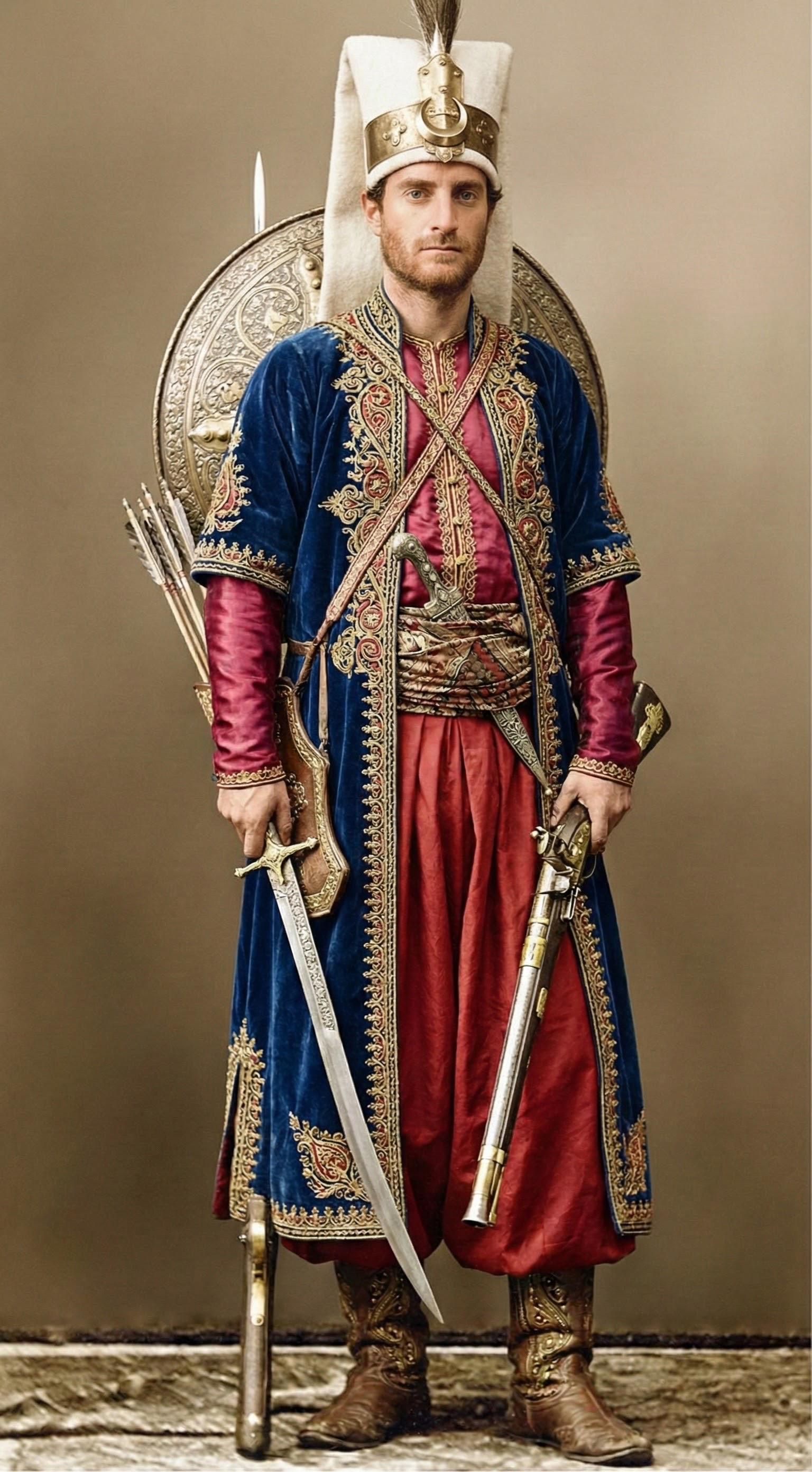
Uniform and equipment
| Uniform | White felt coat, red cap, colored sash |
|---|---|
| Dress uniform | White with gold embroidery, ceremonial robes |
| Headgear | White felt börk with brass holder and plume |
| Equipment | Musket, yataghan, recurve bow (early) |
| Insignia and standard | Kazan (soup cauldron) emblem |
Service record
| First appeared | 1380s |
|---|---|
| Peak strength | 40,000 men |
| Recruited from | Devshirme (Child Levy) |
| Primary tactic | Volley Fire / Trench Assault |
| Signature engagement | Siege of Constantinople (1453) |
| Motto or battle cry | Allah! Allah! (God! God!) |
| Obsolescence | Auspicious Incident (Violent Disbandment) |
Timeline
- 1363: Formation. Sultan Murad I establishes the Janissary corps using the 'pençik' system (one-fifth of war captives).
- 1438: Devshirme System Formalized. Regular levy of Christian boys from the Balkans begins, creating a caste of soldiers loyal only to the Sultan.
- 1453: Conquest of Constantinople. The corps cements its reputation as the premier infantry force in the world.
- 1526: Destruction of Hungary. Victory at Mohács marks the peak of Janissary military dominance in Europe.
- 1622: Regicide of Osman II. The corps murders the Sultan, proving they have become the masters of the state rather than its servants.
- 1826: The Auspicious Incident. Sultan Mahmud II turns his new artillery on the Janissary barracks, massacring the corps and dissolving the order.
Battles
Siege of Constantinople
The defining moment of the corps. After weeks of bombardment, the Janissaries led the final assault through the breached walls, overwhelming the defenders and ending the Middle Ages.
Battle of Chaldiran
The triumph of gunpowder over tradition. Janissary volley fire shattered the elite Safavid cavalry, proving the supremacy of modern infantry tactics in the East.
Battle of Mohács
A masterclass in combined arms. Janissary musketeers, protected by chained wagons, decimated the Hungarian heavy cavalry charge, effectively destroying the Hungarian monarchy in hours.
Siege of Vienna
The furthest expansion of Ottoman power. Despite weeks of mining and assaults, the Janissaries were broken by the Polish Winged Hussars' charge, marking the beginning of the decline.
Commanders
Suleiman the Magnificent
Under his rule, the Janissaries reached their zenith as the most disciplined force in Europe. He personally led them in 13 major campaigns, expanding the empire from Budapest to Baghdad.
Mehmed II (The Conqueror)
The architect of the Byzantine Empire's destruction. He utilized the Janissaries as the tip of the spear to storm the Theodosian Walls, securing Constantinople and the title of Caesar of Rome.
Sokollu Mehmed Pasha
Taken as a boy in the Devshirme, he rose through the Janissary ranks to become Grand Vizier, effectively ruling the empire and commanding its armies for decades with ruthless efficiency.
Tactics
Salvo Fire
One of the earliest adopters of organized volley fire, creating a wall of lead to halt cavalry charges.
Tabur Cengi
A defensive formation using chained wagons and artillery to create a mobile fortress, shielding the musketeers.
Shock Assault
Following artillery barrages or mine detonations, Janissaries would rush breaches with swords and grenades to overwhelm disorganized defenders.
Sapping and Mining
Expertise in digging trenches and tunnels to undermine enemy fortifications, famously used at Vienna and Rhodes.