
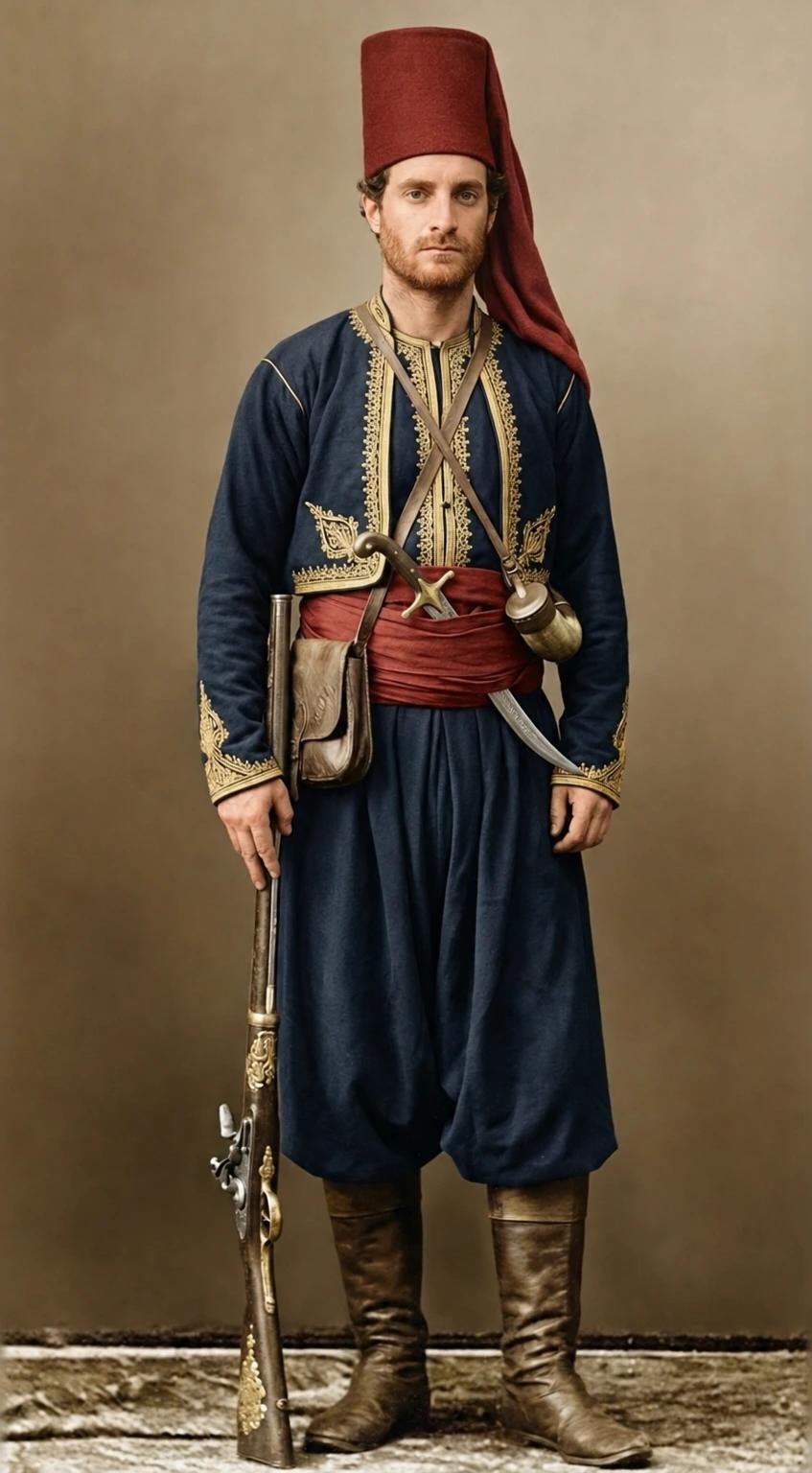
Uniform and equipment
| Uniform | Red cap, simple tunic, sash |
|---|---|
| Dress uniform | Red robes, high cylindrical hat (börk) with flap |
| Headgear | Red cylindrical hat |
| Equipment | Musket, sword, club |
| Insignia and standard | Red cowl/cap draped over shoulder |
Service record
| First appeared | 1400s |
|---|---|
| Peak strength | ~3,000 men |
| Recruited from | Devshirme / Household Slaves |
| Primary tactic | Palace Security |
| Signature engagement | Palace Coups |
| Motto or battle cry | Padişahım çok yaşa (Long live the Padishah) |
| Obsolescence | Modernization (1826) |
Timeline
- 1362: Formation. Established under Sultan Murad I as a specialized corps of the Janissaries to guard the palace grounds.
- 1453: Expansion. Following the conquest of Constantinople, the corps expands significantly to secure the massive Topkapi Palace complex.
- 1596: Heroism at Mezőkeresztes. The Bostancı prove their worth as combat troops, saving the Sultan from capture during a disastrous enemy breakthrough.
- 1622: Regicide of Osman II. In a grim turn, the guards fail to protect Sultan Osman II from a Janissary revolt, leading to his imprisonment and murder.
- 1807: Deposition of Selim III. The Bostancı are overwhelmed by the Yamaks, leading to the fall of the reformist Sultan Selim III.
- 1826: Disbandment. Destroyed alongside the Janissaries during the 'Vaka-i Hayriye' (The Auspicious Incident) by Mahmud II.
Battles
Battle of Mezőkeresztes
When the Ottoman lines broke, the Bostancı stood firm around Sultan Mehmed III's tent. Wielding axes and sabers, these 'gardeners' slaughtered the looting Habsburg troops, turning a rout into a decisive, bloody victory through sheer fanaticism and close-quarters brutality.
The Edirne Incident
A massive Janissary uprising where the Bostancı were forced to choose between their Sultan, Mustafa II, and the mob. Despite their elite status, the political tide turned against them, leading to the Sultan's deposition—a stark reminder that even the best guards cannot stop a crumbling empire.
The Auspicious Incident
The final stand. Sultan Mahmud II turned his new army against the Janissary corps. The Bostancı, linked inextricably to the old order, were caught in the purge. Their barracks were shelled and the unit was violently dissolved, marking the bloody end of centuries of tradition.
Commanders
Daltaban Mustafa Pasha
Rising from the humble ranks of the Bostancı to become Grand Vizier, Mustafa embodied the corps' potential for immense power. Known for his ferocity and loyalty, he navigated the treacherous politics of the Porte before his eventual execution, a fate common to those who served the throne too closely.
Bostancıbaşı Hasan Agha
A quintessential commander of the Imperial Guard, Hasan Agha wielded the dual authority of head gardener and chief executioner. He maintained an iron grip on the Topkapi Palace security, serving as the Sultan's shadow and the silent enforcer of imperial will against rebellious Janissaries.
Tactics
The Sultan's Shield
A defensive formation where guards formed a living, impenetrable wall around the monarch, willing to absorb gunfire and arrows to keep the Sultan safe.
Silent Execution
Specialized training in stealth and strangulation, allowing them to eliminate political rivals within the palace walls without causing a public scene or spilling blood.
Barge Assault
Amphibious rapid response tactics utilizing fast imperial barges to secure the Bosphorus shoreline and intercept threats from the water.
Urban Policing
Deployment in small, club-wielding squads to maintain order in Constantinople's streets, using non-lethal force to quell riots before they threatened the palace.