
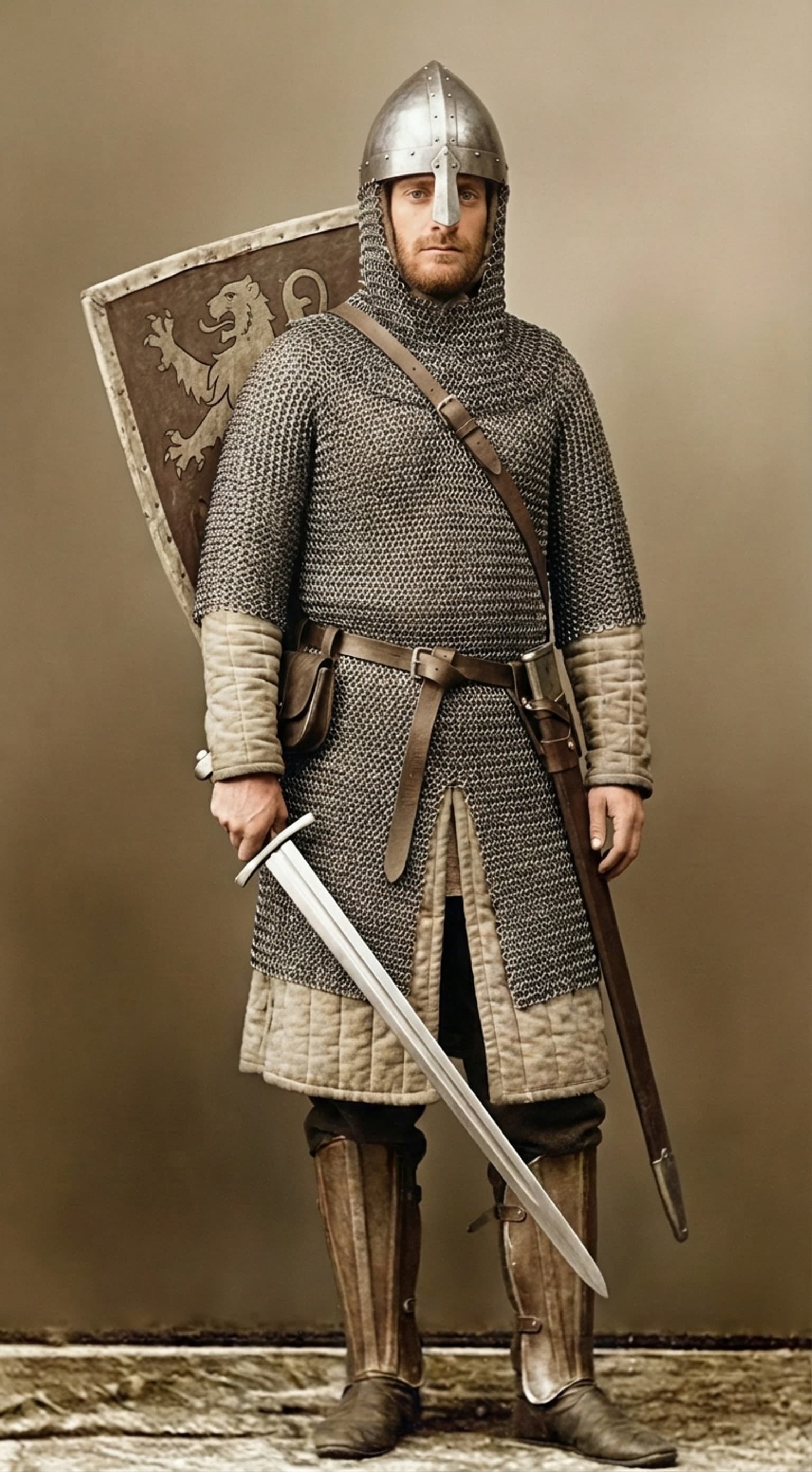
Uniform and equipment
| Uniform | Chain hauberk, kite shield with heraldry, surcoat |
|---|---|
| Dress uniform | Colorful surcoats displaying full arms, silk cloaks |
| Headgear | Conical helmet with nasal guard, sometimes with mail aventail |
| Equipment | Lance, sword, dagger, sometimes mace |
| Insignia and standard | Pre-heraldic geometric/dragon motifs on shields (Bayeux style) |
Service record
| First appeared | 11th century |
|---|---|
| Peak strength | 3,000–5,000 men in major hosts |
| Recruited from | Feudal Aristocracy |
| Primary tactic | Couched Lance Charge |
| Signature engagement | Battle of Hastings (1066) |
| Motto or battle cry | Dex Aie! (God Help Us!) |
| Obsolescence | Plate Armor / Longbow |
Timeline
- 911: Treaty of Saint-Clair-sur-Epte. Viking leader Rollo is granted the land of Normandy, beginning the transition from Norse raiders to Frankish-style mounted knights.
- 1066: The Norman Conquest. William defeats Harold Godwinson at Hastings, establishing the Norman aristocracy in England.
- 1071: Capture of Bari. Robert Guiscard conquers the last Byzantine stronghold in Italy, cementing Norman dominance in the Mediterranean.
- 1086: Domesday Book. Administrative consolidation of England, ensuring the feudal revenue streams necessary to maintain expensive heavy cavalry.
- 1096: First Crusade. Norman contingents from Italy and Normandy lead the march to Jerusalem, exporting their warfare style to the Levant.
- 1204: Loss of Normandy. King John loses the Duchy to France, marking the end of the cross-channel Norman identity and the assimilation of the knights into English or French cultures.
Battles
Battle of Civitate
Outnumbered Norman knights shattered a Papal coalition. Their charge decimated the Swabian mercenaries, proving the supremacy of the Norman couched lance over traditional infantry formations.
Battle of Hastings
The defining clash of the era. Unable to break the Saxon shield wall initially, the Normans utilized disciplined feigned retreats to draw the English out, before crushing them with repeated cavalry charges.
Battle of Dyrrhachium
Guiscard's forces faced the Byzantine Emperor and the Varangian Guard. Despite initial setbacks, a flanking maneuver by Norman heavy cavalry rolled up the Byzantine line, securing a foothold in the Balkans.
Commanders
Robert Guiscard
Known as 'The Fox,' this adventurer carved a destiny in the sun-baked hills of Southern Italy. A master of asymmetric warfare and heavy shock tactics, he humiliated the Papacy and the Byzantine Empire alike.
William the Conqueror
From Bastard Duke to King of England. A ruthless strategist who forged a kingdom through iron will and the devastating application of heavy cavalry. He mastered the logistics of invasion and the brutal politics of feudal dominance.
Bohemond I of Antioch
A giant of a man and a leader of the First Crusade. He translated the Norman hunger for land into holy war, leading the vanguard with terrifying ferocity during the siege of Antioch.
Tactics
Couched Lance Charge
Holding the lance tight against the body (couched) to deliver the combined kinetic energy of rider and horse into a single point of impact.
Feigned Retreat
A high-risk, high-discipline maneuver where cavalry pretends to flee to break enemy formation, then wheels around to slaughter the disorganized pursuers.
The Conroi
A tactical unit of 20-30 knights who trained and lived together, allowing them to act as a cohesive shock projectile on the battlefield.