
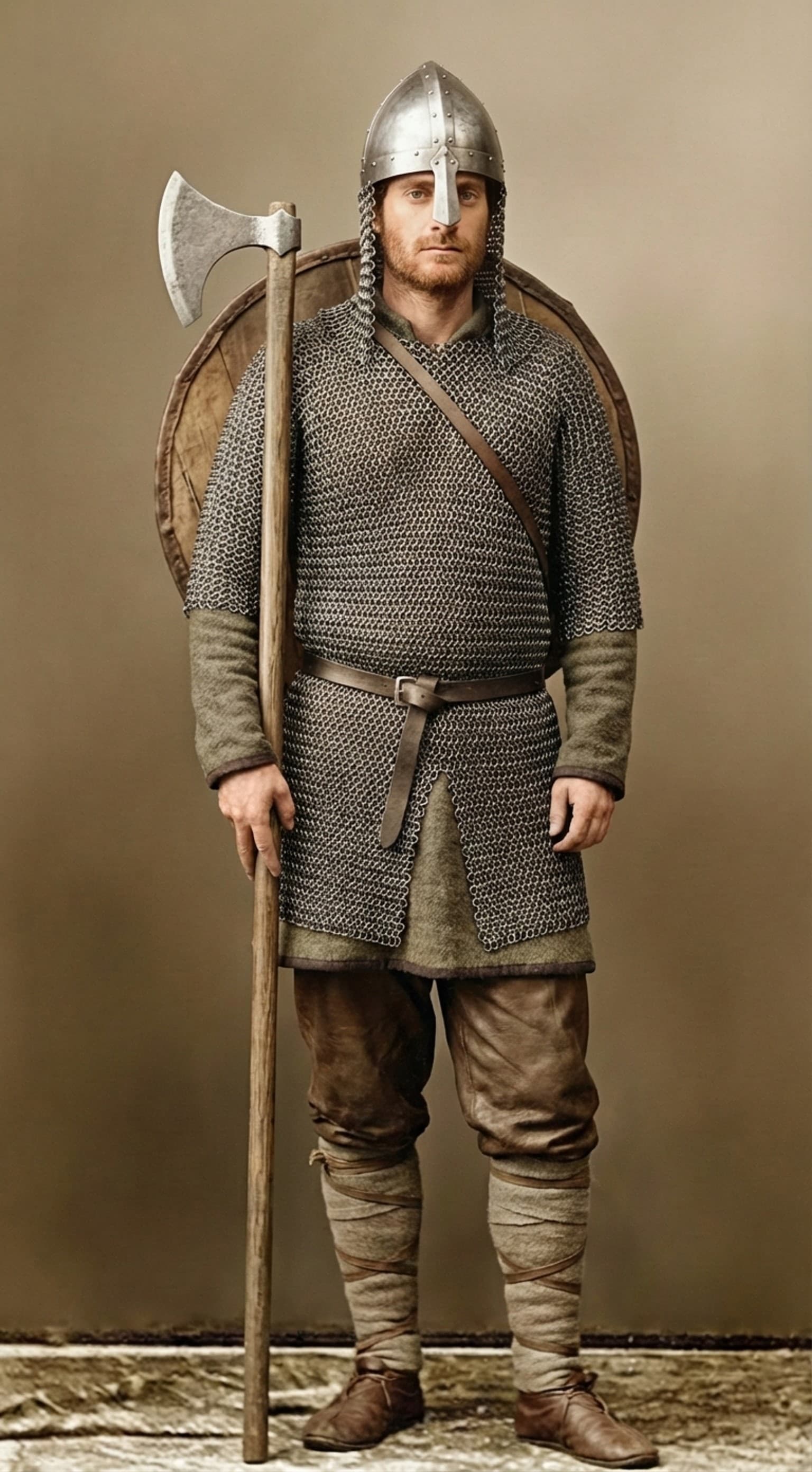
Uniform and equipment
| Uniform | Mail hauberk over wool tunic, round or kite shield |
|---|---|
| Dress uniform | Embroidered cloaks, gilt fittings on belts and scabbards |
| Headgear | Conical helmet with nasal and sometimes mail curtain |
| Equipment | Two-handed Dane axe, sword, spear, shield |
| Insignia and standard | King Harold's Fighting Man standard (gold warrior device) |
Service record
| First appeared | 11th century |
|---|---|
| Peak strength | 2,000–3,000 men |
| Recruited from | Professional Retainers |
| Primary tactic | Shield Wall / Axe Shock |
| Signature engagement | Battle of Hastings (1066) |
| Motto or battle cry | Ut! Ut! (Out! Out!) |
| Obsolescence | Norman Conquest |
Timeline
- 1018: Formation. King Cnut establishes the Housecarls (Huscarles) as a professional standing force of roughly 3,000 men.
- 1042: Retention. Edward the Confessor retains the corps despite his Norman sympathies, cementing them as the core of English military power.
- 1066: The Long March. Housecarls march north to destroy the Vikings at Stamford Bridge, then immediately march south to face the Normans.
- 1066: Annihilation. The flower of English nobility and the Housecarl corps are wiped out at Hastings.
- 1070: Exile. Surviving Housecarls flee England, many joining the Varangian Guard in Constantinople to fight Normans in the Mediterranean.
Battles
Battle of Stamford Bridge
A grueling engagement where Housecarls shattered the invading force of Harald Hardrada. They marched 185 miles in four days to catch the Vikings unarmored, decimating the legendary Northmen in a bloody melee.
Battle of Hastings
The Housecarls formed an impenetrable shield wall against Norman cavalry. Despite exhaustion, they held the hill for hours, their axes cleaving horses and men, until feigned retreats and archery broke their formation. They died protecting the King's body.
Commanders
Harold Godwinson
The last Anglo-Saxon King of England. A warrior-king who marched his elite Housecarls across the country to defeat the Vikings at Stamford Bridge, only to die fighting to the last man beneath the Dragon Banner at Hastings weeks later.
Cnut the Great
The Danish conqueror who established the Housecarls as a standing professional army in England. He transformed a band of Viking raiders into a disciplined royal bodyguard funded by the 'heregeld' tax.
Tactics
The Shield Wall
Soldiers locked shields rim-to-rim, creating a dense, moving fortification. The rear ranks added weight, preventing the line from buckling under charge.
Two-Handed Shock
Select Housecarls would step out or through the shield wall to deliver devastating blows with the Dane axe, relying on aggression to shatter enemy morale.