
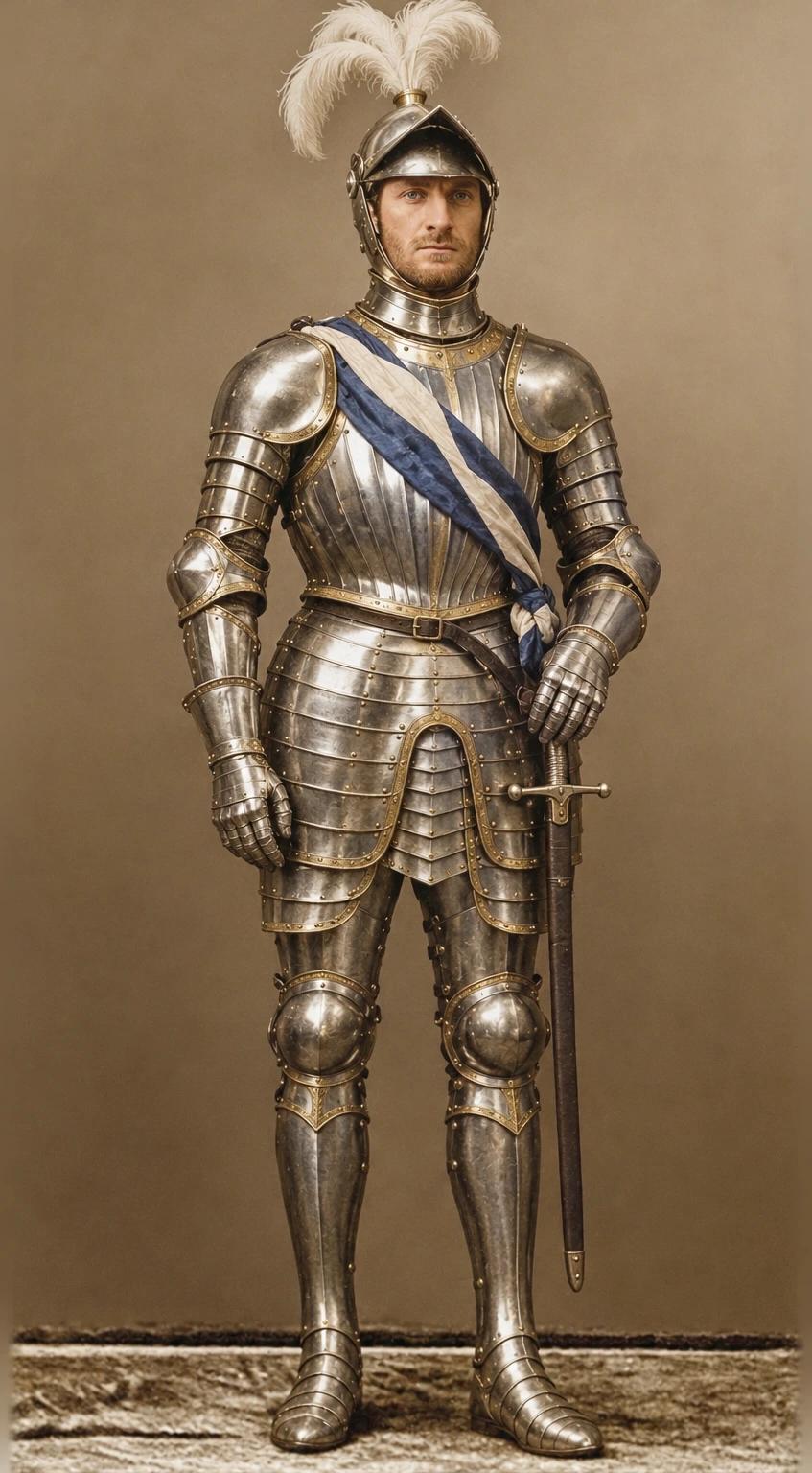
Uniform and equipment
| Uniform | Full plate armor, colored sashes/scarves |
|---|---|
| Dress uniform | Elaborately etched armor, gilt decoration |
| Headgear | Closed helmet with plumes |
| Equipment | Lance, sword, wheel-lock pistols |
| Insignia and standard | Heraldic officer sash |
Service record
| First appeared | 1450s |
|---|---|
| Peak strength | 20,000 men |
| Recruited from | Feudal Nobility |
| Primary tactic | Lance Shock Charge |
| Signature engagement | Battle of Marignano (1515) |
| Motto or battle cry | Pro Fide et Rege (For Faith and King) |
| Obsolescence | Firearms / Infantry Squares |
Timeline
- 1445: Compagnies d'ordonnance Formed. Charles VII establishes the first standing army of professional noble cavalry in France.
- 1494: Invasion of Italy. The heavy cavalry descends into the Italian peninsula, beginning decades of high-intensity warfare.
- 1512: Charge at Ravenna. Heavy cavalry proves decisive against entrenched infantry, cementing their role as shock troops.
- 1515: Triumph at Marignano. The zenith of the armored lancer, breaking the Swiss pike formations in a grueling two-day battle.
- 1525: Disaster at Pavia. Small arms fire decimates the noble charge, signaling the beginning of the end for the pure lance tactic.
- 1544: Battle of Ceresole. One of the last great engagements where heavy lancers played the decisive role before pistols dominated.
- 1580: Transition to Pistoliers. By the late 16th century, the lance is largely abandoned in favor of pistols and the 'Caracole' tactic.
Battles
Battle of Ravenna
A masterclass in combined arms where noble cavalry flanked entrenched Spanish positions. The cuirassiers smashed through the enemy lines in a thunderous assault, though the victory cost the life of their brilliant commander, Gaston de Foix.
Battle of Marignano
The 'Battle of Giants.' The French Gendarmes executed repeated, bone-shattering charges into the disciplined Swiss pike squares. Aided by artillery, the heavy cavalry eventually broke the invincible reputation of the Swiss in a blood-soaked grind.
Battle of Pavia
The twilight of the lance. Impatient noble cavalry charged ahead of their artillery support, bogging down in muddy terrain. Surrounded by Imperial arquebusiers, the flower of French nobility was shot from their saddles in a gritty, unheroic slaughter.
Commanders
Gaston de Foix, Duke of Nemours
The 'Thunderbolt of Italy,' Gaston was a prodigy of aggressive cavalry warfare. He commanded with a speed and ferocity that stunned his enemies, famously breaking the Spanish infantry at Ravenna before falling in the final pursuit.
Francis I of France
A warrior-king who personally led the charge at Marignano. Clad in magnificent armor, he fought in the thick of the melee, embodying the martial spirit of the Valois nobility and the devastating power of the heavy lance.
Pierre Terrail, seigneur de Bayard
Known as 'the knight without fear and without reproach,' Bayard was the epitome of the noble cavalryman. A master of the lance and a ferocious combatant, he led the French Gendarmes with chivalric virtue and lethal efficiency during the Italian Wars.
Tactics
The Shock Charge
A tightly packed formation accelerating from a trot to a gallop, delivering massive kinetic energy to shatter enemy cohesion.
En Haie Formation
Deploying in a thin, wide line to maximize the number of lances engaging the enemy front simultaneously.
Flanking Maneuver
Using superior mobility to bypass the dangerous pike-fronts and strike the vulnerable sides or rear of infantry blocks.