
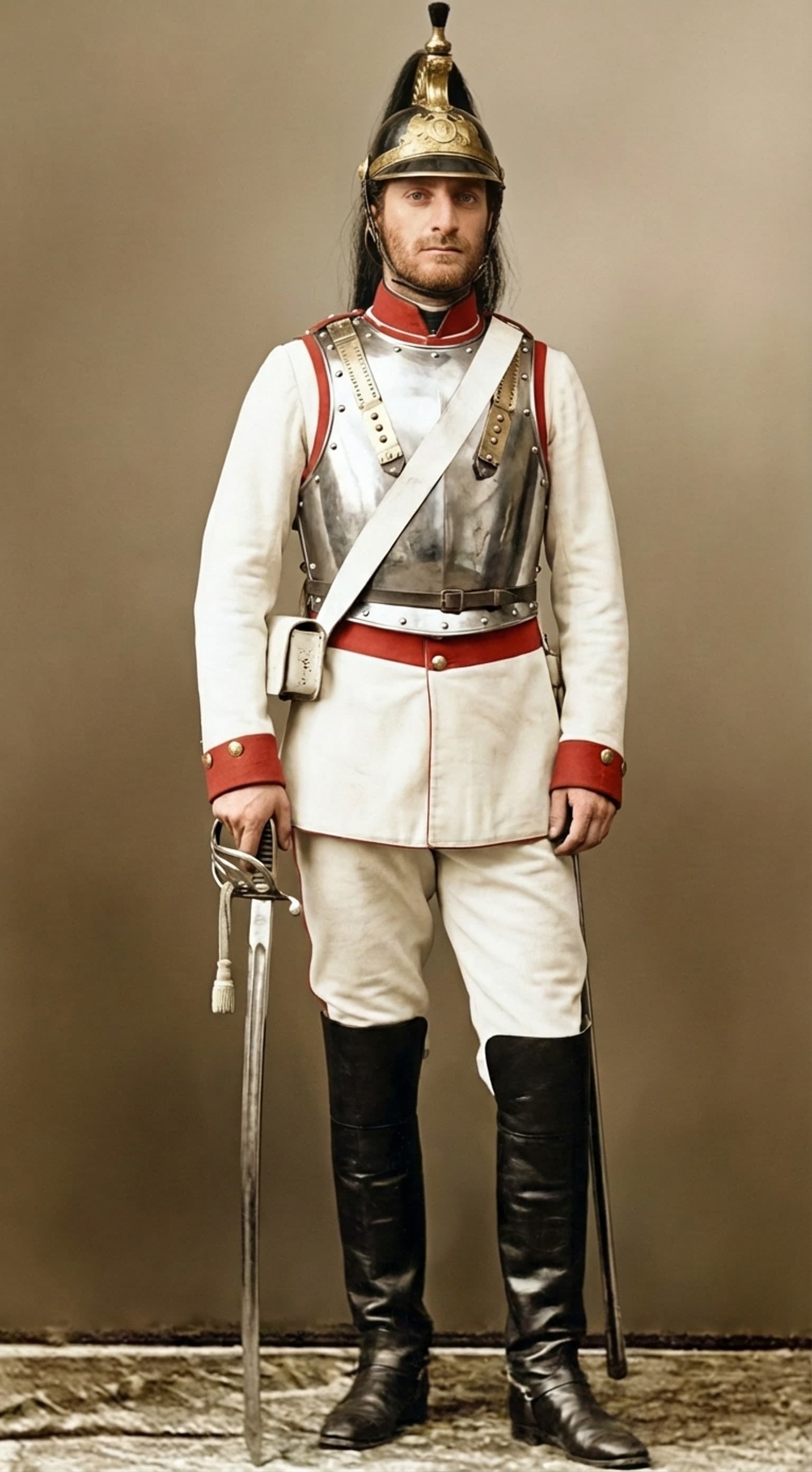
Uniform and equipment
| Uniform | White coat, black breastplate (half-cuirass) |
|---|---|
| Dress uniform | White coat, black tricorn |
| Headgear | Tricorn hat or helmet |
| Equipment | Broadsword, carbine |
| Insignia and standard | Brass double-headed Habsburg eagle helmet plate |
Service record
| First appeared | 18th Century |
|---|---|
| Peak strength | 12 Regiments |
| Recruited from | Conscripts / Noble Officers |
| Primary tactic | Heavy Charge |
| Signature engagement | Battle of Kolin (1757) |
| Motto or battle cry | Viribus Unitis (With United Forces) |
| Obsolescence | Discarded Armor 1860 |
Timeline
- 1701: War of the Spanish Succession. Early heavy cavalry regiments distinguish themselves under Prince Eugene of Savoy.
- 1757: The Charge at Kolin. Austrian Cuirassiers achieve legendary status by breaking Prussian infantry squares.
- 1769: Cavalry Reforms. Standardization of equipment and the introduction of the 1769 pattern Pallasch sword.
- 1805: Disaster at Austerlitz. Heavy losses against the French lead to a tactical re-evaluation of cavalry usage.
- 1809: Resurgence at Aspern. Reformed cuirassier regiments play a pivotal role in Napoleon's first major defeat.
- 1866: Battle of Königgrätz. The final, tragic glory. Cuirassiers charge bravely to cover the Austrian retreat but are decimated by Prussian needle guns.
- 1868: Disbandment. The cuirassier designation is abolished; regiments are converted to dragoons, ending the era of Austrian heavy armor.
Battles
Battle of Kolin
The defining moment for the Austrian heavy horse. The cuirassiers, including the famous 'beardless boys' of the De Ligne regiment, smashed the Prussian infantry, handing Frederick the Great his first decisive defeat.
Battle of Aspern-Essling
In a grueling slugfest on the Danube, massed Austrian cuirassiers repeatedly charged the French center, checking the advance of Napoleon's marshals and proving that the Grande Armée was not invincible.
Battle of Leipzig
During the Battle of Nations, Austrian cuirassiers engaged in massive cavalry melees against Murat's horsemen. Their intervention stabilized the coalition lines during the critical southern engagements.
Commanders
Count Leopold Joseph von Daun
A master of defensive warfare and discipline. Known as the 'Austrian Fabius,' he led the Imperial forces to their first major victory against Frederick the Great, utilizing his heavy cavalry to shatter Prussian lines when it mattered most.
Archduke Charles, Duke of Teschen
One of Napoleon's most formidable opponents. He reformed the Austrian cavalry, emphasizing the coordination of heavy cuirassier reserves to deliver hammer blows, famously rallying his troops in person at Aspern-Essling.
Tactics
The Knee-to-Knee Charge
A shock tactic where riders attacked in a dense, unbreakable wall, relying on the sheer weight of horses and men to crush infantry lines.
Massed Reserve
Holding heavy cavalry back until the enemy was weakened, then unleashing them in a decisive blow to shatter the center.
Caracole (Modified)
Though largely obsolete, elements of pistol-fire discipline remained before the final charge to disrupt enemy cohesion.