
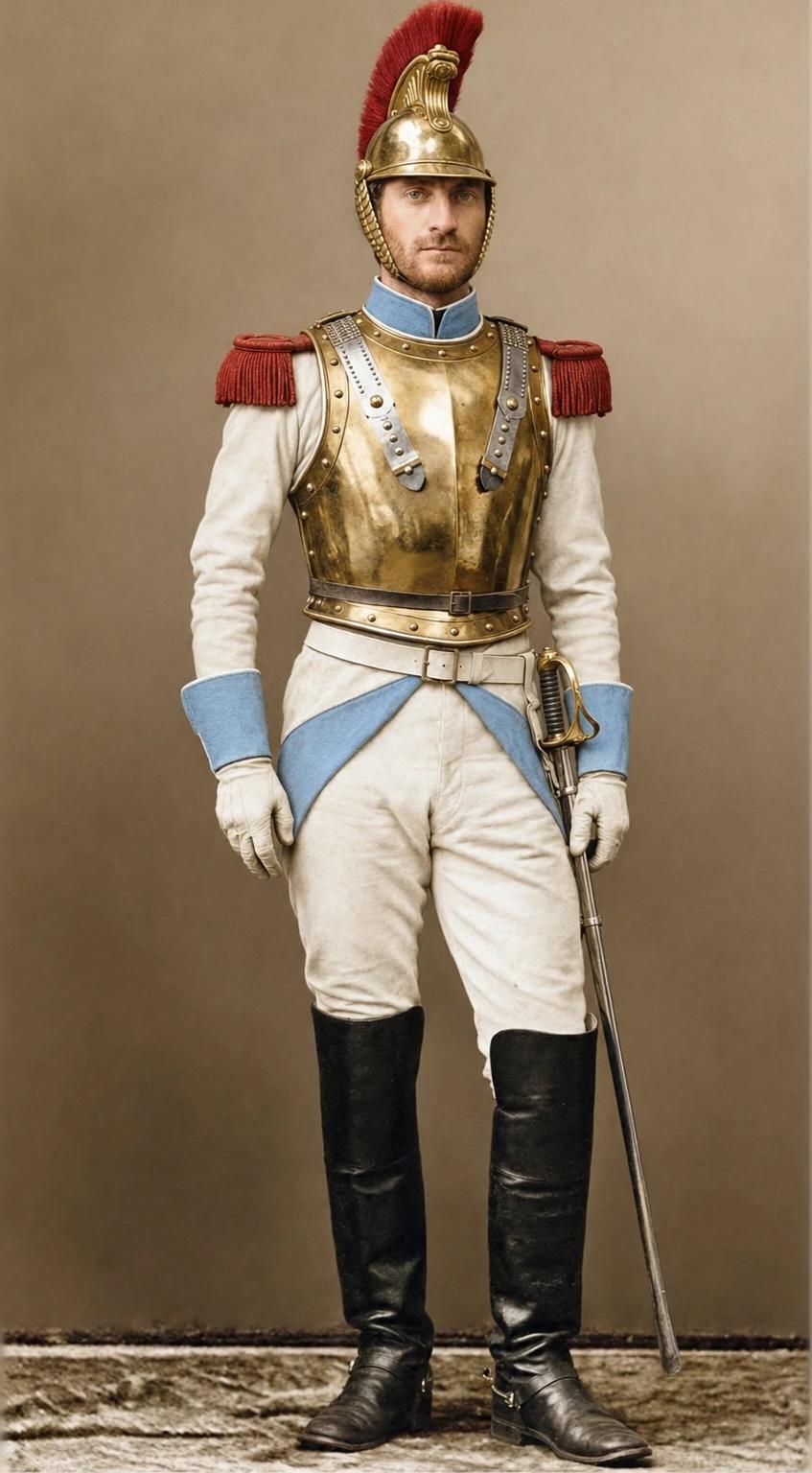
Uniform and equipment
| Uniform | White coat with sky-blue facings, brass-covered cuirass |
|---|---|
| Dress uniform | White with sky-blue facings, polished brass cuirass |
| Headgear | Brass Minerva-style helmet with scarlet crest |
| Equipment | Straight sword, carbine, pistols |
| Insignia and standard | Silver bursting grenade on golden cuirass |
Service record
| First appeared | 1691 |
|---|---|
| Peak strength | 4,000 men |
| Recruited from | Selected Veterans |
| Primary tactic | Heavy Shock / Carbine Fire |
| Signature engagement | Battle of Borodino (1812) |
| Motto or battle cry | Honneur et Patrie (Honor and Fatherland) |
| Obsolescence | Rifled Artillery |
Timeline
- 1693: Formation. Established by Louis XIV as elite shooters within the cavalry, eventually evolving into heavy shock troops.
- 1804: Imperial Integration. The two regiments of Carabiniers are fully integrated into Napoleon's Grande Armée as the senior heavy cavalry units.
- 1809: The Armor Decree. Following heavy losses at Wagram, Napoleon orders the unit to don copper cuirasses and helmets, changing their silhouette forever.
- 1812: Russian Campaign. The unit participates in the invasion of Russia, distinguishing themselves at Borodino but suffering attrition from the harsh winter retreat.
- 1815: The Hundred Days. Reformed for Napoleon's final campaign, they fight at Waterloo before being reorganized under the Bourbon Restoration.
Battles
Battle of Wagram
The Carabiniers suffered horrific casualties from Austrian artillery while wearing their traditional blue coats. The carnage of this victory directly influenced Napoleon's decree to armor the unit in copper-sheathed cuirasses to improve survivability.
Battle of Borodino
In their gleaming new copper armor, the Carabiniers stormed the Great Redoubt. Amidst a hellscape of canister shot and musketry, they forced the fortification, cementing their reputation as the 'Giants of the Empire' despite sustaining grievous losses.
Battle of Waterloo
Part of Ney's massed cavalry assaults, the Carabiniers repeatedly charged the British infantry squares. Despite their bravery and heavy armor, they could not break the disciplined formations in the muddy terrain, marking the tragic end of their imperial glory.
Commanders
Étienne Marie Antoine Champion de Nansouty
A disciplinarian aristocrat who prioritized the health of his horses above all else, ensuring his heavy cavalry arrived at the point of impact with maximum momentum. He commanded the Guard Cavalry and Heavy Cavalry Reserve, wielding the Carabiniers as a sledgehammer against Austrian and Russian lines.
Auguste-Jean-Gabriel de Caulaincourt
A fearless commander who famously took charge of the II Cavalry Corps at Borodino after Montbrun's death. He led the Carabiniers in a legendary, fatal charge against the Great Redoubt, breaking the Russian line at the cost of his own life.
Tactics
Charge à la Botte
The 'Boot-to-Boot' charge. Riders locked knees, creating a solid wall of armored men and horses that smashed through enemy lines by sheer kinetic force.
Echelon Attack
Deploying squadrons in staggered waves to allow successive impacts, preventing the enemy from reforming after the initial shock.
Carbine Skirmishing
While primarily shock troops, they retained the ability to deploy in loose order and utilize their carbines to harass enemy flanks before the main engagement.