
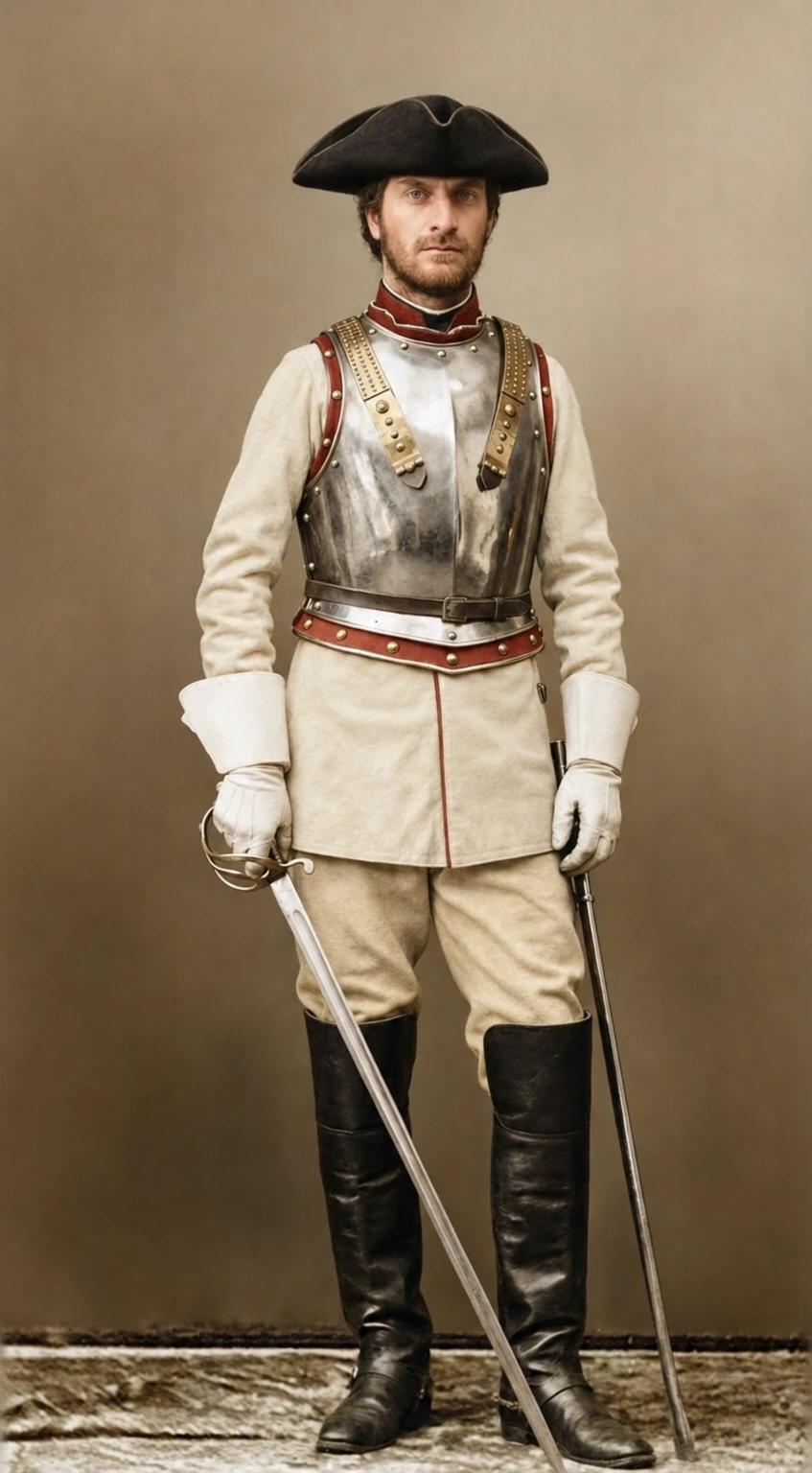
Uniform and equipment
| Uniform | White coat (kollet), steel cuirass, buff breeches |
|---|---|
| Dress uniform | White with colored facings, polished cuirass |
| Headgear | Black tricorne |
| Equipment | Cuirass, heavy sword (pallasch), pistols |
| Insignia and standard | Prussian eagle helmet plate (brass) |
Service record
| First appeared | 1660s |
|---|---|
| Peak strength | ~8,000 men |
| Recruited from | Aristocracy / Wealthy |
| Primary tactic | Massed Shock Charge |
| Signature engagement | Battle of Rossbach (1757) |
| Motto or battle cry | Gott mit uns (God is with us) |
| Obsolescence | Rifled Artillery / Machine Guns |
Timeline
- 1740: Accession of Frederick II. Frederick inherits a sluggish cavalry force and immediately begins draconian reforms to emphasize speed and shock.
- 1745: The Charge at Hohenfriedberg. The reformed heavy cavalry proves its dominance over the Austrians, validating the 'cold steel' doctrine.
- 1757: Triumph at Rossbach. The zenith of Prussian heavy cavalry tactics; Seydlitz achieves total surprise and destroys a larger enemy force.
- 1763: End of Seven Years' War. The Cuirassiers emerge as the most feared cavalry in Europe, though the cost in horses and men was staggering.
- 1806: Disaster at Jena-Auerstedt. The aging, ossified Prussian cavalry, relying on outdated glories, is swept aside by Napoleon's modern warfare.
Battles
Battle of Hohenfriedberg
The debut of Frederick's reformed cavalry. The heavy cavalry, including the cuirassiers, shattered the Austrian lines, proving that Prussian horsemen were no longer the sluggish jokes of Europe but its new masters.
Battle of Rossbach
The defining moment of the age. Seydlitz's 38 squadrons remained hidden behind a hill until the critical moment, smashing the French flank in a thunderous surprise charge. The French army disintegrated in minutes, cementing the legend of the Prussian Cuirassier.
Battle of Zorndorf
A brutal, bloody grinder against the Russians. When the Prussian infantry faltered, Seydlitz led his cuirassiers across the Zaberngrund ravine, smashing the Russian squares and saving the army from total destruction in hand-to-hand carnage.
Commanders
Friedrich Wilhelm von Seydlitz
The archetype of the Prussian cavalryman. A pipe-smoking daredevil known for iron discipline and leading from the front. He transformed the Prussian cavalry into a precision instrument of terror, famously refusing to charge at Rossbach until the enemy was perfectly exposed.
Frederick the Great
While a monarch and strategist, Frederick personally oversaw the grueling reforms of the heavy cavalry. He demanded they charge 'knee-to-knee' at a full gallop, forbidding firing pistols in favor of the cold steel of the sword, turning sluggish troopers into shock weapons.
Tactics
The Knee-to-Knee Charge
Troopers rode so close their knees locked, creating a solid wall of horse and steel that hit the enemy line with massive kinetic energy.
Defense by Offense
Prussian doctrine forbade receiving a charge at a halt. Cuirassiers were ordered to always meet the enemy moving forward, even if outnumbered.
The Seydlitz Rally
Unlike other cavalry that scattered to loot after a charge, Prussian Cuirassiers were drilled to rally immediately to a trumpet call for a second strike.