
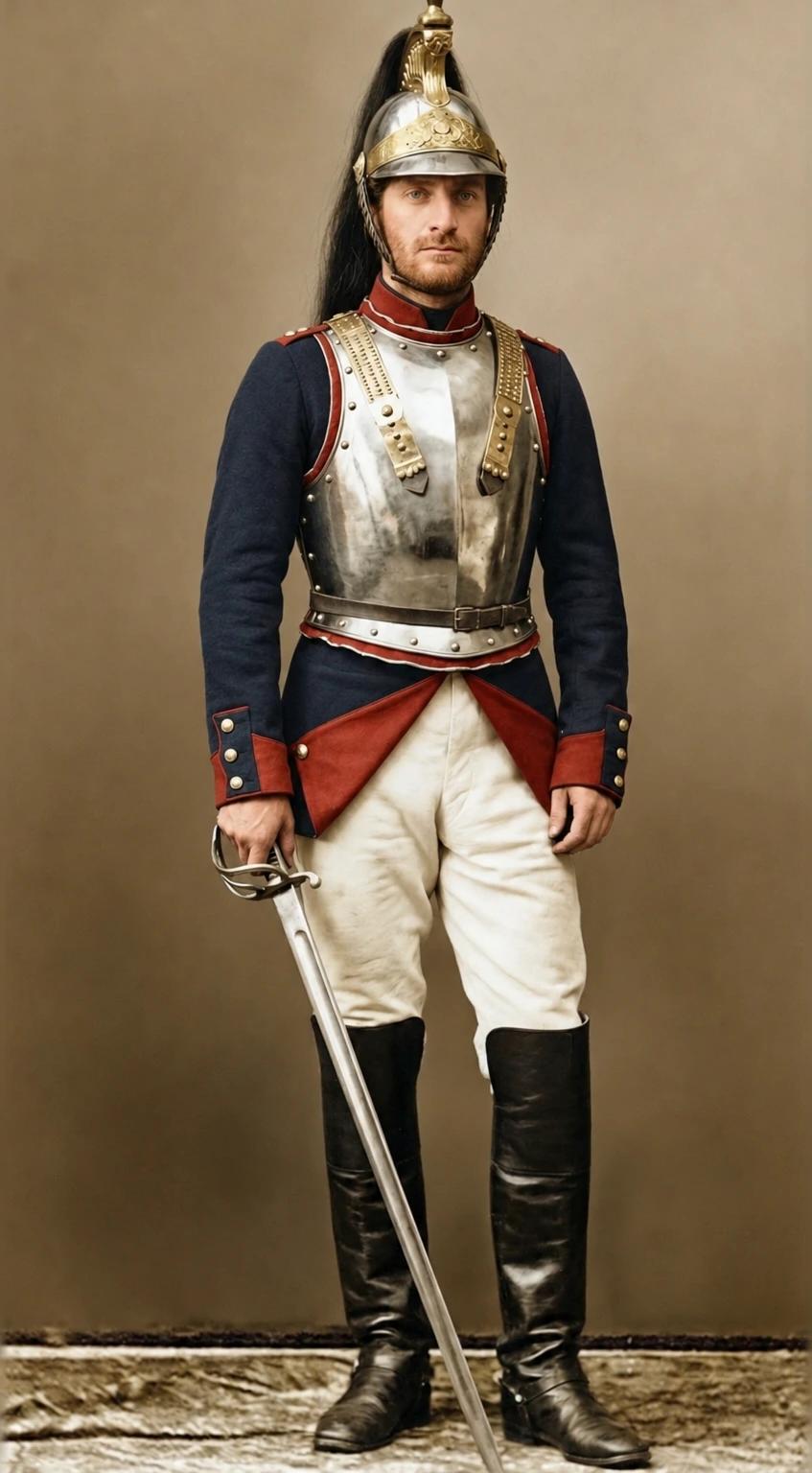
Uniform and equipment
| Uniform | Blue coat, steel cuirass, helmet with horsehair |
|---|---|
| Dress uniform | Polished cuirass, red epaulettes |
| Headgear | Steel helmet with crest and mane |
| Equipment | Straight heavy sword, pistols, cuirass |
| Insignia and standard | Flaming grenade on saddle cloth/belts |
Service record
| First appeared | 1801 |
|---|---|
| Peak strength | 14 Regiments |
| Recruited from | Large Conscripts |
| Primary tactic | Massed Charge |
| Signature engagement | Battle of Eylau (1807) |
| Motto or battle cry | Vive l'Empereur! (Long live the Emperor) |
| Obsolescence | Rifled Firepower |
Timeline
- 1801: Reorganization. First Consul Bonaparte orders the conversion of heavy cavalry regiments into Cuirassiers, reintroducing body armor to the French line.
- 1805: Battle of Austerlitz. The Cuirassiers prove their worth, smashing the Russian Imperial Guard cavalry and cementing their status as the ultimate shock weapon.
- 1807: The Charge at Eylau. The zenith of the Cuirassier legend; a massed charge that saved the Grand Armée from destruction.
- 1812: Russian Campaign. The regiments suffer catastrophic losses not from battle, but from starvation and freezing temperatures. Most horses die, leaving troopers to walk back to France.
- 1815: The Final Charge. The destruction of the Cuirassier corps at Waterloo effectively ends the era of the armored massed cavalry charge.
Battles
Battle of Eylau
In a blinding blizzard, Murat led 10,700 troopers in the greatest cavalry charge in history. They smashed through the Russian lines twice, silencing the artillery and saving Napoleon's center from collapse at the cost of 1,500 casualties.
Battle of Borodino
The Cuirassiers were tasked with storming the Great Redoubt. Riding directly into the mouths of cannons, they seized the fortification in a bloody melee, breaking the Russian line but suffering horrific attrition that crippled the cavalry arm.
Battle of Waterloo
Marshal Ney hurled the Cuirassiers against British infantry squares without support. Despite their armor and courage, the heavy cavalry could not break the disciplined bayonet walls in the mud, marking the tragic end of their dominance.
Commanders
Joachim Murat
Napoleon's First Horseman and King of Naples. A flamboyant daredevil known for his extravagant uniforms and reckless bravery. He led the legendary charge at Eylau, hurling 80 squadrons into the Russian center to save the Emperor's army.
Étienne de Nansouty
A stark contrast to Murat, Nansouty was a disciplined aristocrat who treated cavalry warfare as a science. He commanded the Guard Cavalry and was known for preserving his men and horses until the decisive tactical moment required a crushing blow.
Jean-Louis-Brigitte Espagne
A ferocious commander of the 3rd Cuirassier Division. He led the desperate charge at Aspern-Essling that halted the Austrian advance, paying for the delay with his life on the field of honor.
Tactics
Charge en Muraille
The 'Wall Charge'. Troopers rode knee-to-knee in a tight, two-rank line. The psychological impact of a solid wall of steel and horseflesh was often enough to break enemy morale before impact.
The Thrust
While British heavy cavalry slashed with curved sabers, French Cuirassiers were drilled to use the point of their straight swords to pierce vital organs, a deadlier and more efficient technique.
Caracole (Defensive)
Rarely used, but involved riding up to enemy lines, firing pistols, and wheeling away. The Cuirassiers generally disdained this, preferring the shock of the collision.