
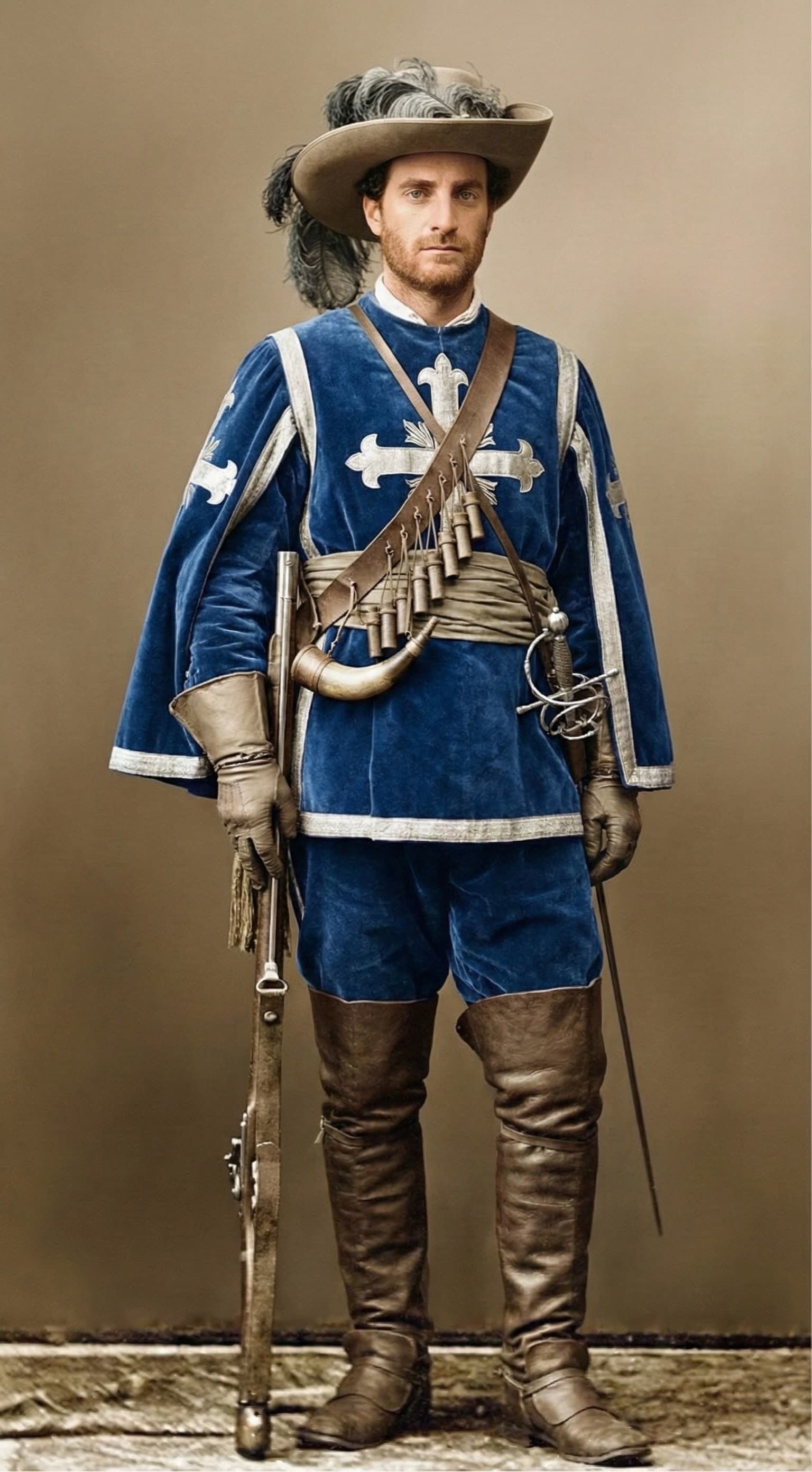
Uniform and equipment
| Uniform | Blue casaque with silver cross, lace trim |
|---|---|
| Dress uniform | Blue with extensive silver lace, white plumes |
| Headgear | Wide-brimmed hat with white plumes |
| Equipment | Musket, rapier, main gauche dagger |
| Insignia and standard | Silver cross with fleur-de-lis and red flames |
Service record
| First appeared | 1622 |
|---|---|
| Peak strength | 600 men |
| Recruited from | Young Aristocrats (Gascons) |
| Primary tactic | Dragoons / Skirmish / Duel |
| Signature engagement | Siege of Maastricht (1673) |
| Motto or battle cry | Tous pour un, un pour tous (All for one, one for all) |
| Obsolescence | Budget Cuts / Revolution |
Timeline
- 1622: Formation. Louis XIII detaches a company of light cavalry (Carabins) and arms them with muskets, creating the Musketeers of the Guard.
- 1646: First Disbandment. Cardinal Mazarin, fearing the unit's loyalty to the King over the Minister, dissolves the corps under the guise of treasury savings.
- 1657: Re-establishment. Louis XIV reforms the unit (the 1st Company, or 'Grey Musketeers') to serve as his personal elite escort.
- 1660: Creation of the 2nd Company. Mazarin's own guards are incorporated into the Royal household, becoming the 'Black Musketeers' due to their horse color.
- 1673: Death of d'Artagnan. The legendary Captain-Lieutenant falls at Maastricht; the unit's reputation for suicidal bravery is cemented forever.
- 1776: Final Disbandment (Ancien Régime). Louis XVI suppresses the Musketeers due to the immense cost of maintaining such a lavish ceremonial unit.
Battles
Siege of La Rochelle
In the mud and salt spray, the Musketeers cut their teeth suppressing the Huguenot rebellion. They proved their versatility, fighting not just as ceremonial guards but as shock troops in the brutal trench warfare surrounding the fortress city.
Battle of the Dunes
Fighting alongside English Roundheads against the Spanish, the Musketeers executed a devastating charge across shifting sands. Their reckless bravery broke the Spanish lines, securing a pivotal victory for the young Louis XIV.
Siege of Maastricht
A day of glory and grief. The Musketeers led a suicidal assault on the Tongerse Gate. They took the position through sheer aggression, but the cost was the life of their beloved commander, d'Artagnan, struck dead by a bullet to the throat.
Battle of Fontenoy
The twilight of their golden age. The Musketeers participated in a desperate, chaotic cavalry charge against the disciplined British infantry squares, suffering heavy casualties but buying time for the French victory.
Commanders
Charles de Batz-Castelmore d'Artagnan
The quintessential Musketeer. A Gascon nobleman whose ferocity and loyalty propelled him from obscurity to Captain-Lieutenant. He served as Louis XIV's iron hand, undertaking sensitive state arrests and leading charges until a Dutch musket ball claimed him in the trenches of Maastricht.
Jean-Armand du Peyrer, Comte de Tréville
The founding father of the corps. A master of court intrigue and a fierce duelist, he molded the Musketeers into an elite brotherhood fiercely loyal to the King, often pitting them against the Cardinal's guards in street brawls that became legend.
Tactics
Dragoon Assault
A hybrid doctrine where Musketeers would ride rapidly to a strategic position, dismount to deliver a volley of musket fire, and then charge with swords.
La Charge Sauvage
A reckless, high-speed cavalry charge with rapiers drawn, relying on shock, élan, and reputation to break enemy morale before contact.
Aggressive Skirmishing
Operating in loose order ahead of the main army to harass enemy lines, utilizing their superior marksmanship and individual combat skills.