
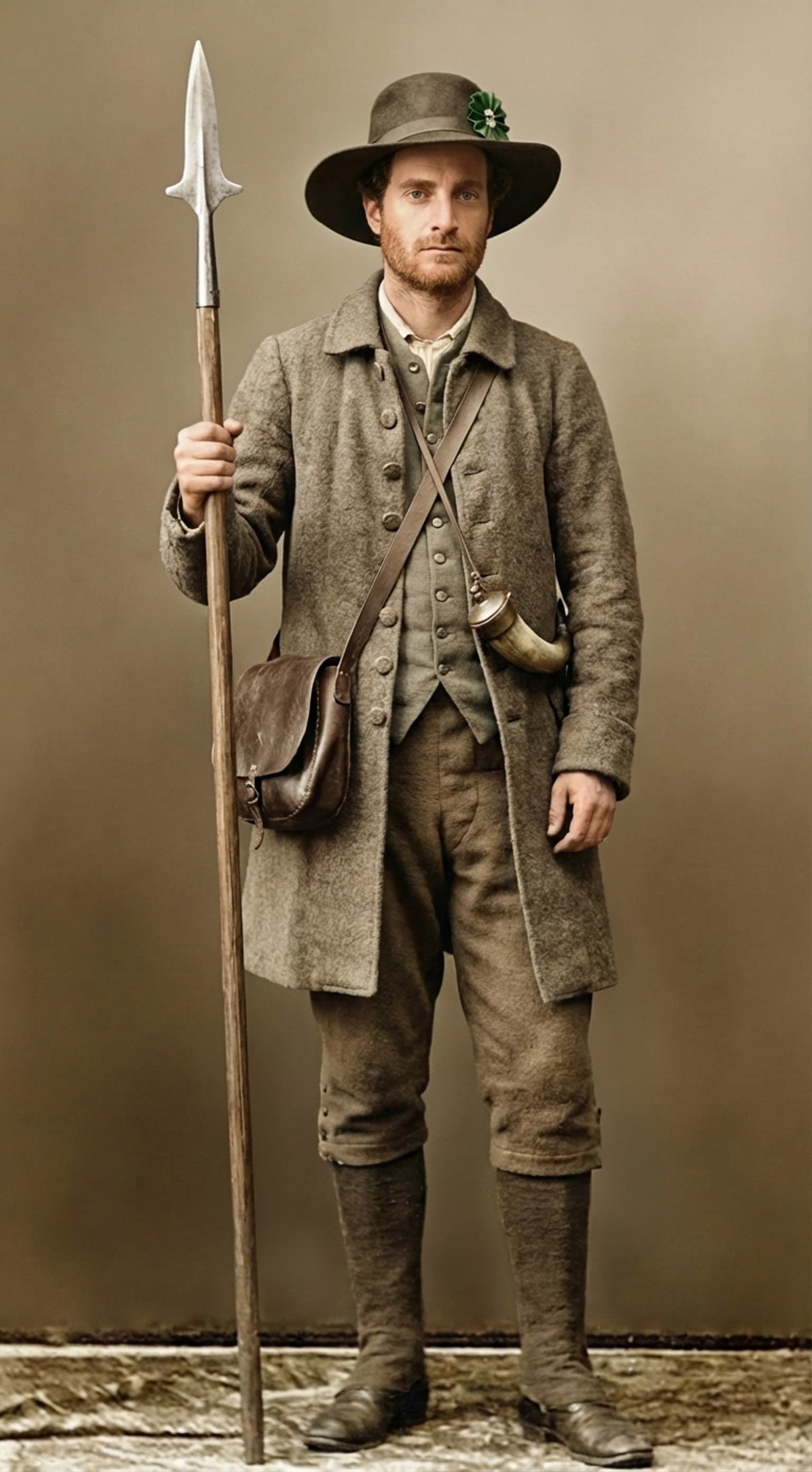
Uniform and equipment
| Uniform | Civilian clothes, green cockades |
|---|---|
| Dress uniform | N/A |
| Headgear | Hat with green ribbon |
| Equipment | Long pike |
| Insignia and standard | Golden harp on green field |
Service record
| First appeared | 1798 |
|---|---|
| Peak strength | Thousands |
| Recruited from | United Irishmen Volunteers |
| Primary tactic | Pike Charge |
| Signature engagement | Battle of Vinegar Hill (1798) |
| Motto or battle cry | Erin go Bragh! (Ireland Forever) |
| Obsolescence | Defeat by British |
Timeline
- 1791: Formation of the United Irishmen. Society founded in Belfast seeking parliamentary reform and Catholic emancipation, later turning revolutionary.
- 1798: Outbreak of Rebellion. May 23-24: The rising begins around Dublin but is quickly contained; signal fires are lit.
- 1798: Wexford Rising. May 26: The rebellion ignites in Wexford, quickly becoming the conflict's epicenter.
- 1798: Battle of Oulart Hill. May 27: First major rebel victory, destroying a detachment of militia.
- 1798: Fall of Wexford Town. May 30: Rebels capture Wexford town, establishing a short-lived republic.
- 1798: Battle of Vinegar Hill. June 21: Decisive defeat of the main rebel army by General Lake.
- 1798: French Landing. August 22: General Humbert lands at Killala with 1,000 French troops to aid the dying rebellion.
- 1798: Battle of Ballinamuck. September 8: French and remaining Irish forces surrender, ending major military operations.
Battles
Battle of Oulart Hill
A shocking triumph for the rebels. Father Murphy ambushed the North Cork Militia, using the terrain and a ferocious pike charge to annihilate the government force. This victory galvanized the population of Wexford to join the rising.
Battle of Vinegar Hill
The rebellion's last major stand. 20,000 rebels held the hill but were encircled by superior British forces under General Lake. Bombarded by artillery and assaulted on all sides, the rebel lines broke, marking the effective end of the Wexford Republic.
Battle of New Ross
One of the bloodiest engagements of the rebellion. Rebels breached the town gates and engaged in savage street fighting. Despite initial success, lack of discipline and heavy artillery fire from Crown forces turned the tide, resulting in a massacre of the retreating pikemen.
Commanders
Bagenal Harvey
A Protestant landowner and United Irishman who commanded the Wexford rebels. Though lacking military experience, he led the desperate assault on New Ross. His leadership symbolized the non-sectarian ideal of the rebellion. He was executed on Wexford Bridge following the collapse of the rising.
Henry Joy McCracken
A founding member of the United Irishmen who led the rising in the North. He commanded the rebel forces at the Battle of Antrim. Despite the failure of the northern uprising, his dedication to the cause of a republic remained absolute until his execution in Belfast.
Father John Murphy
A reluctant revolutionary turned fierce tactician. The curate of Boolavogue led his parishioners into open rebellion after witnessing Crown atrocities. He commanded the decisive victory at Oulart Hill, proving the pike's lethality, before being captured and executed after the fall of Wexford.
Tactics
The Pike Charge
A massed, desperate rush intended to close the distance with the enemy before they could reload muskets. Requires immense courage to face volley fire.
Hedge Fighting
Using the dense hedgerows of the Irish countryside to ambush marching columns and negate the advantage of British cavalry.
Bullock Stampede
Driving herds of cattle into enemy lines to break formations and create chaos prior to an infantry assault.