
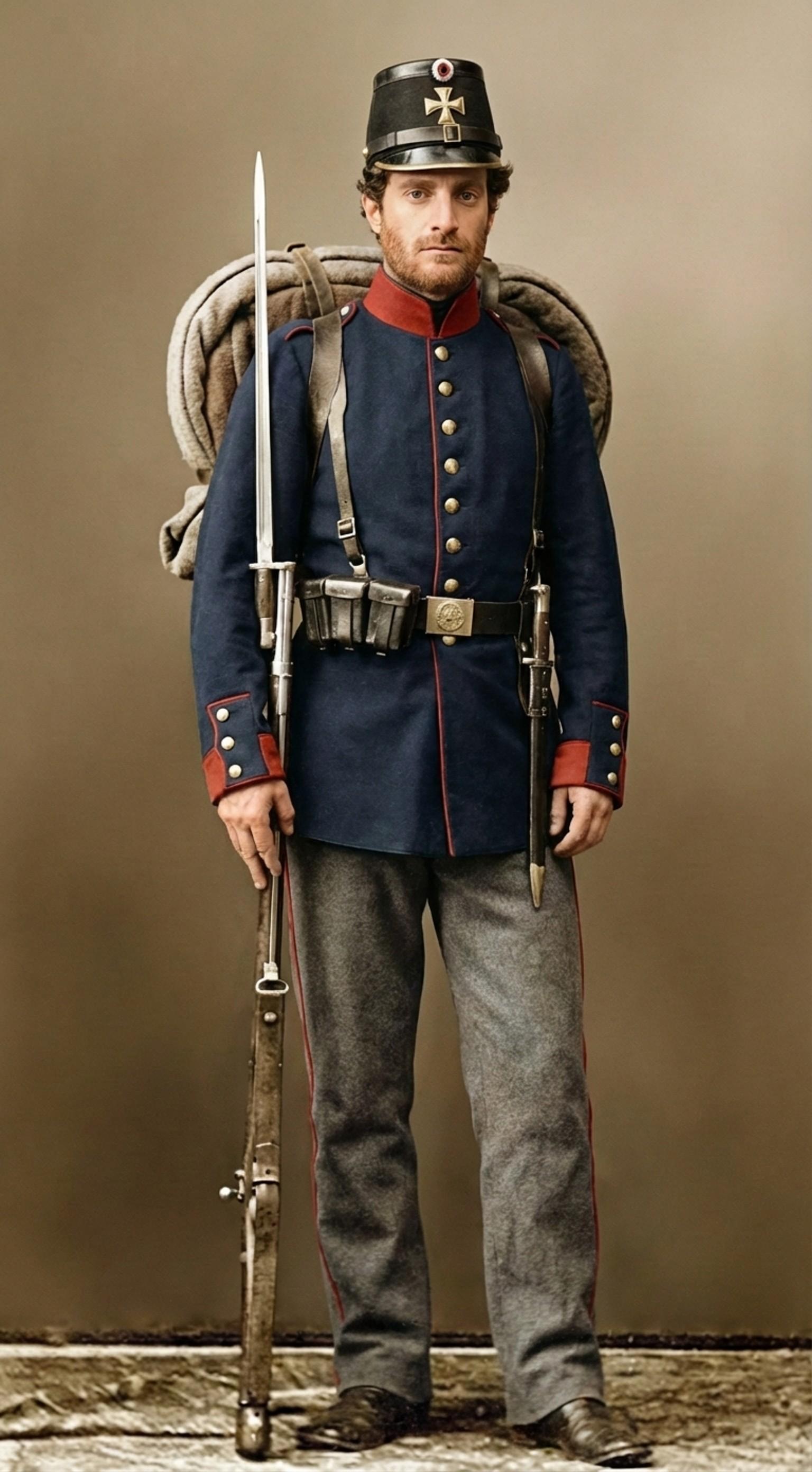
Uniform and equipment
| Uniform | Dark blue coat (simplified), various facing colors by province |
|---|---|
| Dress uniform | Limited dress uniform, mainly parade additions |
| Headgear | Landwehr cross cap (peaked cap with cross) |
| Equipment | Musket, bayonet, basic equipment |
| Insignia and standard | Landwehrkreuz with motto Mit Gott für König und Vaterland |
Service record
| First appeared | 1813 |
|---|---|
| Peak strength | ~120,000 men |
| Recruited from | Civilian Levy / Middle Class |
| Primary tactic | Mass Infantry Defense |
| Signature engagement | Battle of Waterloo (1815) |
| Motto or battle cry | Mit Gott für König und Vaterland (With God for King and Fatherland) |
| Obsolescence | Professional Reserve Systems |
Timeline
- 1813: Royal Decree of March 17. King Frederick William III issues the 'An Mein Volk' proclamation, formally establishing the Landwehr and calling for a general uprising against French occupation.
- 1813: Spring Campaign. Hurriedly raised units, often armed with pikes and wearing civilian clothes, see their first combat in Silesia.
- 1813: Battle of Leipzig. The Landwehr proves itself as a strategic asset, making up a significant portion of the Coalition forces that shattered Napoleon's control over Germany.
- 1814: Invasion of France. Prussian Landwehr units cross the Rhine, marching on Paris and participating in the battles of Laon and Paris.
- 1815: The Hundred Days. Mobilized again to face Napoleon's return, playing the decisive role in the Waterloo campaign despite being exhausted and unpaid.
- 1815: Second Treaty of Paris. Following the war, the Landwehr is institutionalized as a permanent tier of the Prussian military system, distinct from the standing army.
Battles
Battle of the Katzbach
A chaotic encounter in driving rain where Landwehr troops, unable to fire wet muskets, resorted to clubbing French forces with buttstocks. It was the first major proof that the militia could stand toe-to-toe with French regulars.
Battle of Leipzig
The 'Battle of the Nations'. Tens of thousands of Landwehr poured into the fray, suffering horrific casualties but overwhelming Napoleon's forces through sheer weight of numbers and patriotic fervor, sealing the liberation of Germany.
Battle of Ligny
A brutal slugging match where the Landwehr held the center against the Imperial Guard. Though tactically defeated and Blücher unhorsed, their stubborn resistance exhausted the French and allowed the Prussians to retreat in good order to Wavre.
Battle of Waterloo
Arriving on Napoleon's right flank at the critical hour, Landwehr battalions engaged in savage house-to-house fighting in Plancenoit, drawing off the French reserves and ensuring the collapse of the Grande Armée.
Commanders
August Neidhardt von Gneisenau
The intellectual architect behind the Prussian reforms and Blücher's Chief of Staff. He transformed the Landwehr from a ragtag militia into a disciplined operational force, ensuring the citizen-soldiers could maneuver alongside professional regulars.
Hans David Ludwig Yorck von Wartenburg
A stern traditionalist who initially doubted the militia concept, yet commanded Landwehr units with devastating effectiveness during the invasion of France. His leadership bridged the gap between the old aristocratic officer corps and the new patriotic volunteers.
Gebhard Leberecht von Blücher
Known as 'Marschall Vorwärts' (Marshal Forwards), this aggressive, pipe-smoking septuagenarian embodied the ferocious spirit of the Prussian resistance. Despite tactical setbacks, his refusal to retreat and relentless pursuit of Napoleon were decisive in the Coalition's ultimate victory.
Tactics
Attack Column (Angriffskolonne)
Due to limited drill time, Landwehr units often attacked in deep columns rather than lines. This maximized their morale and shock value but left them vulnerable to artillery.
Defensive Square
A formation where infantry formed a hollow box with bayonets facing outward. The Landwehr's ability to hold squares at Ligny against French cavalry saved the army from annihilation.
Massed Volley Fire
Standard linear fire tactics. While their rate of fire was slower than regulars, the sheer number of Landwehr muskets could saturate an area with lead.
Swarm Skirmishing
Operating in loose order ahead of the main line. Motivated by patriotism, Landwehr skirmishers were aggressive, using cover to harass enemy officers and artillery crews.