
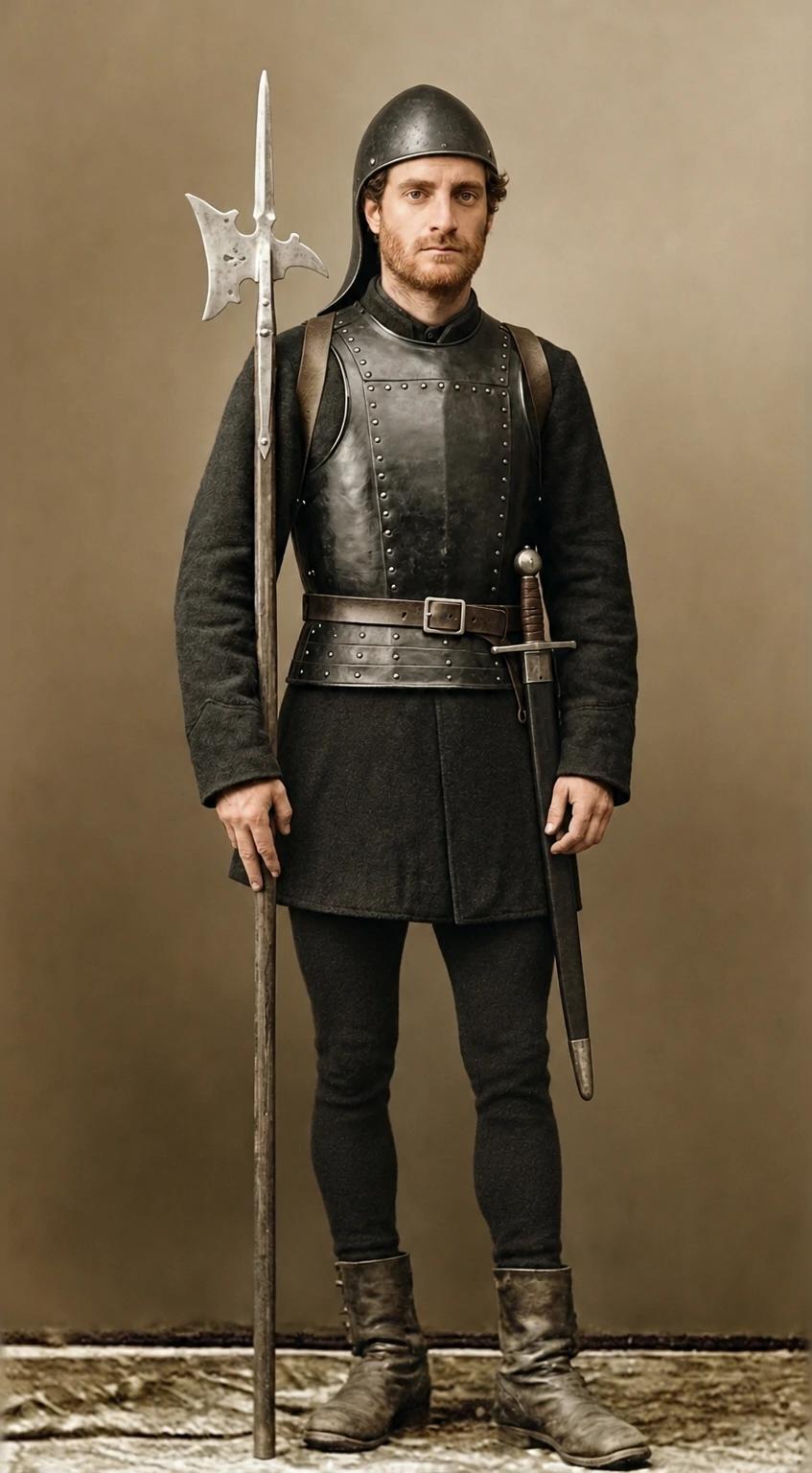
Uniform and equipment
| Uniform | Blackened armor or dark clothing with red elements |
|---|---|
| Dress uniform | Polished black armor with gold etching, velvet surcoats |
| Headgear | Burgonet or sallet with blackened finish |
| Equipment | Lance, sword, crossbow or handgonne |
| Insignia and standard | Raven with gold ring (Matthias Corvinus arms) |
Service record
| First appeared | 1450s |
|---|---|
| Peak strength | ~30,000 soldiers |
| Recruited from | Paid Mercenaries |
| Primary tactic | Combined Arms |
| Signature engagement | Battle of Breadfield (1479) |
| Motto or battle cry | Iustitia est regnorum fundamentum (Justice is the foundation of kingdoms) |
| Obsolescence | Lack of Funds |
Timeline
- 1458: Ascension of Matthias. Matthias Corvinus is crowned King of Hungary and begins organizing a royal standing army.
- 1462: Integration of Hussites. Matthias hires the remnants of Jan Jiskra's Hussite mercenaries, forming the core of the infantry.
- 1479: Triumph at Breadfield. The army achieves its most legendary victory against the Ottoman Empire.
- 1485: Conquest of Vienna. The Black Army captures Vienna, marking the zenith of Hungarian power in Central Europe.
- 1490: Death of the King. Matthias dies without a legitimate heir; funding for the army ceases immediately.
- 1492: Dissolution and Destruction. Unpaid units turn to brigandage and are annihilated by royal decree at the Battle of Halas.
Battles
Battle of Baia
A brutal night engagement against Prince Stephen the Great. While technically a setback where Matthias was wounded, the army's discipline prevented total rout, showcasing their resilience in the worst conditions.
Battle of Breadfield
The army's defining moment. Facing a numerically superior Ottoman force, the heavy cavalry under Kinizsi smashed the Turkish flank while the infantry held the center. It was a slaughter that deterred Ottoman expansion for decades.
Siege of Vienna
The culmination of Matthias's western ambitions. The Black Army starved out the Habsburg capital, allowing Corvinus to take the title 'Duke of Austria' and prove his mercenaries could conquer fortified cities as well as open fields.
Battle of Halas
The tragic end. Unpaid and mutinous after Matthias's death, the remnants of the Black Army were hunted down and destroyed by Pál Kinizsi himself, loyal to the new King. The legends died by the hands of their former master.
Commanders
Matthias Corvinus
The 'Raven King' and visionary founder. A Renaissance prince who understood that standing professional armies, paid in gold rather than feudal obligation, were the future of warfare. He forged the Black Army into the shield of Christendom.
Blaise Magyar
A hardened veteran and Captain of the Upper Parts. He served as a crucial operational commander, leading the Black Army through the brutal campaigns in Bohemia and against the Ottoman frontiers.
Pál Kinizsi
The 'Hungarian Hercules'. A commander of immense physical strength and tactical brilliance who never lost a battle. At Breadfield, he famously dual-wielded swords and celebrated victory by dancing with a Turkish corpse in his teeth.
Tactics
Wagenburg (War Wagon)
Adopted from the Hussites, these reinforced wagons formed mobile fortresses, allowing infantry to fire safely while breaking enemy cavalry charges.
Combined Arms Integration
Seamless coordination where heavy cavalry delivered the killing blow only after infantry and artillery had softened the enemy lines.
Massed Arquebus Volleys
Deploying a ratio of 1 shooter per 4 soldiers (high for the era) to create a withering screen of fire.