
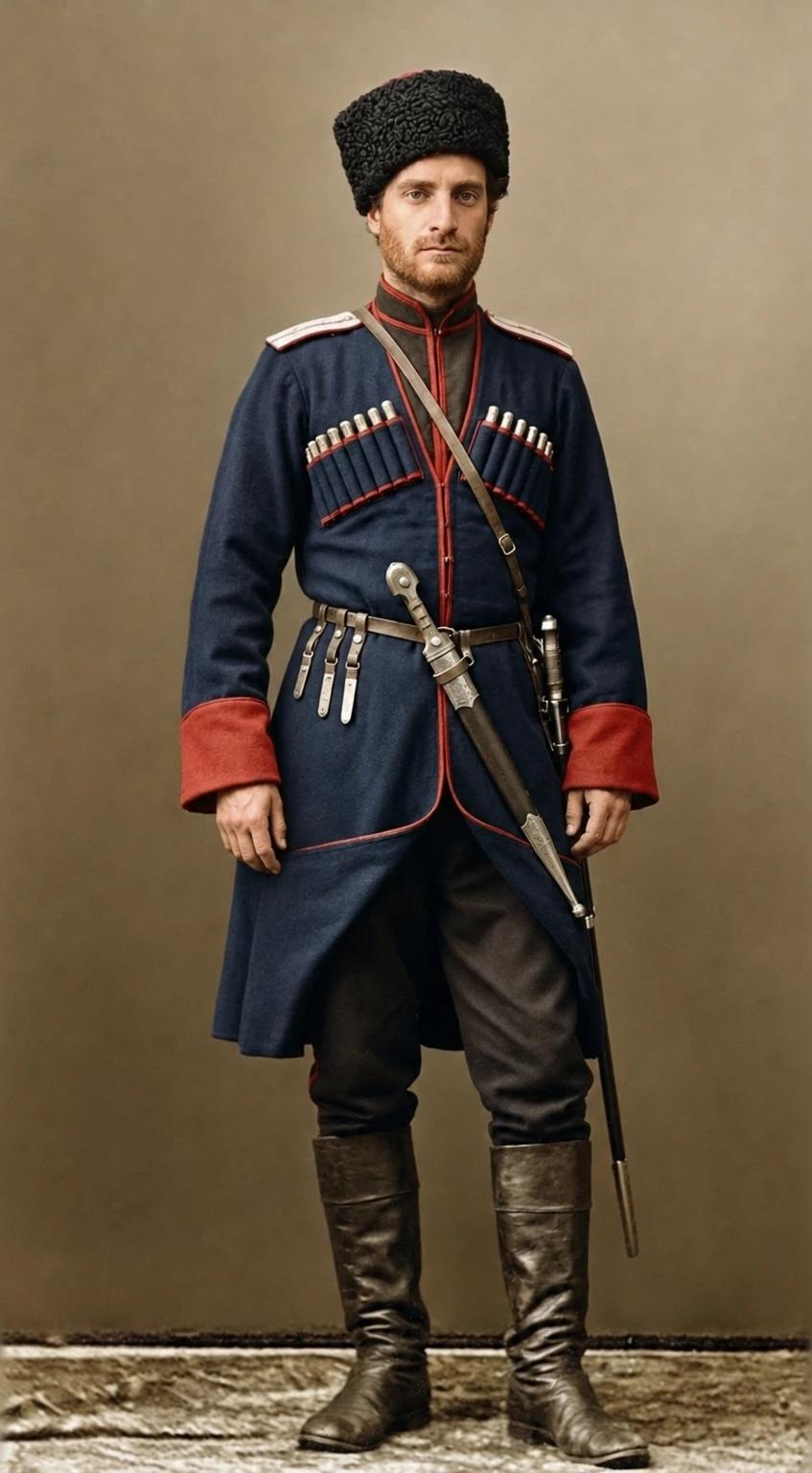
Uniform and equipment
| Uniform | Cherkesska (coat) with gazir cartridges |
|---|---|
| Dress uniform | Red or black cherkesska, silver daggers |
| Headgear | Papakha |
| Equipment | Shashka, kindjal, carbine |
| Insignia and standard | Kuban Host watchtower crest; black cherkesska red facings |
Service record
| First appeared | 1860 |
|---|---|
| Peak strength | Host strength |
| Recruited from | Cossack Host |
| Primary tactic | Cavalry Raid |
| Signature engagement | WWI Eastern Front |
| Motto or battle cry | Slava Kubani! (Glory to Kuban) |
| Obsolescence | Russian Civil War |
Timeline
- 1860: Formation of the Host. The Kuban Cossack Host is officially created by decree of Alexander II, merging the Black Sea Cossack Host with the Caucasus Line Cossack Host.
- 1864: End of the Caucasian War. The long, bloody conquest of the Caucasus concludes; the Kuban Cossacks secure the frontier, transitioning from pure conquest to border defense.
- 1877: Russo-Turkish War. Kuban regiments distinguish themselves in the Balkans and the Caucasus, cementing their reputation as elite shock cavalry.
- 1914: World War I Mobilization. The Host mobilizes over 37 regiments for the Tsar, serving with distinction on the Eastern Front and in the Persian Campaign.
- 1920: Collapse of the Kuban Republic. Following the defeat of the White Army, the Kuban Rada is dissolved by the Bolsheviks, leading to mass execution, deportation, and the suppression of Cossack identity.
- 1936: Soviet Reinstatement. Stalin lifts the ban on Cossacks serving in the Red Army, leading to the formation of new Kuban divisions that would fight in WWII.
Battles
Battle of Sarykamysh
In the freezing peaks of the Caucasus, Kuban squadrons executed critical flanking maneuvers against the Ottoman 3rd Army. Their relentless pursuit through deep snow turned a Turkish retreat into a total rout, saving the southern front.
Second Kuban Campaign
A pivotal operation of the Russian Civil War where the Volunteer Army, heavily supported by Kuban Cossacks, swept through the steppe to reclaim their homeland from Bolshevik forces, securing a temporary stronghold for the White movement.
Charge at Kushchevskaya
In a defiance of modern warfare, the 17th Kuban Cavalry Corps launched a massive saber charge against German infantry and armor. Using the cover of tall sunflowers, they hacked down the enemy, delaying the Nazi advance into the Caucasus.
Commanders
Andrei Shkuro
Known as the 'White Wolf,' Shkuro was a ferocious partisan leader who commanded the 'Wolf Hundred.' His daredevil raids behind Red Army lines became legendary, embodying the reckless bravery and savage efficiency of the Kuban host during the Russian Civil War.
Yakov Baklanov
A giant of a man and a hero of the Caucasian War, Baklanov was feared by the mountaineers as 'Dajjal' (the Devil). He led by imposing physical example, wielding a massive sword and commanding the frontier with an iron will that forged the Kuban reputation.
Tactics
The Lava
A loose, swarming formation attack. Unlike tight European squadrons, the Lava allowed individual riders to maneuver freely, enveloping the enemy flanks and collapsing on them from all sides in a chaotic melee.
Venter (The Vent)
A feigned retreat designed to lure enemy cavalry into a pre-planned ambush. Riders would scatter as if broken, only to wheel around and counter-attack once the enemy lost cohesion.
Dzhigitovka
Combat trick riding. Cossacks would hang off the side of their horses to dodge bullets, shoot from under the horse's belly, or scoop up fallen comrades at a full gallop.