
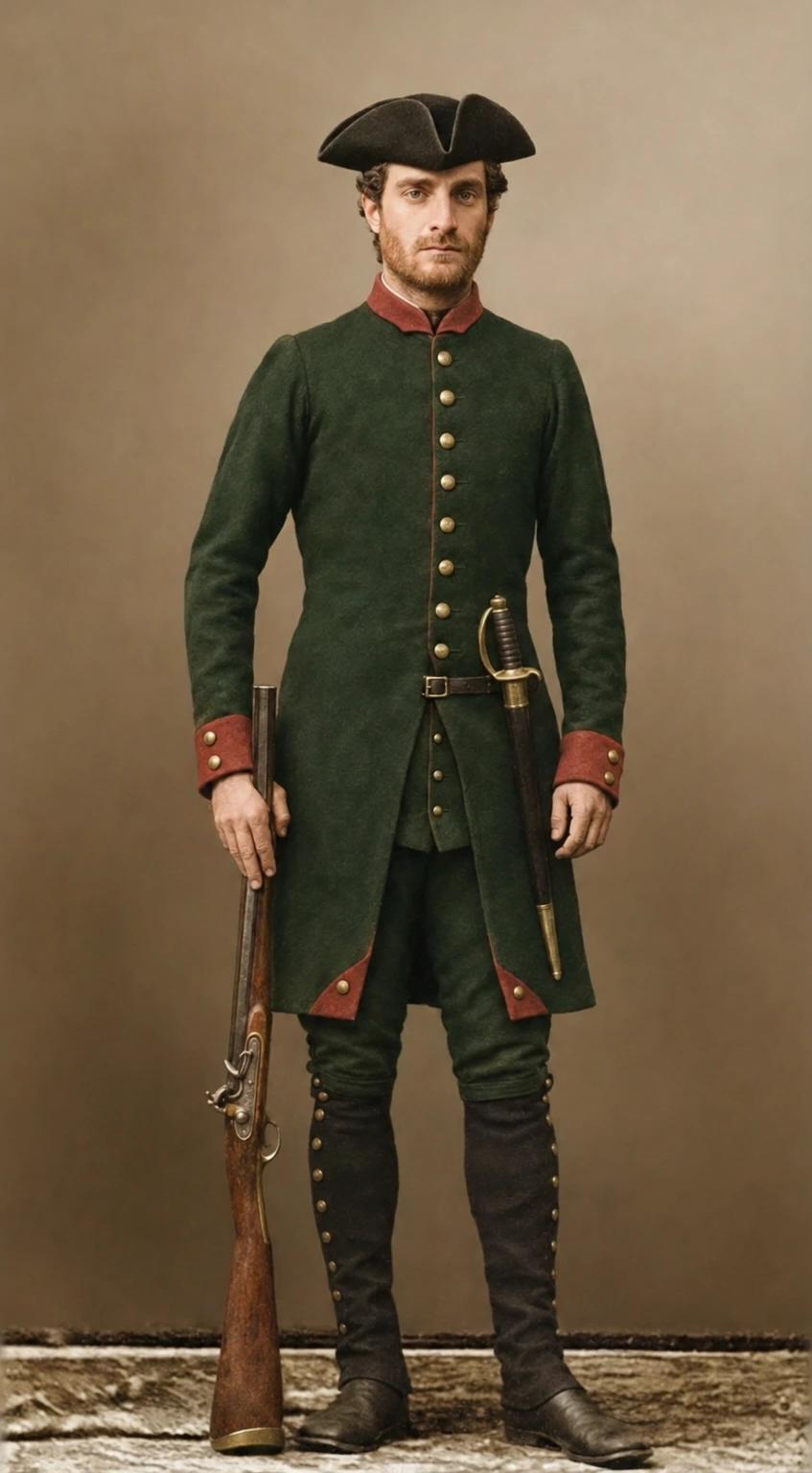
Uniform and equipment
| Uniform | Dark green coat with red collar and cuffs, green breeches, black gaiters |
|---|---|
| Dress uniform | Green with silver trim and braiding |
| Headgear | Black tricorne |
| Equipment | Rifle (büchse), hunting sword (hirschfänger) |
| Insignia and standard | Oak leaf motif / starburst shako badge |
Service record
| First appeared | 1740s |
|---|---|
| Peak strength | ~8,000 men |
| Recruited from | Foresters / Gamekeepers (Volunteers) |
| Primary tactic | Aimed Fire / Irregular Warfare |
| Signature engagement | War of the Bavarian Succession (1778) |
| Motto or battle cry | Horrido! (Hunting cry) |
| Obsolescence | Modern Snipers / Optics |
Timeline
- 1744: Formation of the Feldjäger. Frederick the Great establishes the first independent corps of volunteer huntsmen and foresters.
- 1756: Expansion for Seven Years' War. The unit size is drastically increased to counter Austrian light troops (Grenzers).
- 1778: The Potato War. Jägers dominate the skirmish-heavy conflict in Bohemia, validating their tactical doctrine.
- 1806: Collapse at Jena-Auerstedt. Prussian defeat leads to a complete overhaul of the military, elevating the status of light infantry.
- 1813: The Wars of Liberation. Reformed Volunteer Jäger detachments play a pivotal role in expelling Napoleon from Germany.
Battles
Battle of Leuthen
While the line infantry delivered the crushing blow, Jäger detachments secured the flanks and harassed Austrian outposts, clearing the fog of war for Frederick the Great's oblique maneuver.
War of the Bavarian Succession
Known as the 'Potato War,' this conflict saw few pitched battles but intense skirmishing. Jägers thrived here, stalking enemy foragers in the dense Bohemian woods, proving the value of independent, aimed fire over massed volleys.
Battle of Wartenburg
A defining moment for Yorck's reformed corps. Jägers led the crossing of the Elbe, utilizing cover and precision fire to dislodge entrenched French forces, opening the road to Leipzig.
Commanders
Friedrich Wilhelm von Steuben
Before training the Continental Army, Steuben cut his teeth as a Prussian officer. A master of drill and light infantry tactics, he served in the Seven Years' War, learning the gritty reality of skirmish warfare that defined the Jäger ethos.
Ludwig Yorck von Wartenburg
The father of modern Prussian skirmishing. Stern and unyielding, Yorck transformed the Jägers from forest gamekeepers into a disciplined, lethal tactical force that broke the rigid lines of Napoleonic warfare.
Tactics
Aimed Fire
Unlike line infantry who fired in volleys, Jägers selected individual targets—officers, drummers, and artillerymen—to disrupt enemy command.
Schützenkette (Skirmish Chain)
A loose, flexible line formation allowing soldiers to utilize terrain for cover while maintaining mutual support.
Paired Operation
Jägers often worked in pairs; one would fire while the other remained loaded to protect his partner during the slow reloading process.